

What are you supposed to tell your kids?
What are you supposed to tell your kids?
Last Saturday, I received an email from the Children’s Theatre Company of Minnesota. They explained that they were canceling the weekend’s performances of Go, Dog. Go! “for the safety of our patrons, staff, and artists.” Earlier that morning, federal agents had killed Alex Pretti in the streets, about nine blocks away from the theater’s doors.
The tickets were a Christmas gift to my four-year-old daughter from her grandparents. She has never been to the theater before. In the ever-expanding list of consequences from ICE’s violent occupation of the Twin Cities metro area, this disappointment hardly merits a mention. But it still made me sad, because — as any parent could probably tell you — all I want for my kid is joy, and so much of the world that surrounds her right now is confusion and fear and pain.
I have two daughters. My youngest is not yet two years old and will, I hope, be too young to remember anything about the armed, masked agents terrorizing Minneapolis. My oldest, as she’d proudly tell you, will be five next summer. I don’t know how much she understands, but I wanted to be prepared for anything she might ask, so I turned, as generations of parents have, to Sesame Street. Here’s their advice for ages four to five: “Children may be concerned about your safety or about being separated. Explain all the ways grown-ups can keep them safe—if they’re afraid of an event that happened far away, use the distance to reassure them.”
This advice, well-intentioned as it was, did not make me think about my daughter. It made me think about Liam Conejo Ramos, the five-year-old boy whose photograph — Spider-Man backpack, fuzzy blue bunny hat — emerged, last week, as one of the most enraging and heartbreaking images of this enraging and heartbreaking time for Minnesotans. After he arrived home from preschool on January 20th, ICE detained Liam alongside his father and sent them to a detention center in Dilley, Texas, where they remain at the time of this writing.
Here’s the question that’s been keeping me awake at night: If I were his father, how would I comfort Liam? Let’s consult the Sesame Street checklist. He is right to fear for his family’s safety. He is, terrifyingly, entirely correct about being separated from his family, including his pregnant mother. And there are, apparently, no grown-ups — at least the ones who care about him — who can do anything to keep him safe.
Any parent knows there are only so many ways they can protect their children. Despite your best efforts, they will be hurt: a broken bone, a dying pet, a first breakup. However we might wish it, it’s impossible, and not our real job, to shield them from the hurts that will inevitably arrive. It’s our job to give them a safe, loving place where they can become resilient enough to survive those hurts — maybe even grow from them.
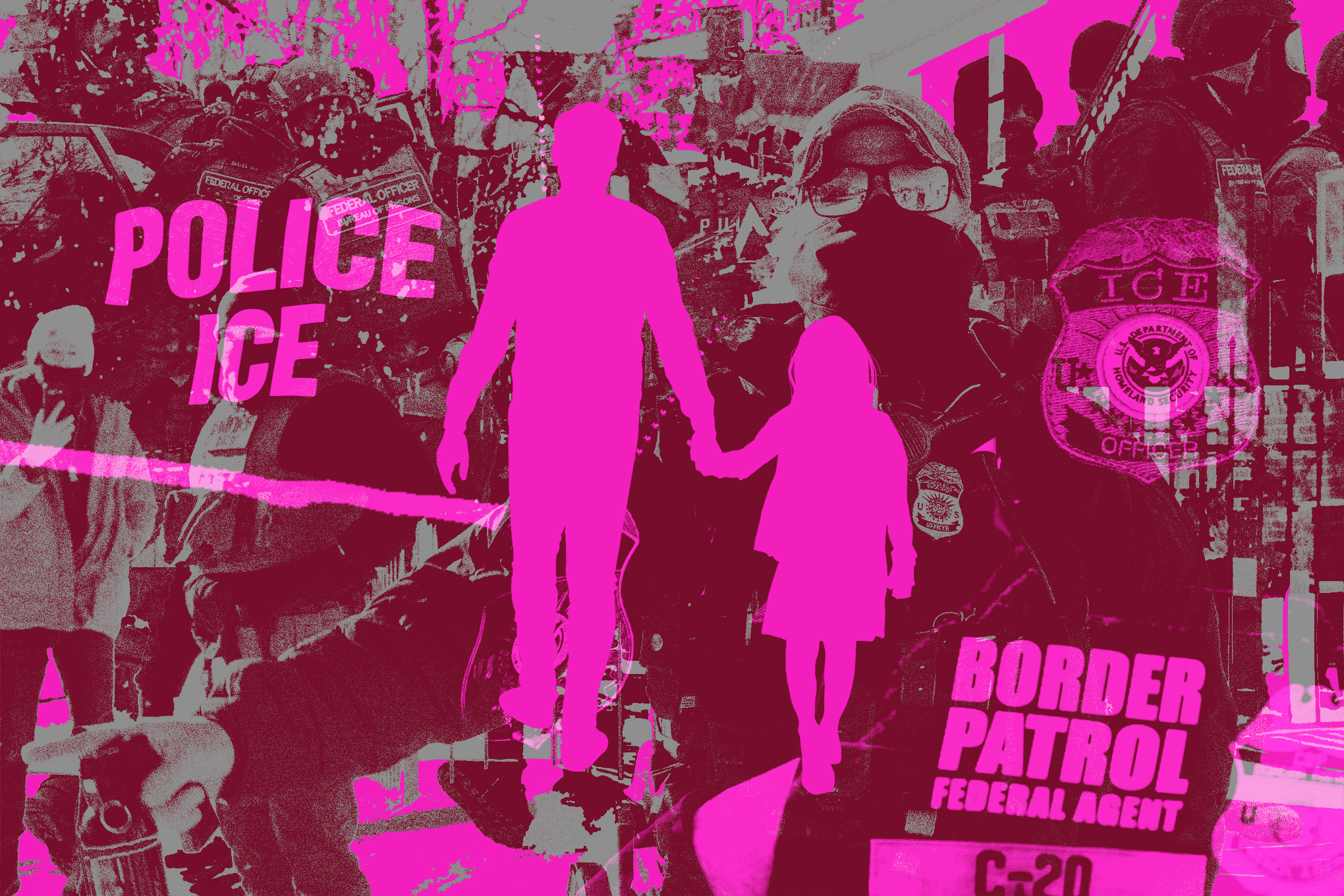
In Minneapolis, there are countless signs every day that the sanctity of our safe, loving places has been ruptured. The Trump administration has not just failed to protect children; it has seen, in their innocence and vulnerability, a fault line that ICE can exploit. It’s disturbing to see Republicans — self-styled protectors of children, but always in theory and never in practice — shrug off those same children as collateral damage. School bus drivers should not need special training on what they should do if ICE shows up at a stop. Parents should not need to explain the routine presence of masked agents wearing military fatigues and carrying guns. Children should be able to attend youth sports without worrying that their proudly diverse leagues will make them a target for ICE raids.
And schoolteachers should not need to explain to their classes why so many desks are now empty — in some public schools, as many as 40 percent — because parents are keeping their children at home for safety or, in the worst cases, because ICE has already abducted and detained them. A photograph’s raw power has made Liam Conejo Ramos a symbol of this administration’s cruelty to nonwhite children, but there are more than a thousand people in his detention center, including “many” under the age of five. A lawyer who recently visited to meet with clients described a nightmarish setting: baby formula mixed with putrid water, insects in the food, verbally abusive guards. While there, he met a family with twins who, having spent nearly a year in detention, had just turned five — 20 percent of their young lives already spent behind bars.
It shouldn’t matter, but in case it does: Liam’s father, Adrian Alexander Conejo Arias, and his wife traveled more than 3,000 miles from Ecuador to Minneapolis, entering the United States legally in December 2024 but ending up stuck, like so many, in the interminable process of seeking legal asylum. Though Donald Trump continues to insist ICE only targets “the worst of the worst,” Arias has no criminal record. His case remained pending when ICE descended upon their home, sweeping up Conejo Arias and Liam while Liam’s pregnant mother remained inside, urged by bystanders to keep their door locked in fear of what ICE might do if she opened it.
“Liam is a very, very cheerful child. He is the most playful in the family,” Conejo Arias’ brother told CNN in an interview after the boy’s photo went viral. In the detention center, his father says, Liam has been lethargic, sleeping a lot. He asks about his family and classmates. He asks for his bunny hat.
What would you tell him?
What I know, looking at that photograph, is that — apart from his family’s country of origin and the color of his skin — Liam Conejo Ramos is just like my daughters. All parents in Minnesota have had the experience of choosing a winter hat for their children; my youngest delights in a fuzzy pink bunny hat she wears inside and outside. Earlier this week, my older daughter’s school buoyed students’ spirits with Superhero Day; she dressed as Ghost-Spider, her favorite Spider-Man superhero. It is only the racism of this administration that makes Liam Conejo Ramos a target; it is only the racism of this administration that keeps my children from being targeted as well.
My daughters don’t have questions yet. But someday they will. When they do, it will be my responsibility to tell them the truth about the United States they grew up in. That the people in power chose to be this cruel. That many, many millions happily supported it. That some of us tried to stop them and didn’t or couldn’t. That the world they’ll inherit isn’t good enough for them. And that I hope their generation will learn from how we failed and do better.