
By the time Dr Liz Njeri boarded a flight to England in 2008, she was ready to abandon medicine altogether.
“I was ready to leave medicine [despite the nine years of training] and do something else,” she says. “It was just the frustration of the system, the lack of resources that got me to that point.”
Her husband’s posting to England for postgraduate study became the turning point: what might have been the end of Liz Njeri’s medical journey in Kenya instead became the beginning of a new chapter in Britain.
They chose Oxford Brookes University, which offered a partial scholarship for students relocating from developing countries.
Her path to the UK was slow. A missing paper derailed her initial visa bid, forcing an appeal that delayed her arrival until October 2008, two months after classes had begun.
She chose to start afresh in February 2009. Course materials arrived months ahead of formal registration, and Liz worked through them on her own, covering each module twice before sitting an exam. The costs were high.
The financial burden was steep. Liz found work at a sleep centre within Oxford University Trust, connecting patients to overnight monitors.
“As a student, your visa allows you to work 20 hours a week,” she says. “Over the summer, which is about two and a half months, you can work full-time. That is how most students survive.”
Night shifts paid around Sh5,000 per hour. Daytime work at a local clinic drawing blood brought in between Sh2,000 and Sh4,000. She raised enough to cover fees and save toward her medical registration exams.
A crisis and an opportunity
In 2009, the H1N1 swine flu pandemic hit. Her university connected her to a public health role through the emergency response. When the crisis passed, she was offered a continuing part-time position in public health, and she took it.
“That public health role was a major milestone and shaped my decision to return to clinical practice in 2012,” she says.
She finished her Master’s degree in public health in 2011. In 2012, she took her General Medical Council licensing exams and stepped into the National Health Service (NHS) as a fully registered doctor.
Career shock
Those first months inside the NHS were a shock of a different kind. Equipment she had only read about in textbooks now sat in front of her, waiting for a decision.
“ECGs, CT scans, MRI scans, they will just be put in front of you to interpret,” she says. “A nurse will come with a result and say, I need a decision now. They are waiting on the spot.”
Arterial blood gases were another one. A nurse would walk up, hand over the result, and stand there. A patient was waiting.
For a doctor fresh from a Kenyan district hospital where investigations were limited, this was a steep and fast climb.
“I felt like I was thrown into the deep end and I had to swim fast,” she says. “But the nurses are incredibly helpful, especially those who have come from abroad. They recognise that you will need some hand-holding and they are very quick at pointing you in the right direction.”
Something else was different, too. In England, doctors do not walk into a room carrying their title.
“Most doctors will introduce themselves by first name when seeing a patient,” she says. “I will not introduce myself as Dr Njeri. They use a first-name basis, and that is just the culture. They value my work rather than my title. That is lovely.”
She adapted faster than she expected. She had spent months inside the hospital setting before qualifying, watching ward rounds, listening to how doctors spoke with patients, learning that a nurse with 30 years of experience often knew more than a newly arrived junior doctor, and that asking was not weakness but good sense. All of it had been preparation without knowing it.
NHS work and Nairobi clinic
Today, she works only a day and a half per week for the NHS. The rest of her time goes to private practice, education, and a clinic she opened in Nairobi that just turned one-year-old.
The clinic, Slimure, sits on the second floor of Fortis Suite in Nairobi, handling women’s health, menopause, and weight loss. Most consultations she runs remotely from Hertfordshire, with a team on the ground in Nairobi for patients needing in-person care.
Starting the clinic cost her roughly Sh1.8 million.
The idea came from her own experience and her kitchen table conversations.
“I have had patients who told me they had been looking for somebody to do menopause care for three or four years,” she says.
“It just breaks my heart that a woman will be suffering for that long because they have not found the right person. That is why I came up with the clinic.”
Outside her profession, she reads motivational books and listens to podcasts. She exercises at least four times a week: gym sessions, walks outside when the UK summer finally shows up, and swims when she gets the chance. She has children to keep up with, bikes to ride, and football to play.
The work-life balance is still something she is building, but she is building it on purpose.
Her long-term plan is to return to Kenya when her children go to university. She has been away for 18 years. The Nairobi clinic is the foundation she is laying to come home.
Gathoni’s psychiatrist chair road
About 200 miles west of Hertfordshire, across the English border into Wales, another Kenyan doctor is doing a different kind of work in the corners of Britain.
Dr Gathoni Kamau is also 44. The psychiatrist chairs the Specialty and Specialist Doctors committee at the Royal College of Psychiatry in Wales.
Her road to that chair was longer and stranger than most.
Dr Gathoni grew up in Eldoret and attended St. Andrew’s School, Turi from 1990. In 1998, she went to England for her A-levels at Monkton Combe School in Bath, finishing in 2000.
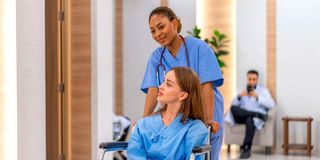
Two Kenyan doctors recount their journey of building medical careers in the UK while maintaining ties to home.
Photo credit: Pool
From there, she enrolled at Coventry University for a Bachelor of Laws, almost following in the footsteps of her father, a lawyer and advocate, who still practises in Nairobi. She left after her second year when family and personal circumstances pulled her back to Kenya.
Between 2002 and 2009, she worked in marketing, sales, and IT, far from anything that looked like medicine. But in 2000, right after finishing her A-levels, she was diagnosed with type 1 diabetes.
“Having type 1 diabetes, you have to be your own doctor,” she says. “I started having a curiosity about the human body, why things happen. It changed the trajectory of my life.”
In 2009, she enrolled at Wenzhou Medical University in China.
“I went straight from Kenya to China and started medical school,” she says. “Five years of practical training and one internship year. When I was graduating, my mother, who is a nurse here in the UK and is now retired, had been living here since 2004. So I flew straight from China and came to England.”
No cheap entry
To practise medicine in the UK as a foreign-trained doctor, she had to sit the Professional and Linguistic Assessments Board (PLAB)exams. The test has two parts. The first is a written clinical paper. The second places candidates in rooms with actors playing patients, and the score depends not only on clinical decisions but on how the patient feels during the interaction.
“Coaching for those practical stations alone costs about Sh85,000; add flights from Kenya, food, accommodation across the preparation period, and a visitor visa. The money was flowing out before a single question had been answered,” says Dr Gathoni.
“The visa itself is not the issue,” she says. “It is the other costs, the exams, the travel… That costs a lot of money.” She passed her exams.
But getting the licence to practice was only part of it. She had to apply to the General Medical Council (GMC), the body that licenses doctors in the UK, get registered, and then find a job. That took four months. She also had to fly back to Kenya to process her work visa before she could legally return and start working.
When she finally did, she joined eight other foreign doctors at the same hospital trust, all new, and all navigating the same unfamiliar ground. The hospital had received specific funding to recruit from overseas because local hiring had left serious gaps in the workforce.
They were given subsidised accommodation within walking distance of the hospital. “The difficult part was learning the system, the cultural differences, how you speak to patients, and what is expected of you.”
What it takes
For anyone thinking of making the same journey, she is clear about what the path looks like. You need to sit and pass the PLAB exams. You need to register with the GMC. You need a job offer from a licensed NHS employer who will sponsor your work visa. The job must meet a minimum salary threshold.
You must pass an English language test. And you will be screened for tuberculosis before the visa is granted. The requirements are standard and clear, she says, but meeting them costs money at every single step before you earn a penny.
Now her working week runs from Tuesday to Friday, 9am to 5pm, with a 30-minute break after every six hours. Those days take her toward care homes, and out on home visits with elderly patients living with psychiatric illness.
Weekends do not bring rest. She is on call Saturdays and Sundays, shifts running up to 12 hours. As a non-residential on-call doctor, she can handle some of that from home, but the phone stays live, and the responsibility does not go anywhere.
“You are working a 12-hour shift, and you do not see light until your day off,” she says. “That can really affect your mental health. You have to find something that brings you back to yourself.”
To decompress, she goes to the gym. She holds a Master’s in Sports and Exercise Medicine and a Diploma in Football Medicine from FIFA. She competes locally in powerlifting, deadlifts, bench press, and squats.
Living under the yoke
The thing that follows her everywhere else, even in her strongest years, is the visa. “I call it living under the yoke of the visa,” she says. “You are scared of doing anything wrong. If you do not get your visa renewed, you are finished. There are people here with families. Permanent residency is about Sh500,000 per person. You are constantly saving to renew your visas.”
That sits alongside the daily cost of living in Wales, money going home to family in Kenya, and immigration rules that shift with every change of government. Wales is cheaper than England, which helps stretch things further.
Some of her elderly patients speak Welsh as their first language, so she has learned enough to keep them comfortable during consultations.