

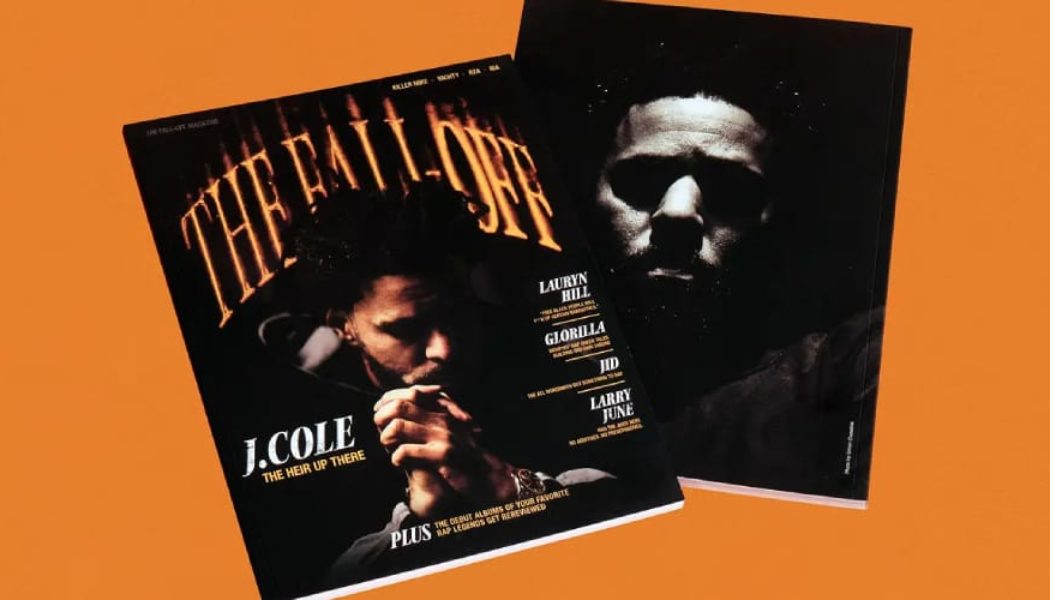
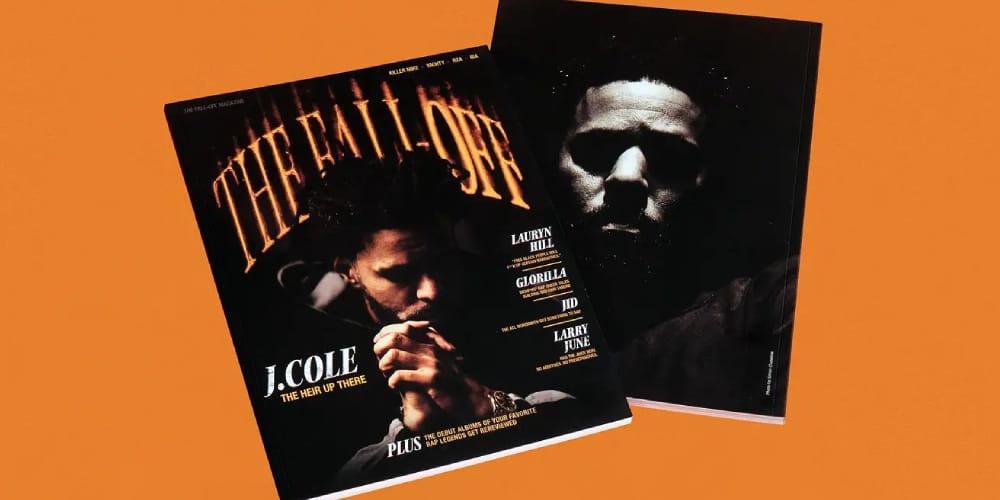
J. Cole has released The Fall-Off Magazine, a 144-page editorial publication produced by a team of over 60 writers, photographers, illustrators, designers, and artists, arriving ahead of his six-month Fall-Off World Tour spanning 15 countries and 50+ cities
The magazine is led by Editor-in-Chief Bonsu Thompson, a three-decade veteran of hip-hop journalism, and Publisher and VP of Creative Felton Brown, with a contributor roster that balances seasoned journalists with emerging talent
J. Cole has released The Fall-Off Magazine, a 144-page editorial publication that treats hip-hop’s past, present, and future as subjects worthy of the kind of long-form, print-first treatment the genre’s most important stories once received as a matter of course. The magazine, available now in a limited print run, features original interviews with JAY-Z, Lauryn Hill, RZA, Glorilla, J.I.D, Lil Yachty, Cash Cobain, and others, assembled by a production team of more than 60 creatives working across reporting, photography, illustration, and design. The publication arrives ahead of Cole’s “Fall-Off World Tour,” a six-month run covering 15 countries and over 50 cities.
The editorial operation behind the magazine is built on a specific infrastructure. Bonsu Thompson serves as Editor-in-Chief, bringing three decades of hip-hop journalism experience across what the press materials describe as some of the genre’s most historic publications. Felton Brown holds the Publisher and VP of Creative role, overseeing the visual and structural identity of the project. Together, Thompson and Brown assembled a contributor team that the press release characterizes as deliberately balanced between veteran journalists and emerging voices, a curatorial choice that mirrors the magazine’s own editorial thesis: that hip-hop’s story is best told as a continuum rather than a series of isolated generational moments.
“Like all essential creative by and for a culture, this collector’s edition arrives when most needed by its audience,” Thompson said. “Hip-Hop journalism has somehow expanded, diversified, atrophied and become amorphous all at once. So my aim was to deploy storytelling and the humanization of starpower to educate the world on how Godly the craftsmen and innovation behind Hip-Hop commerce were, are and will forever be. No wifi needed.”
The interview roster reinforces that structure. JAY-Z, Lauryn Hill, and RZA represent foundational figures whose influence on the genre’s creative and commercial architecture is decades deep. Glorilla, J.I.D, Yachty, and Cash Cobain pull from the current and next-wave talent pool, representing distinct corners of contemporary rap. The juxtaposition is intentional. Rather than organizing the magazine as a retrospective that works forward or a trend report that works backward, the editorial framing places legacy and emergent voices in direct proximity.
“The Fall-Off Magazine documents a singular moment in time,” Brown said. “Like the sun, Hip-hop has never stood still. Every generation has added to the culture, and this publication was built to create space for generations of old and new to commune in conversation with one another. We built this publication because we believe context matters, conversation matters, critical thought matters, and original content matters. Hip-Hop has always mattered. Documenting this thing of ours to be consumed tangibly creates a cultural and educational experience that people can return to long after the moment has passed.”
At 144 pages, the magazine is scaled closer to a book than to a standard periodical. The format accommodates original reporting, photography, artwork, and design across a scope that covers not only music but the business and cultural ecosystems surrounding it. The production deployed more than 60 creatives, a headcount that speaks to the publication’s ambition as a collective editorial effort rather than a single-author project.
The physical format is itself a statement of intent. Produced as a limited print run and positioned as a collector’s edition, The Fall-Off Magazine is designed to function as what the press materials call “a literary artifact,” a publication meant to be revisited and shared rather than consumed and discarded. That framing aligns the project with the tradition of hip-hop print publications that served as primary documents of the culture before the shift to digital fragmented the editorial landscape.
The magazine’s release is timed to the opening stretch of “The Fall-Off World Tour,” Cole’s most expansive live run to date. The six-month itinerary covers 15 countries and more than 50 cities, and the publication functions as both a standalone cultural product and a companion piece to the tour, grounding the live experience in the editorial depth and historical context that 144 pages afford.
The Fall-Off Magazine is available now in a limited print run online.