
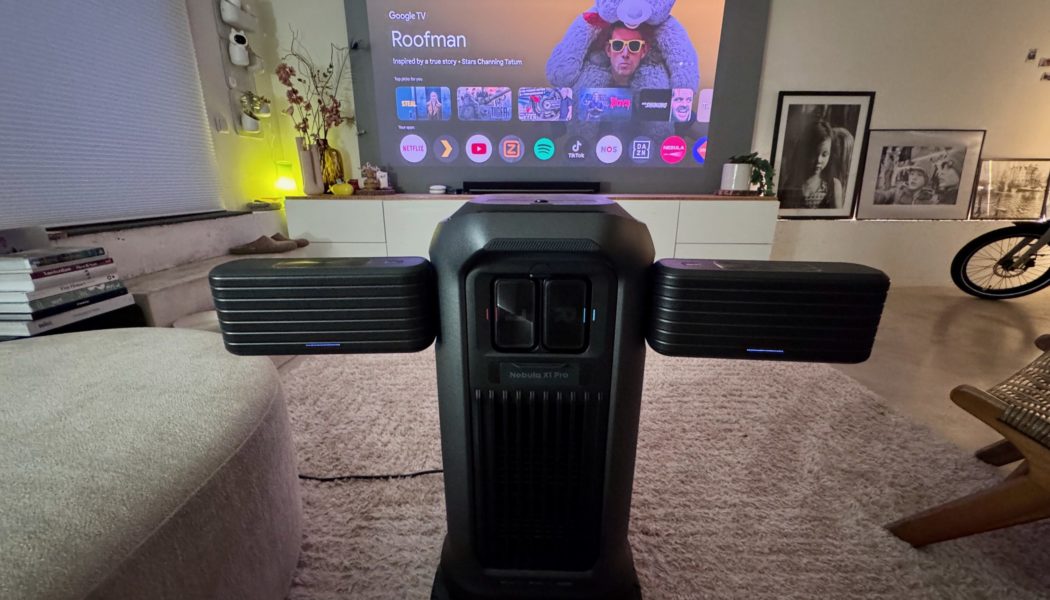
The Nebula X1 Pro shouldn’t exist, but I’m so glad it does.
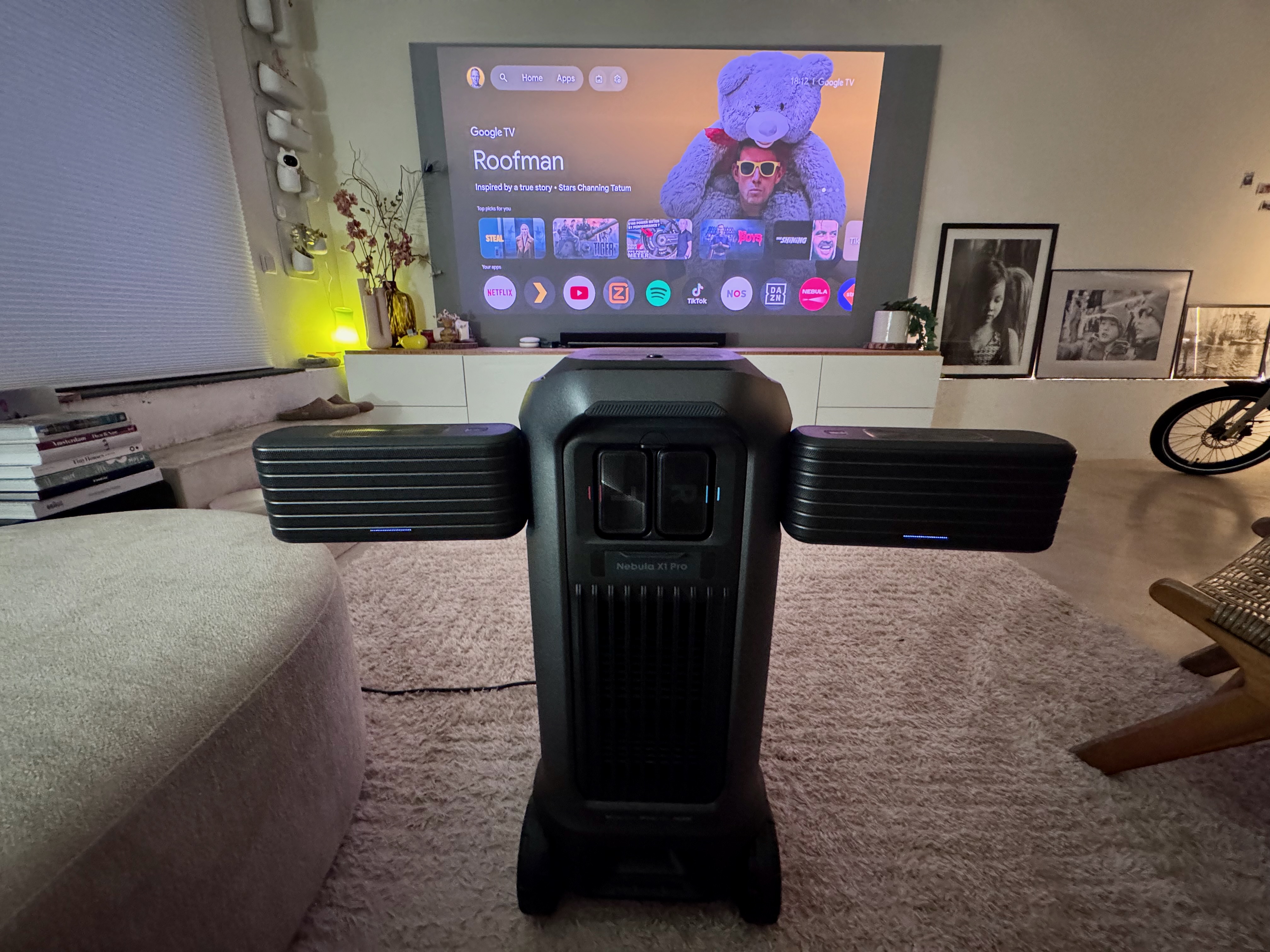

The Soundcore Nebula X1 Pro is too weird to exist. It takes the excellent 4K projector and karaoke microphones from Anker’s Nebula X1 and stuffs them inside a powerful five-speaker Google TV party on wheels. It’s so absurd that it feels like a gadget fever dream – and I’m here for it.
At the heart of this system is the same liquid-cooled, triple-laser, auto-image-correction-everything projector I reviewed last summer. It’s unbelievably quiet for a 3500 ANSI lumen projector that lays claim to the title of being the brightest and most vivid all-in-one portable projector on the market. Now it’s also the loudest, with 400W of audio added to the new Nebula X1 Pro.
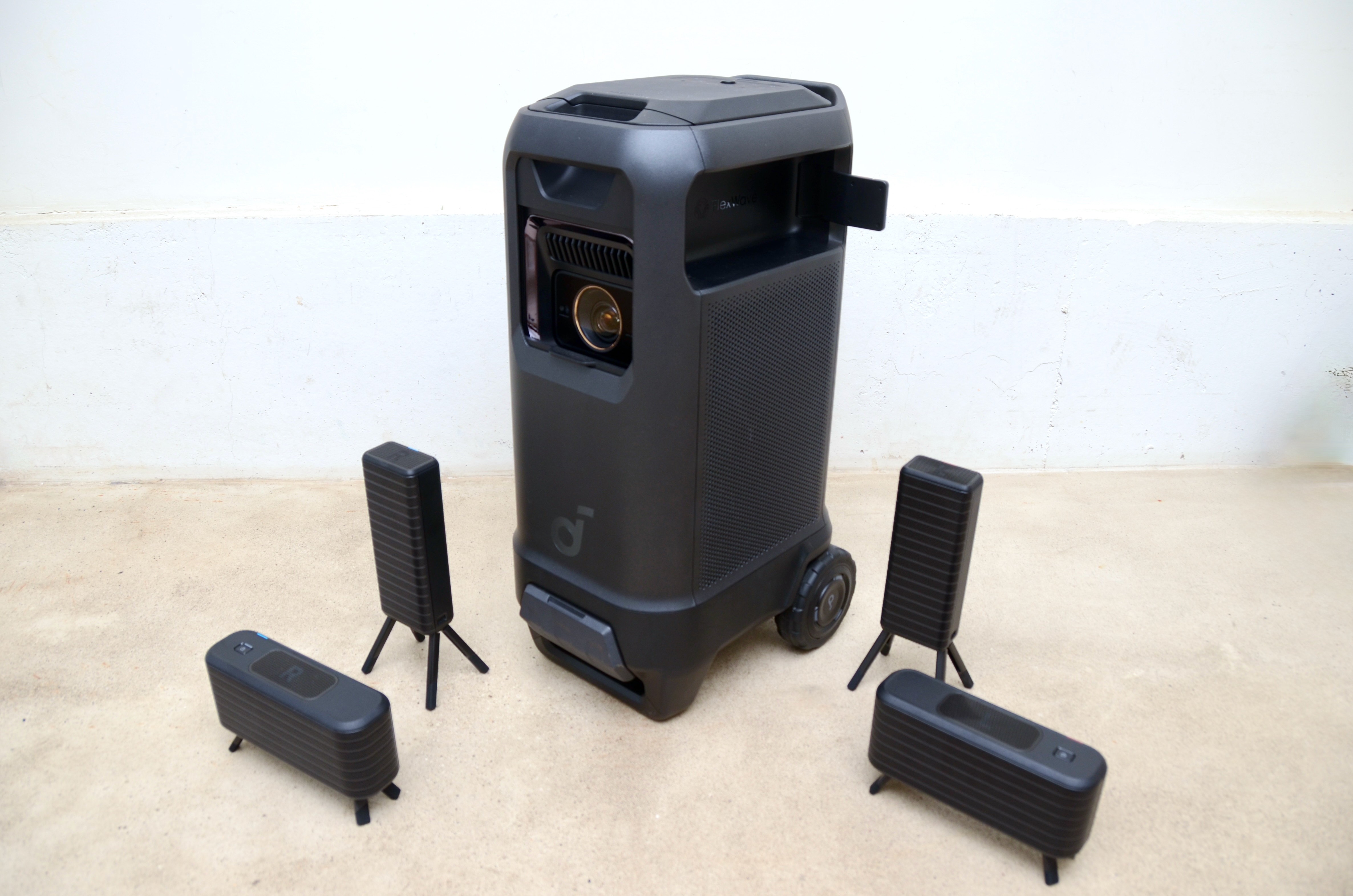
Inside the X1 Pro is a big thumpy subwoofer capable of wall-shaking bass. It also hosts four battery-powered speakers that automatically unfold or pop out to produce a total of seven horizontal channels and another four overhead for wireless 7.1.4 Dolby Atmos immersion.
Other than its size and some intermittent connectivity issues, the only complaint I have is that the Nebula X1 Pro is sometimes too loud. That’s not something I thought I’d ever say about a portable all-in-one projector.
If you’ve got $4,999 to burn, Anker’s Nebula X1 Pro is one hell of a match.
8
Verge Score
The Good
- Complete home theater on wheels
- Bright, vivid picture
- Wireless Dolby Atmos surround
- So much bass
- Doubles as a Bluetooth speaker
The Bad
- Expensive
- “Portable”
- Dropped Wi-Fi connections
Since the video and karaoke capabilities of the projector are the same as the Nebula X1 I won’t be rehashing them here. Instead, I’ll focus on why you might choose the X1 Pro: sound.
Looking at the X1 Pro, you might wonder where all the speakers are. The subwoofer is internal, of course, and the two front speakers automatically unfold like wings with a robotic whoosh at the touch of a button. The two rear speakers spring free from the back of the unit with a firm push.
The X1 Pro operates in three sound modes: with all the speakers docked for 2.1 audio (the rear speakers are inactive), with the front speakers unfolded for 5.1.2 surround, and with all four distributed around the room for full 7.1.4 separation. For the latter, Anker provides animated guidance to help assemble its audio puzzle.
The four satellites are completely wireless with a battery life of over eight hours in my testing. They charge via pogo pins when returned to the projector, or via USB-C. To ensure optimal sound, the X1 Pro features a 4-mic array to automatically optimize audio in the room, letting you drag the sweet spot into your preferred viewing area. I found Anker’s Flexwave spatial audio calibration tech to work very well in my open plan living room, but the sweet spot is only about two-persons wide.
When detached, the four front and rear speakers sync audio over a proprietary 5.8GHz Wi-Fi signal, not Bluetooth, for superior, low-latency, lossless audio. The X1 Pro’s speakers performed flawlessly in my testing. They automatically connected to the projector when it turned on without any of the weird pops or dropouts I saw with the X1’s lone speaker pair. The speakers then went to sleep when the X1 Pro turned off to help save battery.
I did, however, experience some inexplicable Wi-Fi connectivity issues with Google TV. About five times over two weeks of testing it just refused to reconnect to my home network, even though my phone and laptop worked fine. A reboot always solved the problem, but it was very annoying when it disrupted a film.
The bass produced by the X1 Pro’s 160W subwoofer is remarkable for a portable projector. If anything, it can, at times, be overwhelming. Each front surround houses four 20W speakers dedicated to upward, center, front, and surround channels. The smaller rears each contain two 20W speakers for the upward and rear surround channels. The front and rear satellites have folding legs and a tripod mount to help with placement.
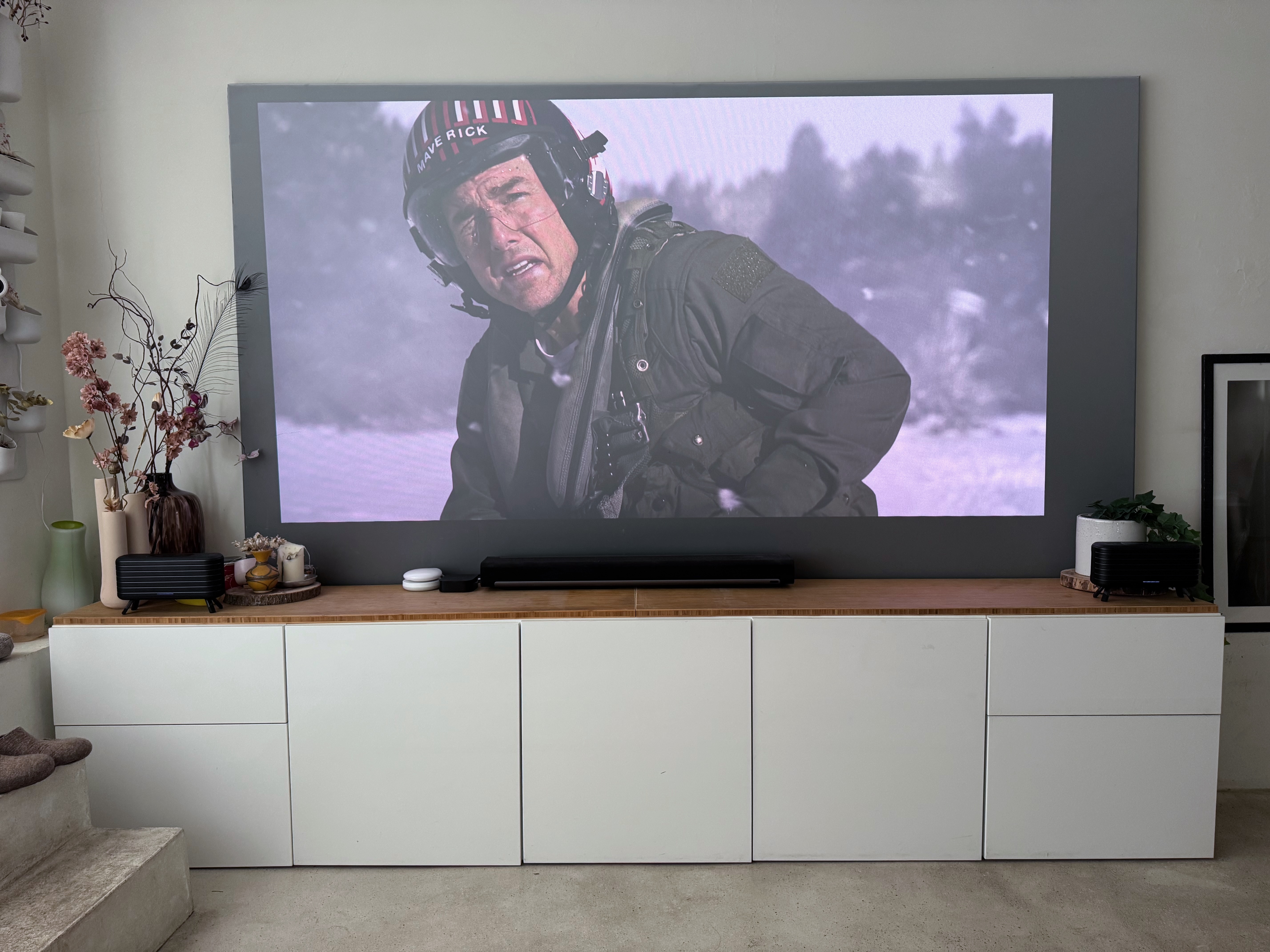
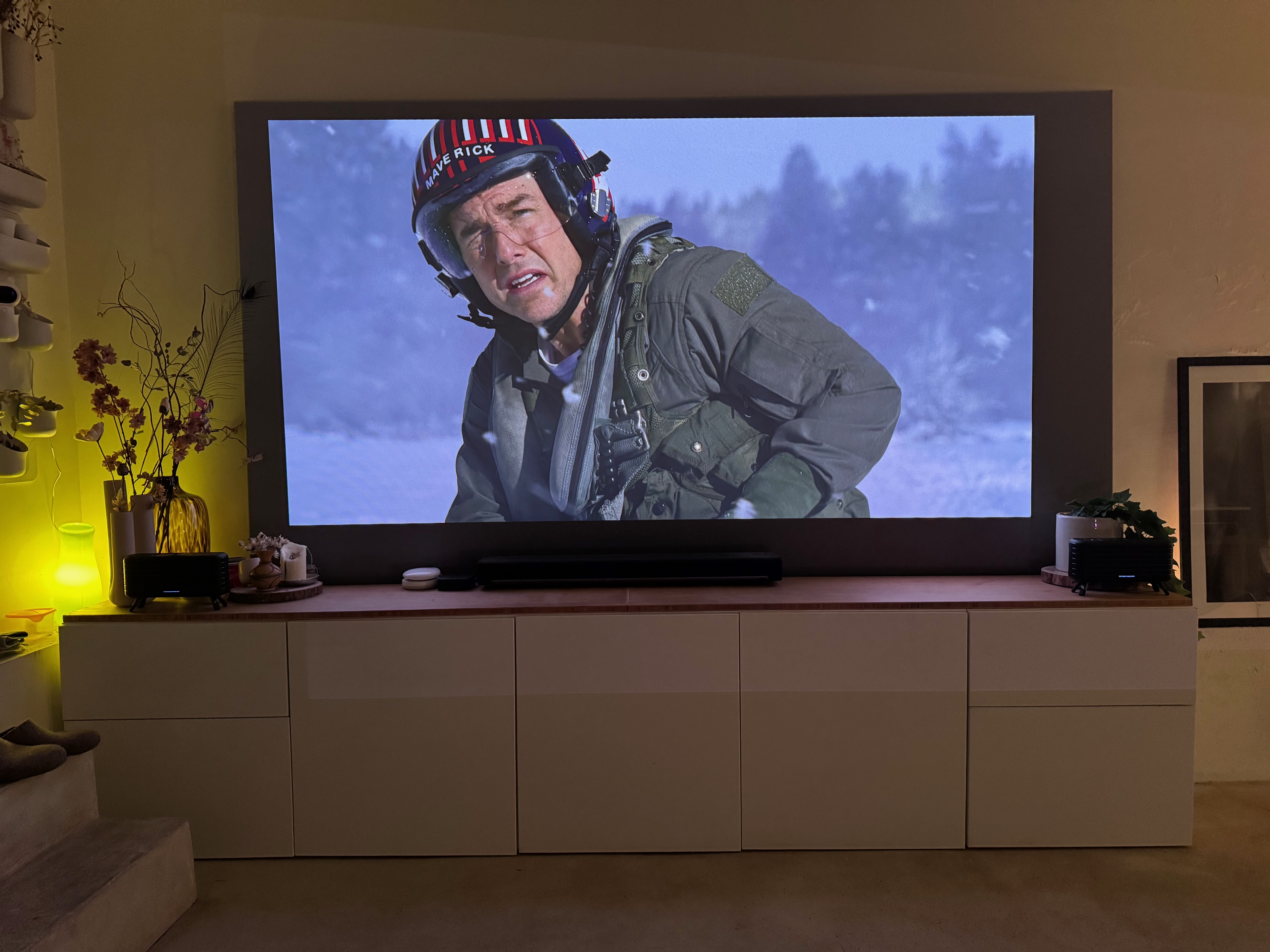
In 7.1.4 mode movie mode, with all four speakers detached, placed in the four corners of the room, and uh, Flexwaved, the sound rivaled my own 5.1 Sonos system built around a soundbar, subwoofer, and two rear satellites.
I especially enjoyed hearing helicopters overhead when watching a Dolby Atmos version of Top Gun: Maverick. Everything I threw at the X1 Pro looked and sounded great and seemed positionally correct, including The Dark Knight, All Quiet on the Western Front, and Blade Runner 2049. Dialog cut a hole through the soundscape in the front center channel, bullets whizzed overhead, and dystopian machines crept through the dark spaces around me. At 30 percent volume, my walls were already shaking, so the X1 Pro should be great for outdoor movie nights come spring.
I listen to music more frequently than I watch videos, so I like that the X1 Pro can be quickly switched into a nearly silent Bluetooth speaker, without the constant fan noise produced by most projectors. With all the external speakers docked for 2.1 audio mode, the X1 Pro can compete with those giant JBL party speakers, only without the superfluous light show.
Listening to Miles Davis on the X1 Pro sounded exceptional, with bright clean horns sparkling against the baseline. I had to reduce the bass in Spotify’s equalizer to enjoy tracks like Ye’s “Black Skinhead” or even “Nutshell” from Alice in Chains. Bob Dylan’s voice in “Masters of War” lost some warmth, however, compared to my Sonos system. I could easily crank the X1 Pro to a very loud 50 percent and still enjoy the music, but things got muddied beyond 70 percent volume.
In general, the sound from the Nebula X1 Pro is a vast improvement over the Nebula X1. But calling the X1 Pro “portable” is a stretch.
The telescoping handle and wheels do make the 435 × 343 × 761mm (17.13 × 13.50 × 29.96 inches) X1 Pro mobile, within reason, because you’ll still want help to hoist the 32.8kg (72.31-pound) party box up stairs or into a car.
And I wouldn’t feel right rolling all those delicate optics and electronics over rough terrain. In fact, the fine print recommends using it on hard surfaces like concrete and wood, and to “avoid dragging the projector across grass, large gravel, cobblestone, or through water deeper than 50mm.” A $400 electric wagon to haul your $4,999 projector around isn’t a terrible idea.
There’s also an asterisk on the unit’s IP43 resistance to water and dust. It only applies when the lens cap is closed and the speakers are returned and retracted, all of which are unlikely if the X1 Pro is accidentally left outside after a movie night. The projector does come with a slip-on cover for those demonstrating more responsibility.
Look, as a gadget nerd, I’m super enthusiastic about the Nebula X1 Pro. There’s nothing else like it on the market and I appreciate Anker’s audacity to build it. But for my money, if you need a portable 4K projector, then the Nebula X1 with optional speaker kit is plenty loud even outdoors, and it’ll save you about $1,000. But if you gotta have that bass, then the Soundcore Nebula X1 Pro won’t disappoint.
Photography by Thomas Ricker / The Verge