


Hot on the heels of new year’s celebrations, the annual Consumer Electronics Show will get underway in early January 2026. Once again, Las Vegas will host a sprawling sneak peek at the tech that will shape the industry throughout 2026.
The Verge will be on the ground at CES 2026 covering the biggest announcements, press conferences, and gadgets and we’ll be sharing hands-on impressions and takeaways of the best new tech making its debut in Vegas. The show floor officially opens on Tuesday, January 6th, for four days, but you can expect some of the major news to drop in the days and weeks leading up to the show.
You can stay on top of all of The Verge’s CES 2026 coverage right here including standout innovations, clever upgrades, and even the weird stuff the show is often known for.
-
 CES silly season begins.
You know it’s almost CES when Samsung Display announces a few weirdo concepts, including an “AI OLED Cassette” with 1.5-inch round displays and an “AI OLED Turntable” with 13.4-inch round display. It offers zero details to justify their existence which is why our team is headed to Vegas to find out. Stay tuned.
-
 This CES post comes to you via Starlink.
United Airlines interrupted boarding my plane to CES 2026 to say: “This flight to Vegas is special.” Why? Apparently, it’s the inaugural flight from Newark Airport with Starlink. There was a wireless charging pad waiting at our seats.
-
 Why hang a painting in your home, when you can tell an AI to put slop on your wall?
The Fraimic Smart Canvas is a framed E-ink screen being shown off for the first time at CES 2026. It’s meant to mimic your typical wall art but, because nothing is sacred, instead of showing an actual painting or a photo by a human, it displays AI “art” generated by your voice prompts. The Smart Canvas is available for preorder in two sizes, standard for $399 and large for $999, though deliveries aren’t expected until June.
-


One of the fun parts of being a tech journalist for over a decade is that occasionally you get to watch a truly unique gadget go from concept to reality — and, eventually, into your living room. That’s the case with the Mui Board, a smart home controller built into a piece of wood.
The Mui was first demoed at CES in 2019, and I’ve seen it at several shows over the years, in various iterations, always with the promise that it would ship soon. Well, this year it did (in limited quantities!), and I finally got to try one out in my living room.
-

Have you always wanted to scan your groceries at home? If so, the newest smart fridge from GE Appliances is for you. There’s a barcode scanner built into the water dispenser that works along with an interior camera and an 8-inch tablet to help you keep track of what food you need and add it to your digital shopping list.
The GE Profile Smart 4-Door French-Door Refrigerator with Kitchen Assistant is being announced at CES 2026, which kicks off next week, and is slated to launch in April for $4,899 — $500 more than a comparable non-Kitchen Assistant model.
-


LG is teasing the 2026 Gram Pro laptops that will be fully unveiled at CES, including what the company claims is the “world’s lightest 17-inch RTX laptop.” The LG Gram Pro 17 (17Z90UR) and Gram Pro 16 (16Z90U) will introduce a new ultralight “Aerominum material” developed by LG that aims to reduce a laptop’s weight while reinforcing strength and scratch resistance.
The LG Gram Pro 17 will feature a 2,560 x 1600 display, paired with Nvidia’s RTX 5050 laptop GPU that has just 8GB of VRAM. LG claims it will still provide “ample performance for graphics-intensive tasks, content creation, and gaming.” You won’t be able to run most modern games at maxed-out settings in a playable state though, so you shouldn’t consider the Gram Pro 17 as a dedicated gaming laptop. LG hasn’t revealed how much the Gram Pro 17 will actually weigh, but notes that it will be exclusive to the US at launch.
-


Clicks is expanding beyond keyboard cases and bringing its QWERTY keys for phones to another format: a magnetic power bank accessory with a slide-out keyboard. The Power Keyboard offers a 2150mAh battery that can top off a phone battery via MagSafe or Qi2 wireless charging, but its real superpower is its full keyboard that can connect to your phone or smart device over Bluetooth. I love a multitasking battery pack, and a keyboard for my phone that I can throw in my bag? Sounds even sweeter.
The Power Keyboard offers a range of extendable positions to accommodate different sized phones. It’ll also work in landscape mode, or over Bluetooth without being physically attached to your device. This way, it can act as an input for a smart TV or a tablet in a pinch. The keyboard does need to draw power from its integrated battery to operate over Bluetooth; Clicks’ cofounder and marketing head Jeff Gadway tells me that users will be able to “protect milliamp-hourage for keyboard usage,” so your phone won’t gobble up all of its charge and leave it inoperable.
-
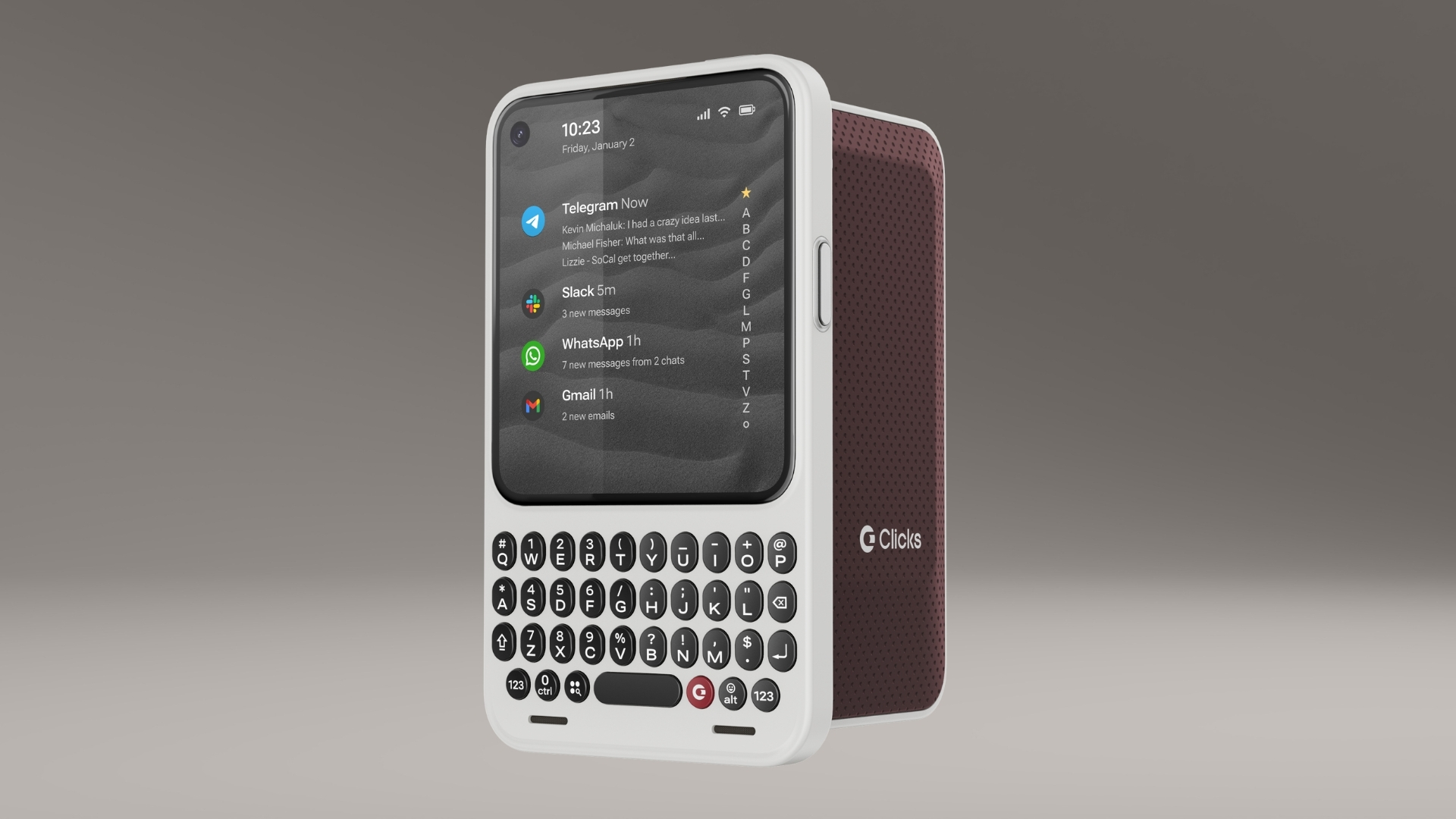
You ever find yourself thinking, “I wish my phone had a phone?” Good news, friend. Clicks — the company behind the QWERTY keyboard case for your iPhone — has just the thing: the Clicks Communicator. It’s intended as a kind of complement to your smartphone for when you just want to stay in touch without all the other distractions of your device. The Communicator comes with a full QWERTY keyboard, along with its own cellular connection, so you can leave your main phone behind. But that privilege comes at a price: $499, to be exact.
Let’s set aside the fact that the Communicator costs as much as a Pixel 9A and focus on the glorious gadgetness of it all. For starters, the Communicator comes with interchangeable back plates so you can switch up your style. There’s also a built-in headphone jack, a physical mute switch, and expandable storage via microSD — all the little things that mainstream phone makers have dropped over the past decade. The keyboard keys are physically larger than what you’ll get on the Clicks phone case, and the whole keyboard is touch sensitive so it can act as a trackpad.
-


The biggest tech show of the year kicks off next week, as some of the industry’s top players show up to Las Vegas for CES 2026. We’ll be there to see all the new product demos we can and to bring you the most exciting news from the show. Follow our coverage for a preview of all the new tech these companies are planning to launch in 2026.
Expect to see the usual suspects: laptops, smart home gadgets, and TVs, and a whole lot more wearables and health tech. We’re anticipating seeing more products with AI integration. Also, robots. Perhaps, humanoids even.
-


Fender, the guitar maker also known for its amps and speakers, has a new consumer electronics brand called Fender Audio making its debut at CES 2026. In addition to a new pair of wireless headphones, Fender Audio has announced a pair of portable Bluetooth speakers called ELIE, which is short for “Extremely Loud Infinitely Expressive.”
The ELIE speakers will be available in two sizes, but both versions can be connected to a second unit to create a stereo pair, or you can connect and sync up to 100 of them to fill a larger space with sound. They also both support a unique feature letting you listen to audio from up to four different audio inputs simultaneously. These can include a Bluetooth device like a smartphone, an instrument or microphone plugged into the ELIE’s XLR/1/4-inch combo jack with a cable, and two other accessories connected using Fender’s proprietary wireless system.
-

Fender Audio, the consumer electronics brand owned by the famous guitar maker, has announced its first pair of wireless headphones at CES 2026. What sets the Mix headphones apart from the competition are impressive battery life, a modular design that allows the ear cups and headband to be swapped to alternate colors, and a focus on longevity with a battery that’s easy to access and swap.
When they launch this year the Mix headphones will initially be available in olympic white and skyscraper black color options for $299.99. That’s considerably cheaper than Sony’s $450 flagship WH-1000XM6 headphones that debuted last May. We haven’t had a chance to test the Mix’s hybrid active noise cancellation to confirm if it’s comparable to Sony’s class-leading ANC in the WH-1000XM6, but Fender Audio bests Sony on battery life. While Sony’s ANC headphones max out at up to 30 hours of playback with ANC on and up to 40 hours with it off, the Mix headphones offer up to 52 hours with ANC and up to 100 hours without.
-
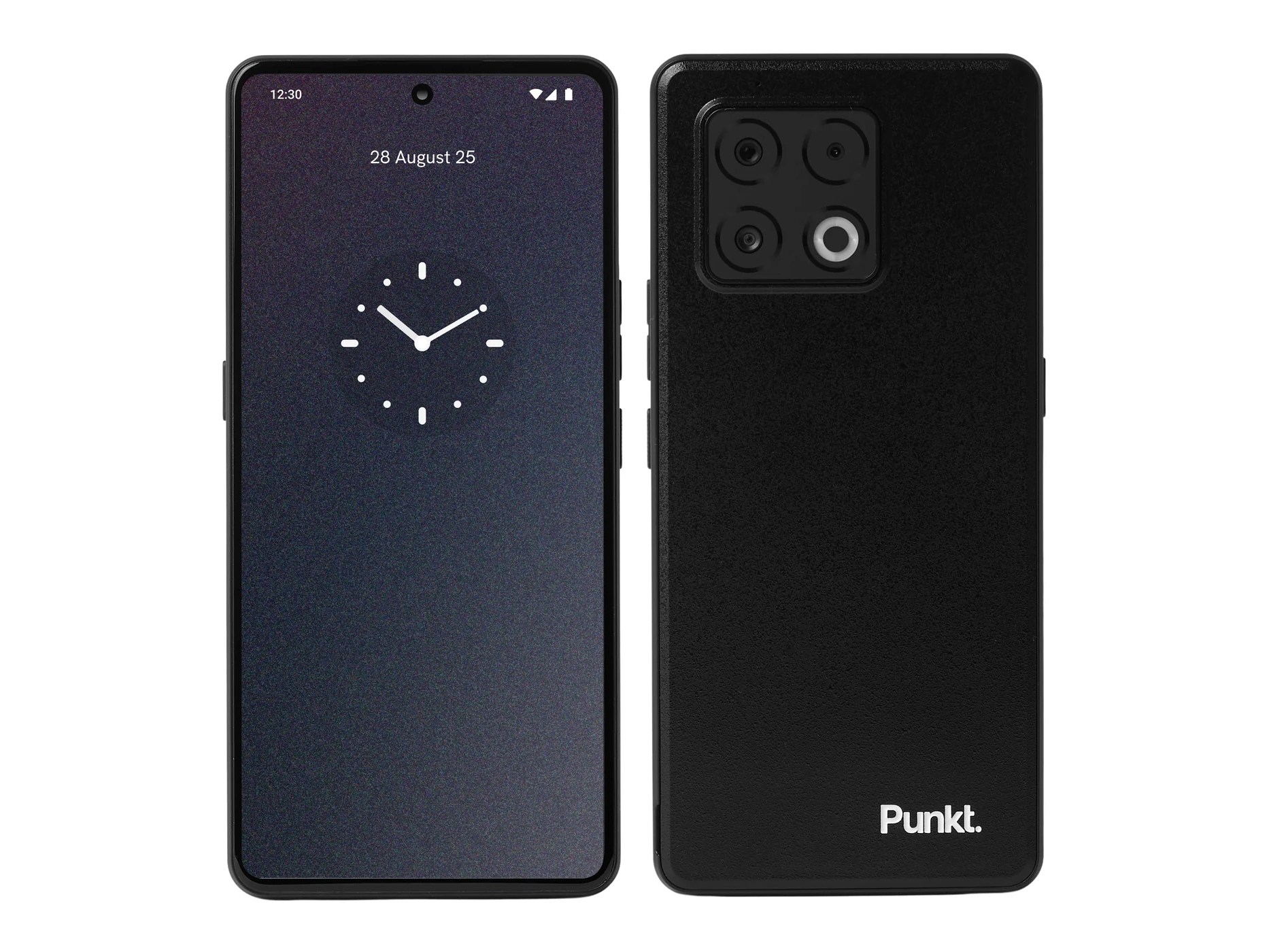
Punkt, the Switzerland-based, privacy-focused phone maker, is trying the whole “smartphone” thing again. The MC03 improves on some of the disappointing features of its previous effort, the MC02, while maintaining its security focus. Likewise, its software still comes with a subscription fee: the first year is included free, but it’s $12 per month after that. On top of that, the MC03 is Punkt’s first phone to be assembled in Europe rather than Asia, making good on its promise from earlier this year.
The MC02, released last year, wasn’t exactly a critical darling. Punkt seems to be addressing some of those criticisms with a more modern 6.67-inch 120Hz OLED compared to last year’s 60Hz LCD. The 5,200mAh battery is user-replaceable. The MC03 ships with AphyOS, from the equally privacy-oriented company Apostrophy, and it’s based on AOSP 15 — more current than the AOSP 13-based version the MC02 shipped with, though still a version behind this year’s flagships. The MC03 is IP68 rated, comes with a MediaTek 7300 chipset, and is scheduled to get three OS upgrades and five years of security updates.
-

The Freestyle Plus all-in-one portable projector features 430 ISO lumens, or “nearly twice the brightness of the previous generation,” according to Samsung. Great! But also a little strange since both the original and second generation Freestyle projectors listed “550 lumens” on their respective spec sheets.
See, projector makers are notorious for playing fast and loose with the lumen spec. So much so that Epson has been on a legal rampage over the last few years. As a result, companies like Anker, Yaber, AAXA, Xgimi, AWOL vision… even Dr. J have all been forced to restate brightness measurements in industry standard ISO lumens. That’s good because having a consistent lumen spec makes it easier to predict how the projected image will hold up to ambient light that wants to wash out the viewing experience.
-

Petkit has announced two new automated machines at CES 2026 designed to feed and care for your pets using AI-powered cameras that track their behavior and provide health insights that may otherwise go unnoticed.
Launching sometime in April 2026, the Petkit Yumshare Daily Feast is one of the first automatic dispensers that works with wet food. The machine can provide up to 7 days of meals and uses an NFC-based tracking system to automatically remove a serving if it hasn’t been consumed after 48 hours. UVC lighting helps sanitize the delivery of fresh meals, while an AI-powered 1080P night vision camera with a 140-degree field-of-view tracks when your pet eats and how much food is left over before a fresh pack is dispensed. Petkit plans to offer the Yumshare Daily Feast to pet food companies as a wet food serving platform instead of selling it directly to consumers, and each company will set the pricing of the machine and meal refills.
-
 Qualcomm, Intel, or AMD? HP’s leaked Elitebook X reportedly lets you pick.
 -
Leak: Dell is about to bring back XPS.
-

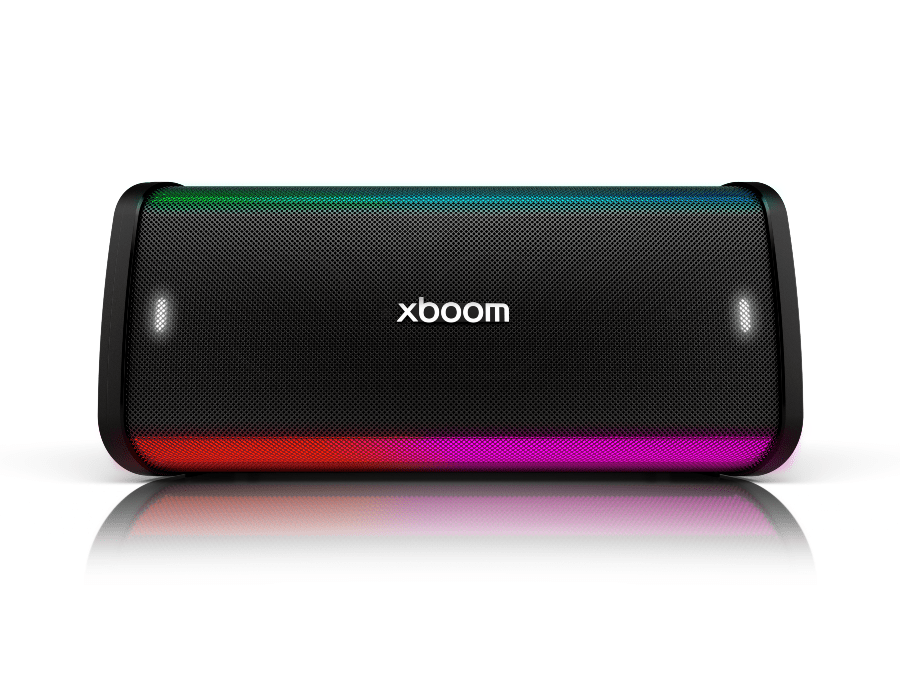
LG is adding a karaoke-focused party speaker to its lineup of Xboom devices, which is built in collaboration with Will.i.am. Announced this week, LG says the Stage 501 speaker comes with an “AI Karaoke Master” that can remove or adjust vocals from “virtually any song,” similar to the Soundcore Rave 3S.
It can also adjust the pitch of the songs to make them more comfortable to sing, and it doesn’t require karaoke-specific audio files to do so, according to LG. Like its predecessor, the Stage 501 features a five-sided design but comes equipped with upgraded dual woofers and full-range drivers that LG claims will deliver richer audio. The swappable 99Wh battery offers up to 25 hours of playback and delivers 160W of power (or up to 220W when plugged in).
-
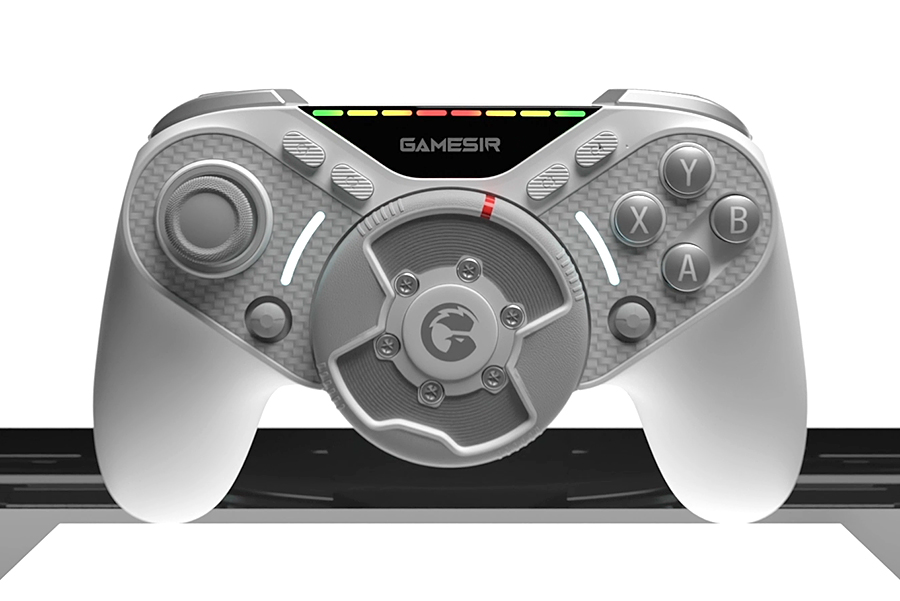
GameSir is no stranger to experimenting with unique controller features — its Tarantula Pro can automatically swap its face button labels to accommodate alternate layouts, and its Pocket 1 clamps Game Boy controls onto your phone. What sets its new Swift Drive controller apart is a small steering wheel located smack-dab in the middle of the gamepad that’s connected to what GameSir calls the “world’s smallest direct drive motor” providing force feedback effects for racing games.
Pricing and availability hasn’t been announced yet, but GameSir has revealed plenty of details about the Swift Drive’s features and functionality. The steering wheel uses a “high-precision” Hall effect encoder with “up to 65,000 levels of resolution for ultra-accurate steering.” Its movement can be adjusted between 30 and 1080 degrees of rotation, and the wheel itself can be removed and swapped with alternate styles. Hall effect sensors are also used in the Swift Drive’s joysticks and buttons, while its triggers are further enhanced with individual haptic motors to simulate the feeling of ABS braking and wheel slip.
-


In just the past couple years, the art TV category that’s been dominated by Samsung’s The Frame has seen growth, with additions from both TCL and Hisense. Now LG has announced its own entry, the LG Gallery TV. The TV will leverage the Gallery+ service that LG released earlier this year, which includes thousands of display visuals ranging from pieces of art to cinematic images to gaming scenes. Much like Samsung’s Art Store, Gallery+ has a limited free option, but its full capability requires a subscription.
The new Gallery TV shouldn’t be confused with the G Series OLED TVs, like the LG G5, even though the G Series used to be called the Gallery Series up until a couple years ago. The Gallery TV is a mini-LED TV with “a specialized screen that reduces glare and minimizes reflections for an art-like viewing experience” (so it likely has a matte coating). LG hasn’t specified the backlight configuration, but all of the other art TVs use edge lighting, so it’s a safe bet that this one will as well. OLED technology, while offering superior picture quality to mini LED, isn’t able to display a single image for an extended time without concern of image retention (or burn-in).
-

LG unveiled a whole new line of gaming monitors ahead of CES on Friday. The UltraGear evo line are all high-end monitors covering a range of technologies, but united by 5K resolution and AI upscaling.
The three flagships under the new branding are the 39GX950B, the 27GM950B, and the 52G930B. The first number in the model name indicates the size. The rest of the letters and numbers, well, I’m sure they mean something to someone.
-
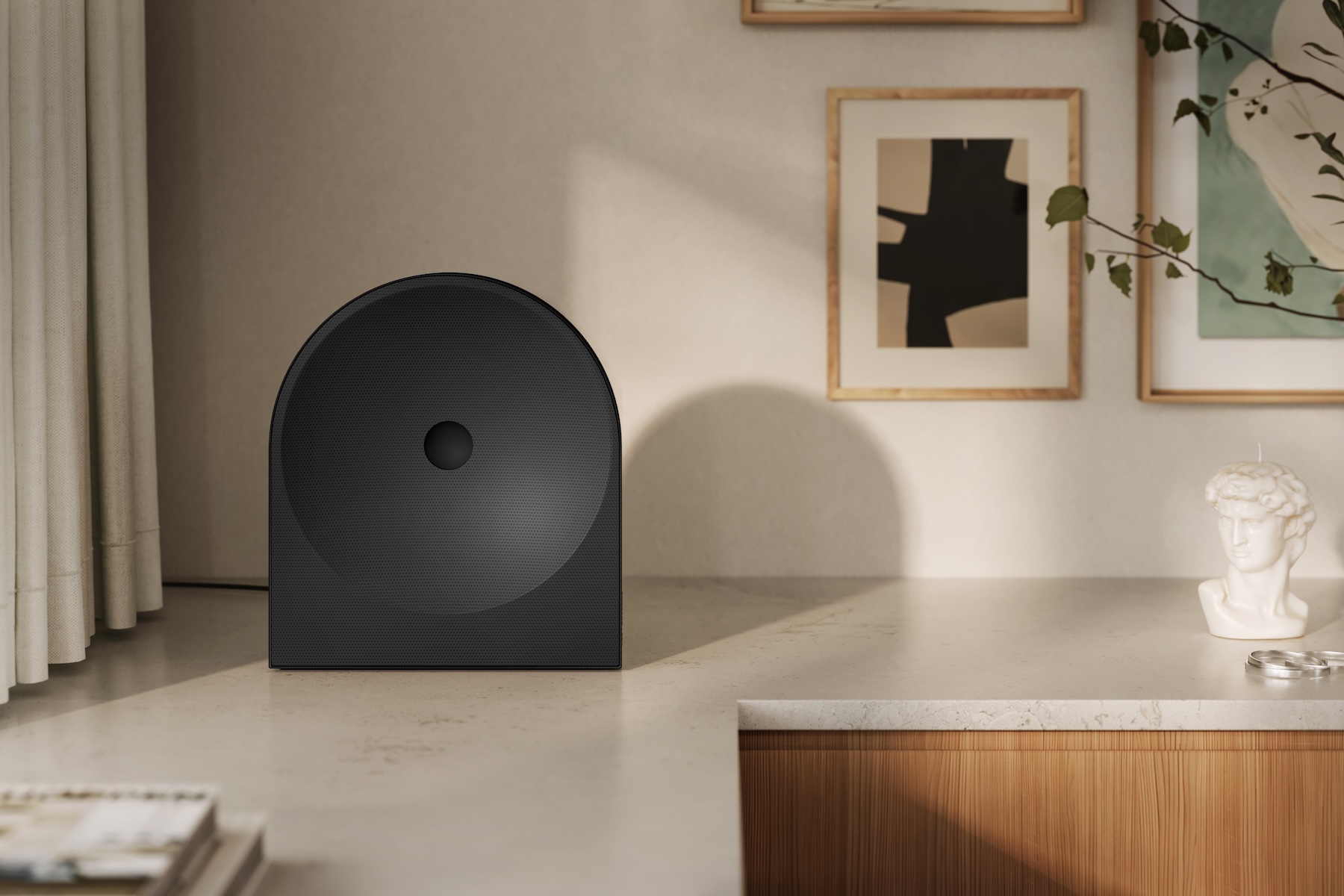
For years, Samsung has made products that try to camouflage what they are by displaying works of art. The Frame TV is the most famous example, but the company also released the Music Frame, a speaker disguised as a picture frame, at last year’s CES. Now, instead of hiding a speaker with a piece of art, Samsung worked with designer Erwan Bouroullec to make a speaker into a piece of art.
According to Samsung, the Music Studio line of speakers, debuting at CES 2026, draw inspiration from the “timeless dot concept” found throughout music and art. As a musician, the Music Studio 5 reminds me of a fermata, the symbol meant to hold a note or silence. It has a 4-inch woofer and dual tweeters with built-in waveguide.
-

-

Samsung is breaking new ground with its 2026 lineup of gaming monitors, with the Odyssey 3D G90XH becoming the first to feature a 6K display with “glasses-free 3D.” The new monitor comes with a 32-inch IPS panel, offering real-time eye-tracking that “adjusts depth and perspective” based on your position, along with a speedy 165Hz refresh rate that you can boost to 330Hz with a Dual Mode feature that switches to 3K.
The 2026 Odyssey 3D is an upgrade to the display Samsung revealed during CES last year, which comes with a smaller 27-inch display and a lower 4K resolution. We’ve seen a few other 6K monitors from Asus, Dell, and LG, though they don’t come with the Odyssey’s 3D effects or a focus on gaming. For now, select games like Stellar Blade, Lies of P: Overture, and The First Berserker: Khazan are optimized specifically for the Odyssey 3D, but several other titles still support its 3D effects, including Black Myth: Wukong, Hogwarts Legacy, Palworld, and Silent Hill 2.
-

Ahead of CES 2026 getting underway in early January, Birdfy has announced two new camera-equipped smart bird feeders that can identify and capture visitors in slow motion. The Birdfy Hum Bloom is specifically designed to attract and record hummingbirds using a nectar bulb that mimics flowers they’re naturally attracted to, while the Feeder Vista introduces a 360-degree camera and a bottom-up feeding system that doesn’t obstruct views. Both feeders are expected to be available in Q2 of 2026, but pricing hasn’t been announced.
The Birdfy Hum Bloom is built around an 8MP camera that can capture 4K video of hummingbirds at 20fps. Capturing 120fps slo-mo videos requires a drop in resolution to 1080P, but with hummingbirds flapping their wings around 50 to 80 times per second while hovering, you shouldn’t expect footage that will rival a National Geographic documentary.
-
A GoPro laptop from ASUS.
The two already announced a collaboration back in October meant to “streamline creator workflows with AI.” Now the relationship is evolving into a dedicated button on new ASUS ProArt GoPro edition laptop that’ll probably also net a free subscription to GoPro Premium Plus for some period of time. All will be revealed at CES on January 6th.