
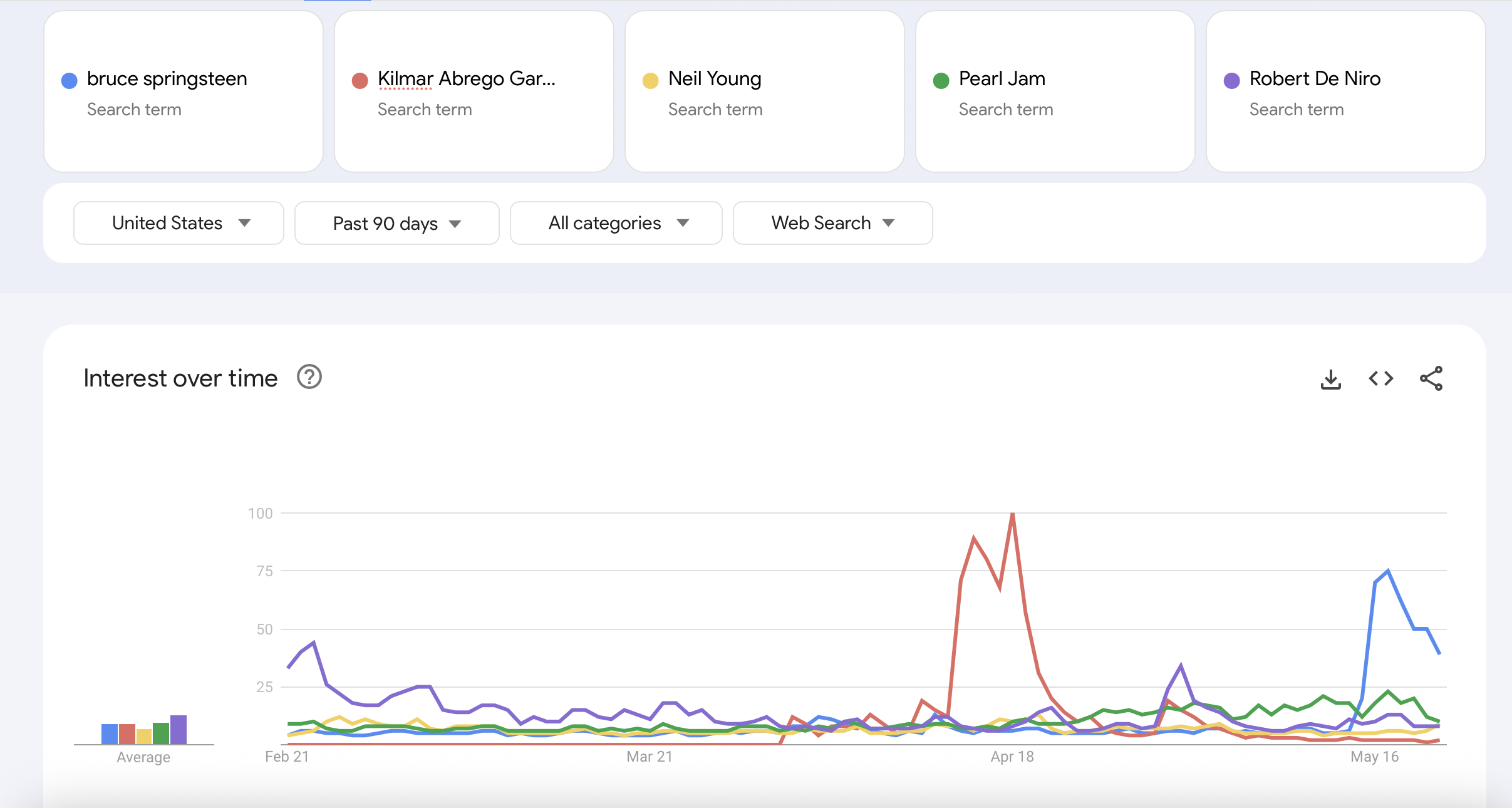
Wren Graves (Managing Editor): Bruce Springsteen’s clash with President Donald Trump broke through the political discourse to become one of the most-searched issues of the last week, according to data from Google Trends. Search volume for Springsteen spiked to nearly its highest point in the last five years from the week of May 14th to the 20th — a period just following his fiery tour kickoff in Manchester, England. The concert provoked Trump to post, “He ought to keep his mouth shut until he’s back in the country.”
While criticism from Neil Young, Robert De Niro, Eddie Vedder, and others have hardly registered, Springsteen’s words stuck. Search traffic for his name reached almost as high as the peak for Kilmar Abrego Garcia, the man whose wrongful deportation became the face of the Trump administration’s brutal policies. Springsteen is probably the most prominent Trump critic from the world of pop culture whose name doesn’t rhyme with Sailor Drift.
Get Bruce Springsteen Tickets Here
Alex, you’ve covered Springsteen a lot over the years. We’re living through a moment where celebrity political statements have become both more common and less impactful. What makes Springsteen distinct from the chorus of other celebrities speaking out against Trump?
Related Video
Alex Young (Publisher): I think it comes down to the fact that Trump took the bait and responded with an over-the-top reaction— even by his own standards — essentially threatening to block Springsteen from re-entering the country once his European tour ends. Then Springsteen goaded him again, and Trump doubled down with yet another ludicrous threat: to investigate him over his support of Kamala Harris during the 2024 presidential election.
Had Trump not responded, I don’t think Springsteen’s comments would have made nearly as much of an impact. After all, he’s spoken out against the president countless times before. But I also think Springsteen knew exactly what he was doing —rebranding the entire tour as a rebuke of Trump, making those remarks in Europe, opening the set with a speech, uploading the videos to YouTube, and releasing a live EP featuring the speeches. It was calculated to draw attention, and sure enough, Trump played right into it, amplifying Springsteen’s message far more than he could have on his own.
Wren: I’m interested in the economics of stance-taking for artists. Most of the names we’re mentioning are older. Are younger artists trying? Could they make the same amount of noise if they wanted to? And more broadly, what does this tell us about the relationship between political authenticity and commercial success in American music?
Alex: In year five — or, is it year nine? — of the Trump political era, I really don’t see a musician’s political stance impacting their commercial viability in one way or the other. Despite what the social media edgelords might way, Springsteen isn’t going to lose one fan because of whatever anti-Trump remarks he makes in concert. Alternatively, he probably won’t gain any either — unless maybe some of the viral clips make their way to a younger Gen Z audience unfamiliar with his music. But I can’t imagine that attracting many new listeners. If anything, he’ll probably receive a much more significant boost later this year when his biopic, starring Jeremy Allen White, hits theaters.
Same goes for pro-Trump musicians, too. The days of the MAGA hat being a scarlet letter are long gone. If anything, it’s become a boon for some artists. See: Morgan Wallen, who rode the wave of cancel culture all the way to becoming one of the five biggest active acts in music.
But while being pro- or anti-Trump may not directly impact an artist’s commercial viability, there are certainly risks involved in being an outspoken opponent of the president. In the early months of Trump’s second term, his administration has already shown a willingness to test the limits of the Constitution — or ignore it outright — particularly when targeting non-citizens, students, the media, political opponents, and other vocal critics. That’s likely why we’re seeing younger artists hesitate to speak out.
Established artists like Springsteen, Eddie Vedder, and Neil Young have the financial means to fight back if the administration chooses to retaliate; many others do not. I see a lot of comments criticizing Bruce and others for speaking out, mocking them as out-of-touch multi-millionaires. But a strong case can be made that they’ve stepped up to the plate — not just because they want to, but because they can. They’ve used their platform and privilege to take on risks that others in less secure positions might not be able to afford.