
Three painters, disgruntled by the bureaucratic eccentricities of the traditional art scene, joined brushes together to form a collective pact that would come to be known as Brush Tu, loosely translated “just keep on painting.”
Through Brush Tu, they set out to develop and nurture young artists not only on the craft but in the business of art, ensuring that creativity could also become a sustainable livelihood.
At the Circle Art Gallery this week, the exhibition Handle With Care brings together the three founders of Brush Tu: Boniface Maina, David Thuku and Michael Musyoka. While style, technique and skill are fundamentally at play as would be expected of veteran painters, what audiences will relish is the sheer diversity of works on display. Experience, here, feels entirely at home.
Boniface admits that Brush Tu wasn’t formed with the aim of becoming a collective. It started as a common studio shared by painters eager to put their mark in the art scene in the region. But with time, more young artists who were hungry and eager for a platform to learn and show their work joined.
“Formed in 2013, it was not until 2016 that we realised our numbers had grown and that we were slowly morphing into what could be considered a collective, which wasn’t what we had envisioned in the first place. It became a place where we could also focus on the business side of art, something that has long been ignored in traditional art spaces for practising artists,” he says.
Before Brush Tu came into place, the founding artists all had their individual practices ongoing. Michael was a specialist in commissioned murals for households and public spaces, David was doing stage designs and backdrops for drama festivals across the country while Boniface was a painter.
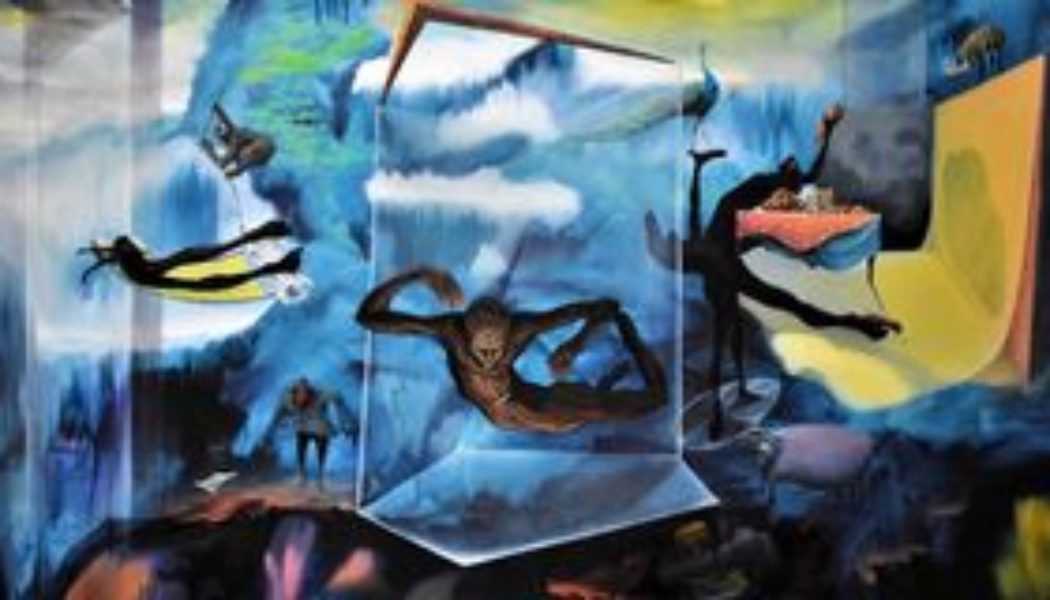
A World of Temptations oil-on-canvas artworks by Kenyan artist Boniface Maina, displayed at Circle Art Gallery in Nairobi on May 27, 2026.
Photo credit: Billy Ogada | Nation Media Group
Through collaborative projects, they identified and brought on board talented young artists whose skills enriched the collective’s growing network.
In the show, Boniface’s work of oil on canvas distinctively stands out not because of the medium used but because of his unique style of layering oil mosaics to create distinctive human figures.
His grotesque subjects have a distinct beauty to them but besides the precise layering of oil patterns, it is his application of shade, colour and transparency.
In Handle With Care, Boniface’s contribution is a compelling exploration of both colour and figuration. Viewed collectively, the works feel like a signature style reaching maturity — a body of work beginning to outlive its maker.
His recurring motif of glass, visible throughout many of his paintings, captures softness and vulnerability while simultaneously lending his subjects clarity, resilience and sharp focus.
“Over time, my work has changed from commenting on society in general to exploring human personality from an individual perspective. My current works are a departure from political commentary. Human figures remain central to my expression, but they have taken on a different appearance. Since 2016, my focus has been on deconstructing the human figure into a more transparent, basic and disfigured form. What you see now is the result of a 10-year journey focused on deconstructing the human body from the inside out.”
He adds: “I have a fascination with human anatomy especially when it comes to the muscle structure, so I started making my figures to resemble this as a form of expression.”
Michael’s work on the other hand moves inward, to the psychological and moral realm. The image of the clown transcends his body of work which is said to confront the contradictions between inner truth and outward behaviour.
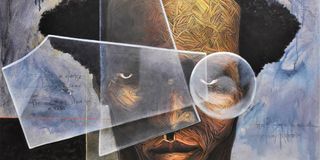
Pensive Gaze Oil, oil-on-canvas artworks by Kenyan artist Boniface Maina, displayed at Circle Art Gallery in Nairobi on May 27, 2026.
Photo credit: Billy Ogada | Nation Media Group
His work exposes the porous boundary between virtue and vice, sincerity and performance, suggesting that identity itself can become a role shaped by the expectations of others.
Here, survival is entangled with compromise, and the cost of belonging is measured against the erosion of self. His works carry with them the poignancy of looking at images sketched on an old paperback and by nature of their appearance and outlook, divine and infinite. There is a timelessness to his murals that is soft and gentle but also carefully abrasive.
David uses paper as both medium and metaphor, constructing intricate, layered subjects mirroring the complexity of human experience. His fragmented figures inhabit spaces that feel both comforting and strange, where ease is temporary and belonging is never fixed.
Working primarily through papercut techniques, his practice is a display of remarkable dexterity. It isn’t just about the stories he is telling but the delicate nature in which he is able to have different trajectories narrow down on a theme with ease. The exhibition ends on May 29.