
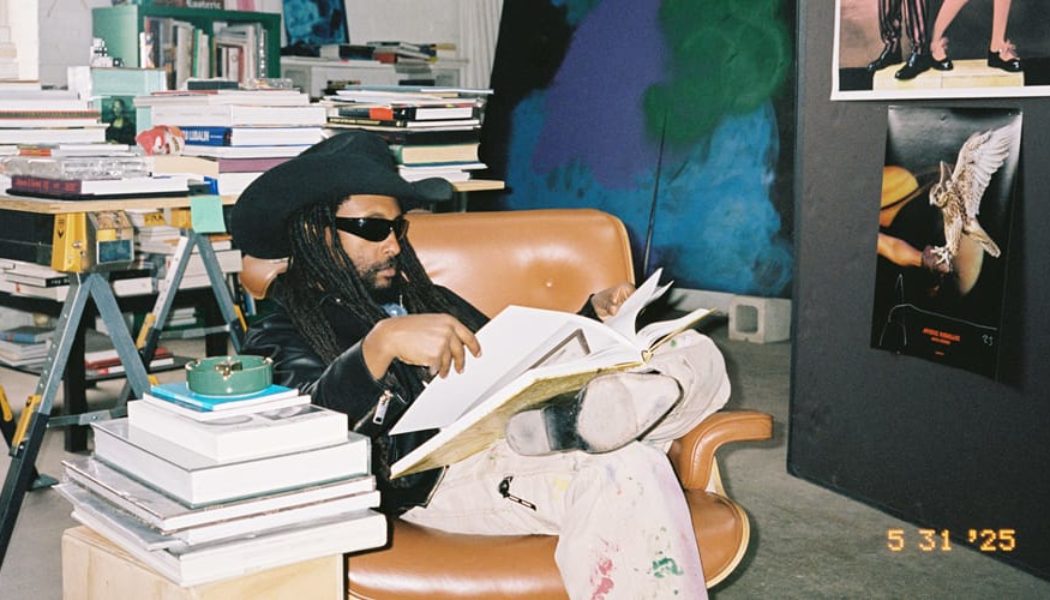
“I’m invested in creating forms that resist simplification, works that operate in layers, that embrace contradiction, spirituality, and opacity. “
What does your creative process look like on a practical level?
Research > Study > Implement a new idea into the world.
Are there specific rituals, routines, or environments you need in order to get
into a state of flow?
Good music, good reads, good Frankincense.
Are there any particular images, symbols, or references you feel have been co-opted or misused in ways that dilute their original meaning or your own relationship to them?
I’ve always been drawn to the ways symbols become emptied out, how they’re co-opted, sanitized, or commodified until their original meaning, their cultural and political charge, is stripped away. One figure I return to often is the bust of Nefertiti. To me, it isn’t simply an ancient artifact; it’s a cipher, a contested icon whose history has been displaced. In Western institutions, she’s often encased behind glass, removed from her cultural lineage and repurposed as a static emblem of idealized beauty. That kind of dislocation, where a deeply symbolic figure is transformed into a Eurocentric
fantasy, is its own form of erasure. Instead, I’m invested in creating forms that resist
simplification, works that operate in layers, that embrace contradiction, spirituality, and
opacity. The goal isn’t necessarily to merely reclaim the image, but to reanimate it, to
charge it with a renewed sense of power and presence.
We’re oversaturated with imagery today especially with AI creating content at scale. As someone deeply invested in the power of images, what concerns you most about where visual culture is heading?
I’m actually excited that the AI over saturation will ultimately lead to a revival of human made objects, images and experiences