
The sample-focused DAW gets an MPC-like hands-on interface.


Native Instruments and Ableton have had incredible success with their custom MIDI controllers that integrate with their DAWs (digital audio workstations), Maschine and Live, respectively. Native Instruments’ Maschine (yes, it’s the name of the hardware and the software) and Ableton’s Push are pretty much the gold standard for integration between music-making software and hardware. Serato is hoping it can capture even a sliver of that magic with its pairing of Slab and Serato Studio.
Plenty of others have tried their hand at building (or having others build for them) custom controllers for their DAWs — FL Studio, Studio One, and the MPC desktop suite have all gotten dedicated hardware at some point. Success, however, has been mixed. What Serato has going for it is that Studio is a relatively young and streamlined DAW with minimal bells and whistles. That means where Push and Maschine can be intimidating (and expensive) with their sprawl of buttons, pads, knobs, and sizable screens, Slab is much more approachable and affordable at $329.
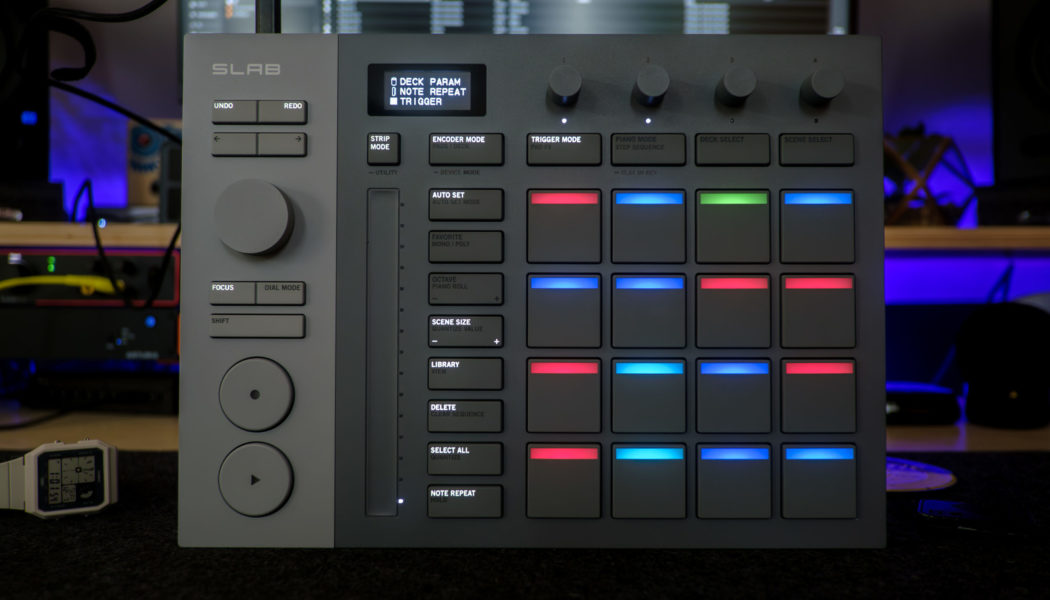
Design-wise, Slab bears more than a passing resemblance to Maschine. It’s not just that both are built around a grid of 16 pads; it’s also the layout, label placement, and font choices. If you told me Slab was built by Native Instruments instead of AlphaTheta (Serato’s partner), I wouldn’t second-guess it.
It’s a handsome enough piece of hardware, though. The gray-on-gray color palette may not be exciting, and a little hard to read under certain lighting, but the matte texture and clean lines avoid feeling purely utilitarian. Slab is all plastic, but it doesn’t feel cheap. Encoders have a good amount of resistance, the buttons aren’t mushy, and the big dial has firm detents. The screen is quite small, and while it gives you some visual feedback, you’ll never be able to compose a beat on Slab without looking at your computer. That’s to be expected of a controller in this price range, though, like the Atom SQ or MPC Studio controller.
The velocity-sensitive pads are decent, if nothing spectacular. They’re good enough for some finger drumming, but Akai’s MPC still reigns supreme in this field. I’ve found the response to be a touch inconsistent and, while AlphaTheta lists “adjustable aftertouch” as one of the features of Slab, Serato Studio does not currently support aftertouch, which is a bit shocking in 2025. The RGB lighting, though, makes it a breeze to quickly color-code your chops and drum hits so you can identify your kicks, for instance, by making them all red.
In keeping with its budget price, connectivity is barebones here — just a USB-C port for connecting to your computer. There’s no integrated audio interface or MIDI outputs, like you’d find on Maschine and Push.
What matters most is how Slab integrates with Serato Studio. The good news is that most of the DAW’s essential features are at your fingertips. I’m new to Serato Studio, and I’ve only had Slab for about two weeks, but I had little trouble quickly getting the basics down pat. It’s easy and intuitive to sequence a drum pattern or play a bassline by hand. You even have quick access to the stem separation tech that has made Serato Sample so successful.
Slab allows you to browse your library of samples or fire up plugins without reaching for your mouse or keyboard. That being said, depending on the size of your collection, it might be faster and easier to go for the mouse anyway.
It was simple and quite fun to pull in a drum break, chop it up, and start crafting a beat without leaving Slab. By the end of my first day, I’d already put together a couple of (admittedly pretty terrible) beats. While the quality of my output was questionable, I had a blast making them. Part of the reason I hadn’t really delved too deeply into Serato Studio before is that it wasn’t a particularly tactile experience.
That’s the appeal of hardware. While it might be easy to chop samples or draw a melody with a mouse, it’s just a lot more fun to hit pads and turn knobs. Slab also puts several performance-focused effects in easy reach, like a pitched looper and wah. They’re not quite as robust as what you might find on a standalone device like the SP-404 or something from Teenage Engineering, but they still spice up a jam nicely.
Where Slab loses points is in its variety of modes and shift functions. Those more familiar with Serato Studio might have an easier time than I did, but I frequently found myself confused about which mode I needed to be in to change the note repeat rate, or by the lack of visual feedback when browsing effects and sample chopping modes. And each element has its own “mode,” from the dial, to the encoders, and the touchstrip. Keeping it all straight can get a little cumbersome.
Despite Serato Studio being a relatively simple DAW focused primarily on drum programming and sample chopping, Slab can feel menu-divy at times. And while Studio does support VST and AU plugins for playing your favorite software synths, Slab offers limited control over them.
Slab is unlikely to win over many new converts. But if you’re already using Serato Studio and have been eyeing Maschine and MPC owners with jealousy, the Slab might be a decent investment. It gives you a similar hands-on experience at a reasonable price.