

Court

Celsius bankruptcy proceedings show complexities amid declining hope of recovery
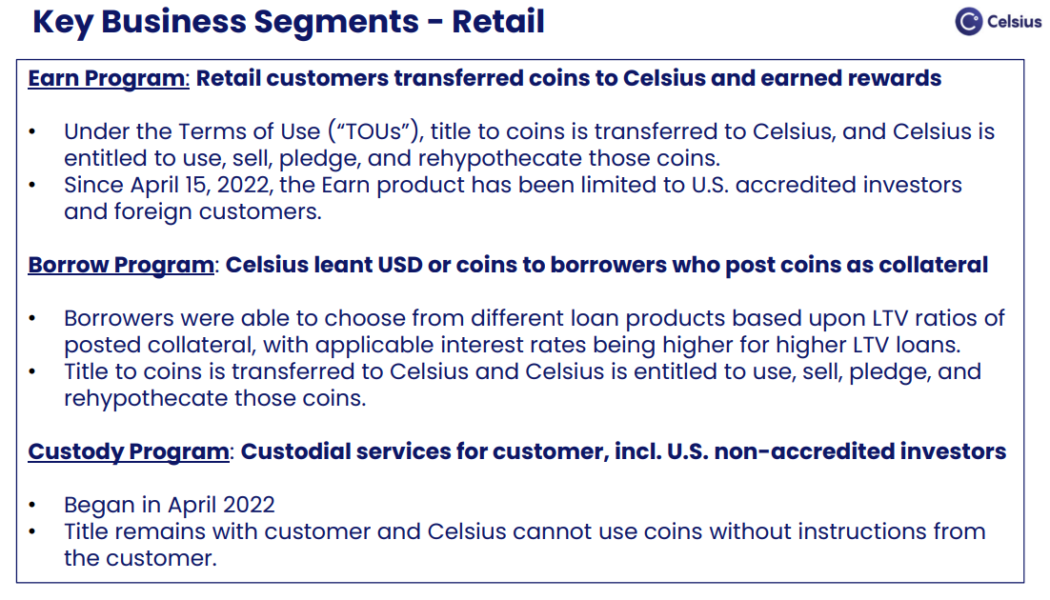
The Celsius Network is one of many crypto lending firms that has been swept up in the wake of the so-called “crypto contagion.” Rumors of Celsius’ insolvency began circulating in June after the crypto lender was forced to halt withdrawals due to “extreme market conditions” on June 13 and eventually filed for chapter 11 bankruptcy a month later on July 13. The crypto lending firm showed a balance gap of $1.2 billion in its bankruptcy filing, with most liabilities owed to its users. User deposits made up the majority of liabilities at $4.72 billion, while Celsius’ assets include CEL tokens as assets valued at $600 million, mining assets worth $720 million and $1.75 billion in crypto assets. The value of the CEL tokens has drawn suspicion from some in the crypto community, however, as t...

For greater good: NY judge allows Celsius to mine, sell Bitcoin
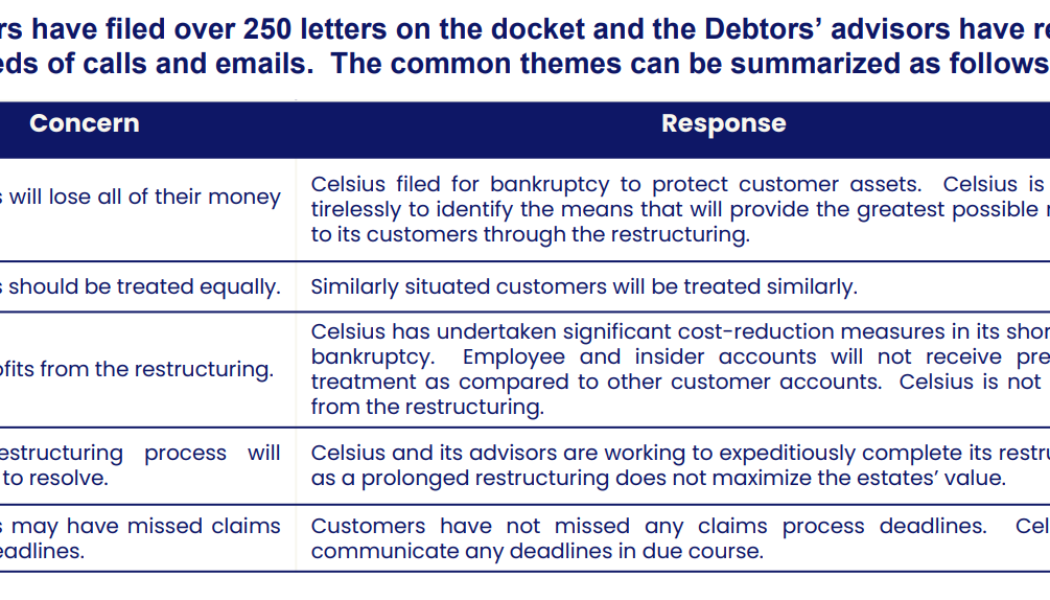
Not even 24 hours after revealing a three-month cash flow forecast that threatens total exhaustion of funds, a New York judge allowed crypto lender Celsius Network to mine and sell Bitcoin (BTC) during its bankruptcy. Since July 2022, Celsius Networks stands at the crosshair of United States officials after reports of bankruptcy surfaced, which risks losing the live savings of numerous crypto investors. Last week many got very upset with me as I said @CelsiusNetwork would run out of money & solutions needed to be acted upon faster. I was told I don’t understand Chapter 11. They have now confirmed they run out of money by October. https://t.co/CyzjgKpId7 pic.twitter.com/vBIRIGEmG2 — Simon Dixon (Beware Impersonators) (@SimonDixonTwitt) August 15, 2022 During the second day of the case h...


Crypto lender Hodlnaut seeks judicial management to avoid forced liquidation
Singapore-based crypto lending platform Hodlnaut is seeking judicial management to manage its ongoing liquidity crisis and avoid the forced liquidation of assets in the current bear market. The crypto lender informed its users in a Tuesday announcement that they have applied to the Singapore High Court to be placed under judicial management. The firm said: “We are aiming to avoid a forced liquidation of our assets as it is a suboptimal solution that will require us to sell our users’ cryptocurrencies such as BTC, ETH and WBTC at these current depressed asset prices. Instead, we believe that undergoing judicial management would provide the best chance of recovery.” Judicial management is a law in Singapore that allows financially troubled firms to rehabilitate themselves. Und...


Zipmex gets 3 month protection in Singapore amid halted withdrawals
Cryptocurrency exchange Zipmex has gotten a chance to sort out liquidity issues as a court in Singapore has granted the firm with more than three months of creditor protection. Singapore’s High Court has ruled to give each of the five Zipmex entities a moratorium until Dec. 2, 2022 to come up with a restructuring plan, Bloomberg reported on Monday. The action aims to protect Zipmex from potential creditor lawsuits during the moratorium period after the exchange abruptly halted crypto withdrawals on its platform in mid-July. The cryptocurrency has since resumed partial withdrawals from Zipmex’s trade wallet but is yet to resume all withdrawals. Zipmex sought creditor protection for a period of six months subsequently after halting withdrawals, filing five moratorium applications on July 27....


BitMEX former executive pleads guilty to violating the Bank Secrecy Act
Another top executive joins three co-founders of the crypto exchange BitMEX, pleading guilty in the United States District Court for the Southern District of New York. The court case under the headline “U.S. v. Hayes et al.” goes on for two years, with BitMEX management being indicted for violating the U.S. Bank Secrecy Act. According to the Wall Street Journal, on Aug. 8, a one-time head of business development at BitMEX, Gregory Dwyer, admitted his guilt of violating the Bank Secrecy Act in court. As part of a plea deal, Dwyer would pay a $150,000 fine. As Manhattan Attorney Damian Williams commented on this development: “Today’s plea reflects that employees with management authority at cryptocurrency exchanges, no less than the founders of such exchanges, cannot willfu...


Crypto Biz: The 3AC saga takes another bizarre twist
About eight months ago, I vouched pretty strongly for Su Zhu to be included in the prestigious Cointelegraph Top 100. My reasoning was pretty straightforward: Zhu was not only an influential figure on social media, but he ran arguably the most revered hedge fund in crypto — Three Arrows Capital, also known as 3AC. Then, the bear market of 2022 exposed 3AC as a house of cards run by founders who believed their own hype — and made reckless business decisions along the way. With the 3AC saga still unfolding, we received privileged information this week about the company’s remaining assets. The revelations aren’t good if you’re a 3AC creditor looking to be made whole again. Source claims 3AC’s Deribit exposure is worth much less than reported An anonymous source close to the 3AC debacle ...


SEC dismisses claims against John McAfee, fines accomplice for ICO promo
The United States Securities and Exchange Commission (SEC) obtained the final judgment for an initial coin offering (ICO) promotion scheme against late entrepreneur John McAfee and accomplice Jimmy Gale Watson, Jr., filed on October 5, 2020. In the original complaint, the SEC alleged that McAfee and Watson promoted ICO investments on Twitter without disclosing that they were paid for them. Watson allegedly assisted McAfee in negotiating promotional deals with ICO issuers and cashing out the crypto payments, among other pump-and-dump charges. The U.S. District Court for the Southern District of New York found Watson guilty of violating the law and imposed a cumulative fine of $375,934.86. In addition, Watson has been barred from participating in ICO-related issuance, purchase, offer o...

Celsius denies allegations on Alex Mashinsky trying to flee US
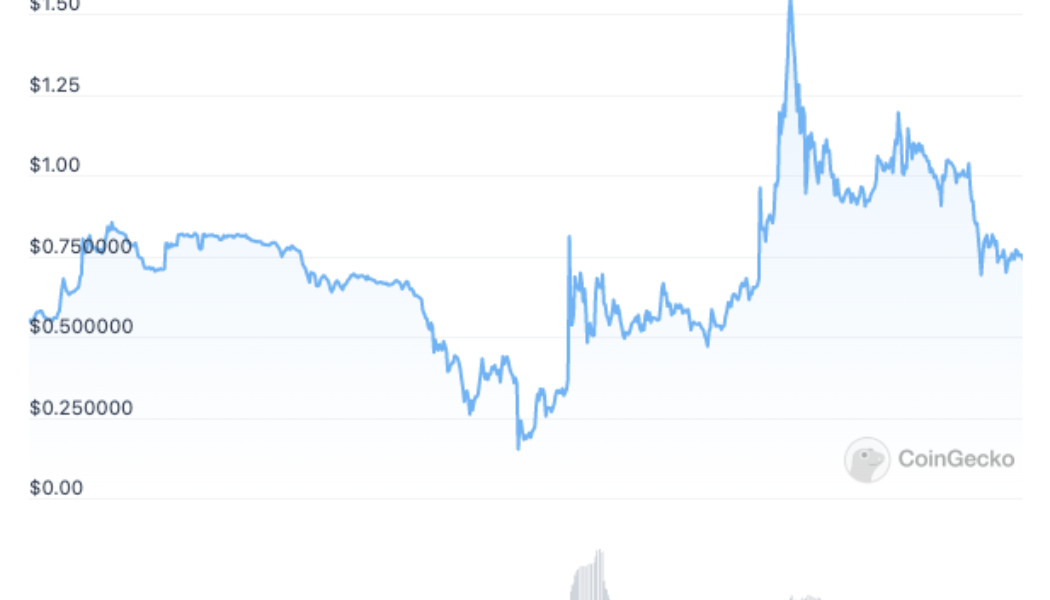
Troubled crypto lending firm Celsius is putting their best foot forward to recover operations alongside CEO Alex Mashinsky, who currently stays in the United States, the company has claimed. A spokesperson for Celsius has denied rumors that the company’s CEO tried to flee the U.S. last week amid the ongoing liquidity crisis of the Celsius Network. The representative told Cointelegraph on Monday that the firm continues working on restoring liquidity, stating: “All Celsius employees — including our CEO — are focused and hard at work in an effort to stabilize liquidity and operations. To that end, any reports that the Celsius CEO has attempted to leave the U.S. are false.” Celsius’ statement came shortly after Mike Alfred, co-founder of the crypto analytics firm Digital Assets Data, took to T...

Arthur Hayes to serve 2-year probation owning up to BitMEX’s AML mishap
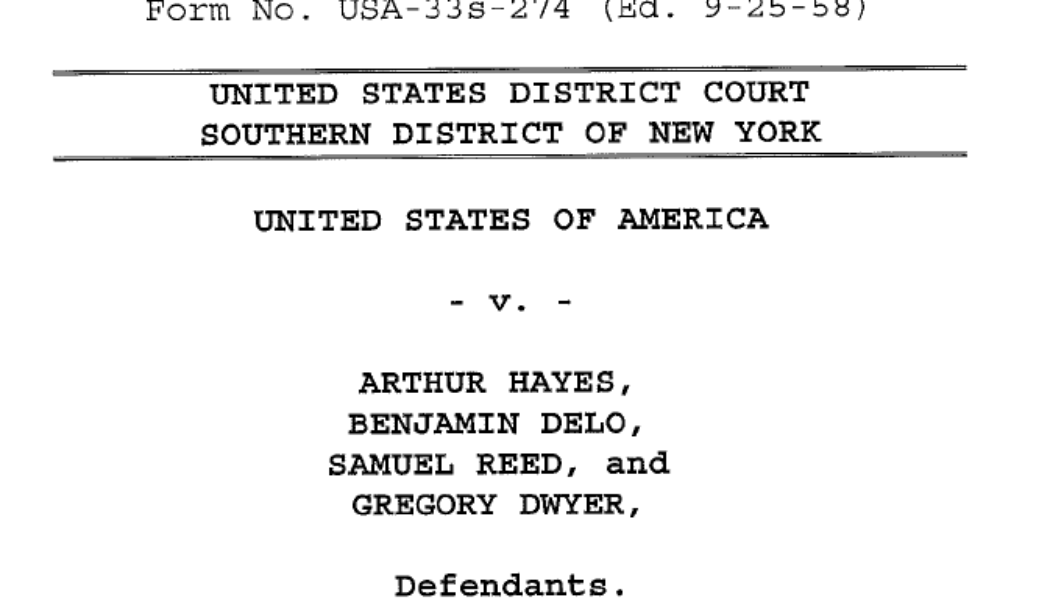
Bringing closure to the long-awaited judgment related to the money laundering activities over the BitMEX crypto exchange, one of the four federal district courthouses in New York reportedly sentenced two-year probation and six months of home detention to founder and ex-CEO Arthur Hayes. Arthur Hayes, along with the other BitMEX co-founders — Benjamin Delo and Samuel Reed — and the company’s first non-employee Gregory Dwyer, pleaded guilty to the Bank Secrecy Act (BSA) violations on Feb 24, admitting to “willfully failing to establish, implement and maintain an Anti-Money Laundering (AML) program at BitMEX.” Indictment against BitMEX co-founders and employees for violating BSA. Source: Justice.gov Pleading guilty to supporting money laundering is a punishable offense, often carrying a ...


UK Court recognizes NFTs as ‘private property’ — What now?
At the beginning of May, the British Web3 community celebrated an important legal precedent — the High Court of Justice in London, the closest analog to the United States Supreme Court, has ruled that nonfungible tokens (NFT) represent “private property.” There is a caveat, though: In the court’s ruling, this private property status does not extend to the actual underlying content that NFT represents. Cointelegraph reached out to legal experts to understand what this decision could possibly change in the British legal landscape. The theft of Boss Beauties In February 2022, Lavinia D. Osbourne, founder of Women in Blockchain Talks, wrote on Twitter that two digital works had been stolen from the Boss Beauties — a 10,000-NFT collection of empowered women that was created by “Gen Z chan...


Shanghai court affirms that Bitcoin is virtual property, subject to property rights
The Shanghai High People’s Court has issued a document in which it states that Bitcoin is subject to property rights laws and regulations. That finding was made in relation to a lawsuit filed in a district court in October 2020 involving the recovery of a loan of 1 Bitcoin (BTC). The lower court recognized Bitcoin as having value, scarcity and disposability, and therefore being subject to property rights and meeting the definition of virtual property. According to the Sina website, the Shanghai Baoshan District People’s Court ruled in favor of plaintiff Cheng Mou, ordering defendant Shi Moumou to return the Bitcoin. When the defendant failed to do so, the case was returned to the court, which held a mediation in May 2021. Since the defendant no longer had possession of the Bitcoin, t...


Chinese court rules marketplace guilty of minting NFTs from stolen artwork
A court in the Chinese city of Hangzhou ruled a one-of-a-kind judgment against a nonfungible token (NFT) marketplace for allowing a user to create (or mint) NFTs of stolen artwork. As reported by South China Morning Post, the court verdict toward the NFT marketplace was made after Shenzhen-based company Qice filed a lawsuit against NFTCN’s parent company, BigVerse. The lawsuit claimed that an NFTCN user stole a copyrighted artwork of Ma Qianli, a Chinese artist specializing in drawing and printing. The user of the NFT platform allegedly poached one of Ma’s creations of a cartoon picture. Based on the evidence collected, the court found the NFTCN platform guilty of not checking for forgery or intellectual property (IP) theft prior to allowing users to mint NFTs. As a result, NFTCN was charg...
