

crypto blog


Crypto exchange Coincheck plans Nasdaq listing in July 2023
Japanese cryptocurrency exchange Coincheck has confirmed plans to pursue a public stock offering in the United States through Nasdaq — a move that would give the company access to the country’s lucrative capital markets. In documents filed with the U.S. Securities and Exchange Commission on Oct. 28, Coincheck’s majority owner, Monex Group, confirmed that it is proceeding with Nasdaq listing procedures through a merger with special purpose acquisition company (SPAC) Thunder Bridge Capital Partners IV. If all goes according to plan, Coincheck’s Nasdaq listing will take place on July 2, 2023. Coincheck said the SPAC merger would allow the exchange to expand its crypto-asset business and gain direct access to U.S. capital markets. The technology-rich Nasdaq is one of the world’s lar...

THORChain network resumes following 20-hour chain halt
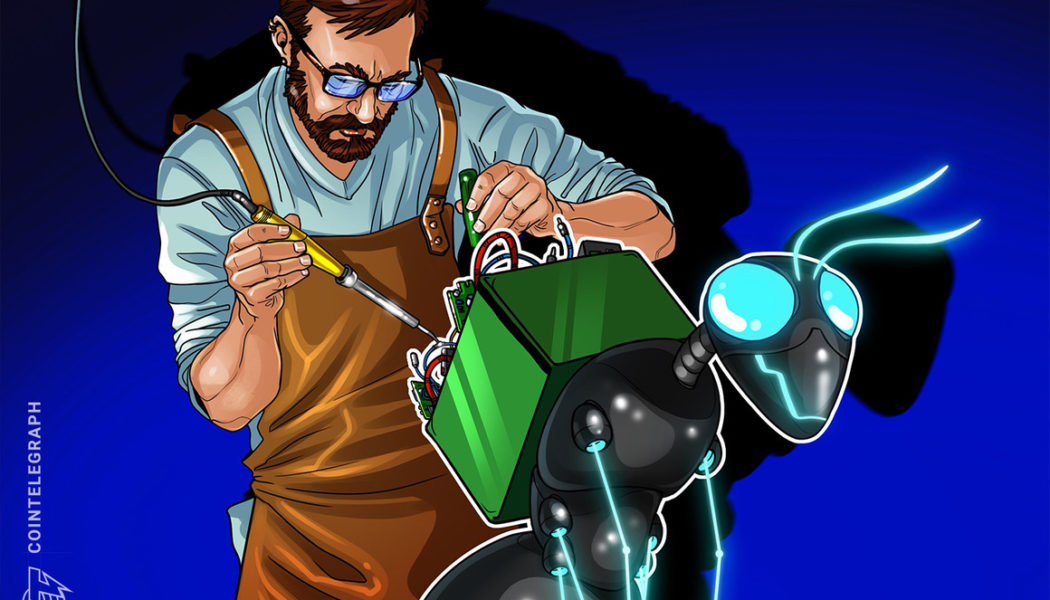
Cross-chain exchange and proof-of-bond network THORChain announced it was once again “fully operational” after an outage of more than 20 hours In an Oct. 28 tweet, the THORChain team said the network was “back online and producing blocks” and had reenabled trading. The network was halted on Oct. 27 after the team said a bug had caused “non-determinism between individual nodes.” “Turns out to be string manipulation: code was pushing a cosmos.Uint (instead of a uint64) into a string, which causes the string to get the point of the big int instead of the actual value, causing the memo string to be different on different nodes,” said the THORChain team following the chain halt. “Didn’t see this in stagenet because the bad memo never gets written to disk/block, because it gets swapped immediate...


Terra co-founder Do Kwon faces $57-million lawsuit in Singapore
Do Kwon, the co-founder of Terraform Labs who may be facing legal actions in South Korea and the United States, is the target of a lawsuit in Singapore along with the Luna Foundation Guard (LFG) and Terra founding member Nicholas Platias. In a lawsuit filed in Singapore’s high court on Sept. 23, 359 individuals allege Kwon, Platias, the LFG and Terra made fraudulent claims, including that Terra’s stablecoin, TerraUSD (UST) — now TerraUSD Classic (USTC) — was not “stable by design” and unable to maintain its U.S. dollar peg. The claimants are seeking compensation for roughly $57 million worth of “loss and damage” combined based on the value of UST tokens they purchased and held or sold amid the market downturn in May. They also request an order to pay for “aggravated damages.” According to ...

Ethereum sets record ETH short liquidations, wiping out $500 billion in 2 days
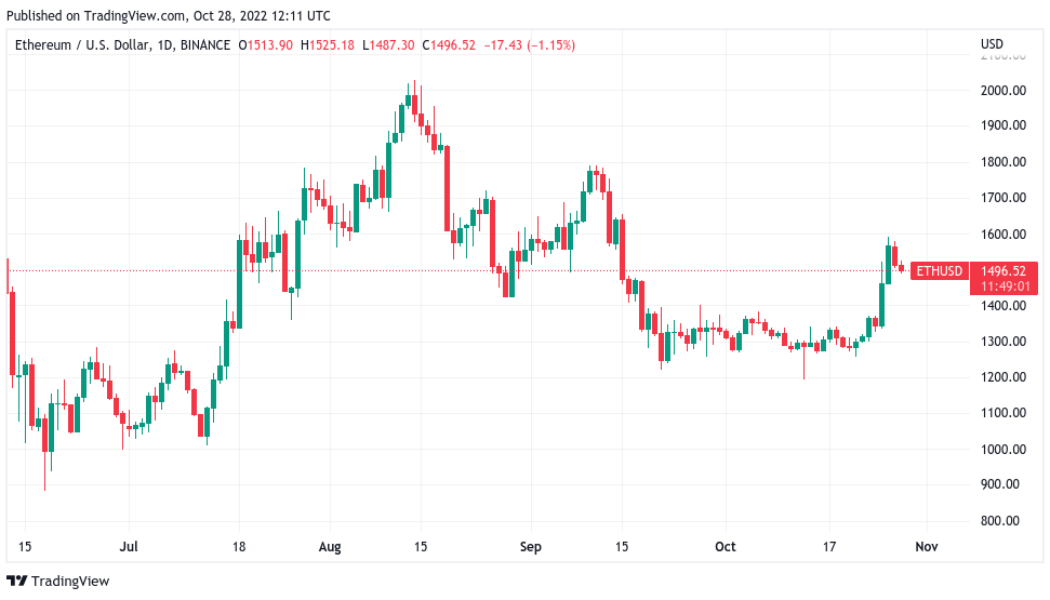
Ether (ETH) is setting liquidation records this week as a comparatively modest price uptick reveals how bearish the market has become. Data from on-chain analytics platform CryptoQuant confirmed that United States dollar-denominated short liquidations hit a new all-time high on Oct. 25. Two days, half a billion dollars of ETH shorts It is not just Bitcoin (BTC) causing the bears severe pain this week — data from exchanges also shows that Ethereum shorters have suffered heavy losses. ETH/USD delivered fairly impressive gains on Oct. 25-26, rising from lows of $1,337 to highs of $1,593 on Bitstamp before retracing, according to data from Cointelegraph Markets Pro and TradingView. ETH/USD 1-day candle chart (Bitstamp). Source: TradingView While nothing unusual for crypto and for altcoins, in ...

3 striking similarities with past Bitcoin price bottoms — But there’s a catch
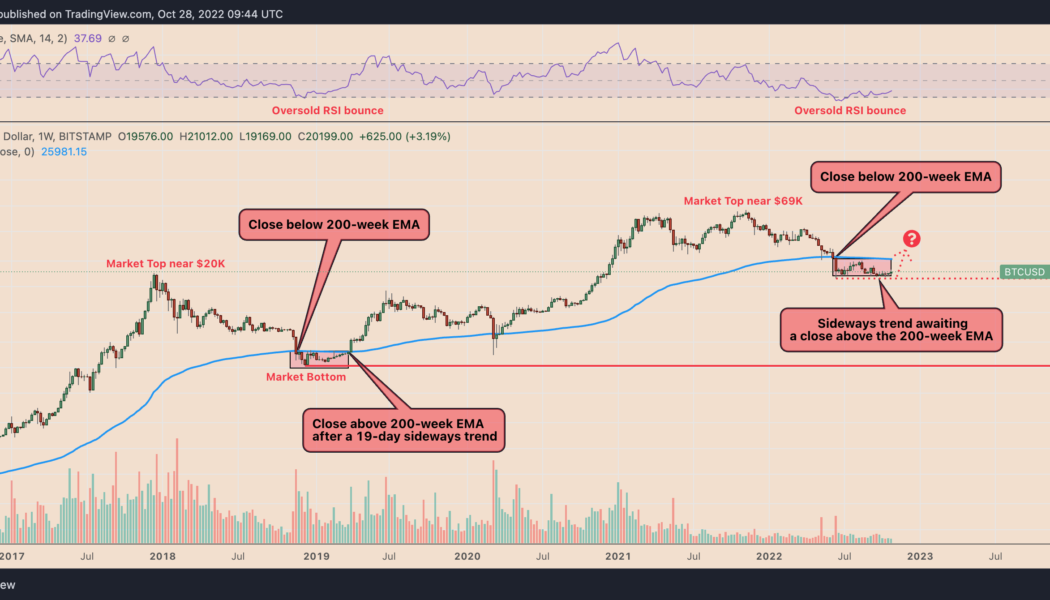
Bitcoin (BTC) has been consolidating inside the $18,000–$20,000 price range since mid-June, pausing a strong bear market that began after the price peaked at $69,000 in November 2021. Many analysts have looked at Bitcoin’s sideways trend as a sign of a potential market bottom, drawing comparisons from the cryptocurrency’s previous bear markets that show similar price behaviors preceding sharp bullish reversals. Here are three strikingly similar trends that preceded past market bottoms. 2018’s sideways trend for BTC price The 2018’s Bitcoin bear market serves as a major cue for a potential market bottom in 2022 if one looks at its eerily similar price trends and indicators. One of the key indicators is Bitcoin’s 200-week exponential moving average (200-week EMA; the blue wave in the ch...

Binance still serving Russians while seeking clarity on EU crypto sanctions
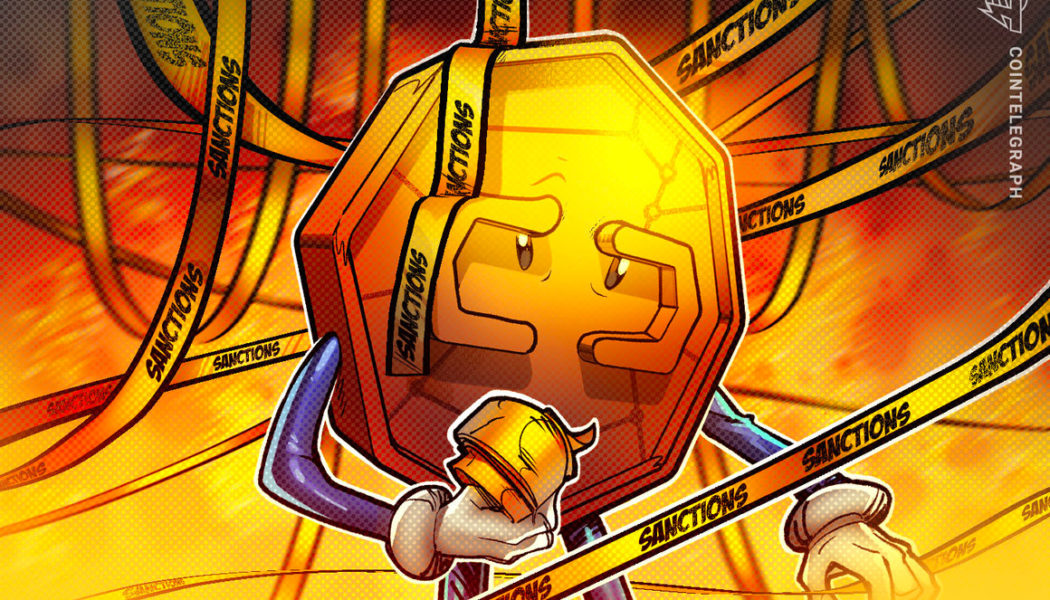
In the weeks following new sanctions from the European Union, Binance has kept its doors open for non-sanctioned Russian nationals, but that does not mean that the firm isn’t complying with EU sanctions, according to Binance’s newly-appointed sanctions executive. Western sanctions against Russia have been a major challenge for Binance from day one, and the firm has been working hard to comply, Binance’s global head of sanctions Chagri Poyraz told Cointelegraph in an interview. Since the start of Russia’s invasion of Ukraine, Binance has comprehensively blocked several non-government-controlled territories of Ukraine, including annexed regions like Donetsk and Luhansk, Poyraz said. “There is still an active war going on in the region,” he noted, adding that Binance continu...

What the Russia-Ukraine conflict has revealed about crypto
The Russia-Ukraine conflict has tested the capabilities of crypto in a real-world conflict where sanctions and inventive blockchain crowdfunding models abound. The war, which is drawing into its ninth month, has uncovered a raft of blockchain benefits, such as the capacity to support humanitarian endeavors. It has also revealed how much control national authorities can exert over crypto networks. Vadym Synegin, co-founder at IT and crypto solutions provider Tecor, told Cointelegraph that cryptocurrencies have a unique advantage in situations where there is an increased risk of money transfer interruptions due to the centralization of conventional systems. “With most markets controlled by centralized authority figures that can easily buckle under the political tensions, the crypto markets r...


Nifty News: LooksRare the latest NFT market to sack royalties, Twitter’s tweeting tiles and more
Nonfungible token (NFT) marketplace LooksRare is the latest in a string of NFT markets to do away with enforcing creator royalties by default, following the likes of Magic Eden and X2Y2. The platform tweeted on Oct. 27 that it would not be supporting creator royalties by default, instead choosing to share 25% of its protocol fees with NFT creators and collection owners. Buyers can still choose to pay royalties when purchasing an NFT but it will be on an opt-in basis. Explaining the changes, it said 0.5% of its 2% protocol fee would go to collections, as long as that collection has a receiving address for the funds. LooksRare said the willingness of buyers to pay royalties has “eroded” as a result of many NFT markets now moving to a zero-royalty model adding that these disadvantage cre...

Celsius bankruptcy case Trustee slams $3M employee bonus motion
The United States Trustee overseeing the Celsius Chapter 11 bankruptcy case, William Harrington, has objected to a Celsius motion that would see 62 of its 275 employees paid a retention bonus totaling $2.96 million. The Trustee has blasted Celsius in its supporting statement for the objection filed on Oct. 27, noting: “It defies logic, not to mention the Bankruptcy Code, that a company where the majority of its functions are no longer providing services, would now propose a multi-million dollar bonus scheme.” For the “bonus motion,” as it is aptly named, to receive approval, the Trustee claims that Celsius must show that the bonuses are reasonable based on the facts of the case. Without any identifiable metrics, the Trustee says Celsius has failed to do so. While the objection does not inf...

Ripple reports XRP holdings below 50% for the first time
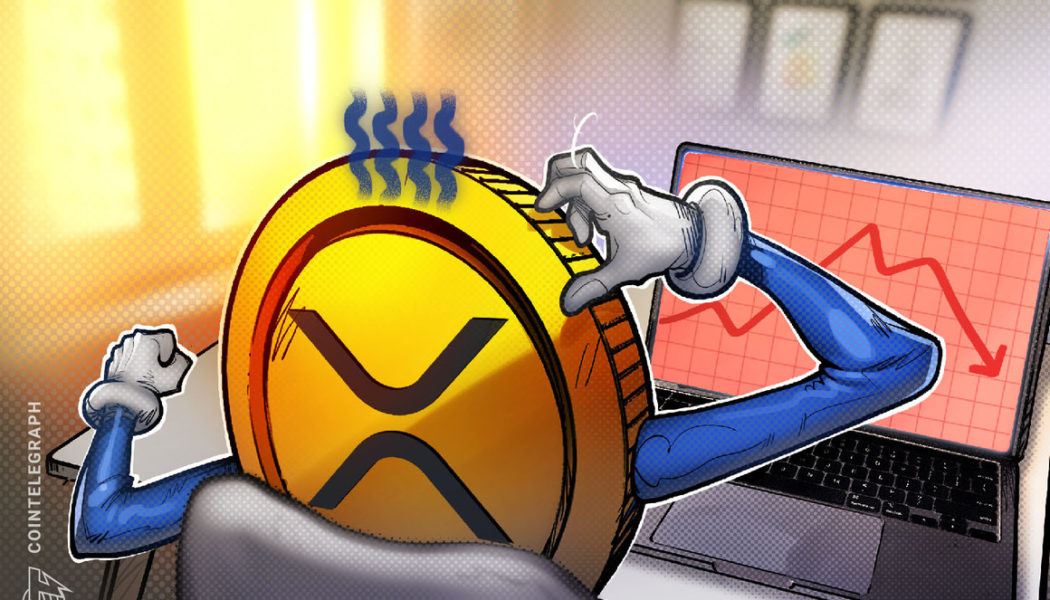
Ripple Lab’s XRP (XRP) token holdings have dropped below 50% of the total circulating supply for the first time in the company’s history. Ripple has faced criticism in the past by some that have raised questions over the firm’s significantly large ownership of XRP, arguing that it gives the company centralized control over its XRP Ledger (XRPL). In a Q3 report published on Oct. 27, Ripple once again refuted that criticism while also pointing out that its XRP holdings continue to decline, falling below 50 billion tokens, or 50% of the total supply. “Critics have pointed to the company’s XRP ownership as an indicator that the XRP Ledger is controlled by Ripple. This is not true,” Ripple stated, adding that: “The XRP Ledger (XRPL) uses Federated Byzantine Consensus to validate transactions, a...

Web3 sees 15 new scam smart contracts an hour: Solidus Labs
The Web3 and cryptocurrency space is seeing a significant amount of smart contract scams proliferating, with blockchain risk monitoring firm Solidus Labs saying it has detected on average 15 newly deployed scams every hour. Solidus Labs said on Oct. 27 that it had been monitoring 12 blockchains including Ethereum, Polygon and BNB Chain since Oct. 10, and in that time, had detected 188,525 smart contract scams. Former United States Consumer Financial Protection Bureau (CFPB) director, Kathy Kraninger, who is now Solidus’ vice president of regulatory affairs, said in the statement that “while some of the big rug pulls and scams make the news […] the full picture stemming from our data shows the vast majority of these scams go unnoticed.” The firm also shed some light on the number...


Visa’s trademark applications suggest more involvement in crypto space
Major credit card company Visa may be planning to explore digital wallet services based on two recent trademark applications. According to records submitted to the United States Patent and Trademark Office on Oct. 22, the Visa International Service Association filed two applications for its character mark to be used in software “to view, access, store, monitor, manage, trade, send, receive, transmit, and exchange” crypto assets and nonfungible tokens, or NFTs. The filings also suggested the credit card company may be exploring a move into the metaverse, with its namesake used in “virtual environments in which users can interact for recreational, leisure or entertainment purposes.” VISA has filed 2 trademark applications claiming plans for: ▶️ Managing Digital, Virtual, ...
