

Crypto news


How Web 3.0 apps must adapt to become next-gen of tech, explained
Unlike Web 2.0 applications, offerings built on Web 3.0 are enabling users with true data ownership. Web 2.0 brought about a major change to how the world views the internet, introducing online platforms like TikTok, Twitter, Meta (former Facebook) and Instagram, among others. Although valuable in the number of opportunities made available, Web 2.0 has brought concerns about data ownership. With users spending more time online, their data, including what they like, the content they create and other details about themselves, are being shared with big tech companies, many of which have been caught in data scandals in the past and paid their way out of it. Web 3.0 addresses these concerns by presenting a new reality for application usage. Leveraging verifiable, trustless, self-governing, perm...

Here’s how the Akutars NFT project hopes to redefine how culture intersects with Web3
Since the wake of the nonfungible token (NFT) boom, creators have been leaving their Web2 entities in droves and are carving their own lanes in the Web3 world. It’s not just technologists and artsy-creators who are pivoting toward Web3. For example, former American professional baseball player Micah Johnson pivoted to painting and focused his pieces on representation. In debuting his first digital piece, sä-v(ə-)rən-tē (pronounced “sovereignty’) Johnson was not only fueled by adversity but inspired by a question that would change the trajectory of his work. “Can astronauts be black?” Johnson’s four-year-old nephew asked his mother. Alas, the main character of “Akuverse” was created in February 2021. Aku is a physical depiction of the confidence and boldn...


Binance pushes back against report exchange supplied customer data to Russian government
Major crypto exchange Binance challenged the accuracy of a report, which stated one of its regional heads agreed to supply Russia’s financial intelligence unit with customer data potentially related to donations for anti-corruption and anti-Putin activist Alexei Navalny. Reuters reported on Friday that Binance’s head of Eastern Europe and Russia Gleb Kostarev met with officials from Russia’s Rosfinmonitoring, a financial monitoring service linked to the country’s Federal Security Service, or FSB, in April 2021. Kostarev reportedly agreed to a request from the government body to turn over certain user data — including names and addresses — later telling an associate he didn’t have “much of a choice” in the matter. However, another unnamed crypto exc...
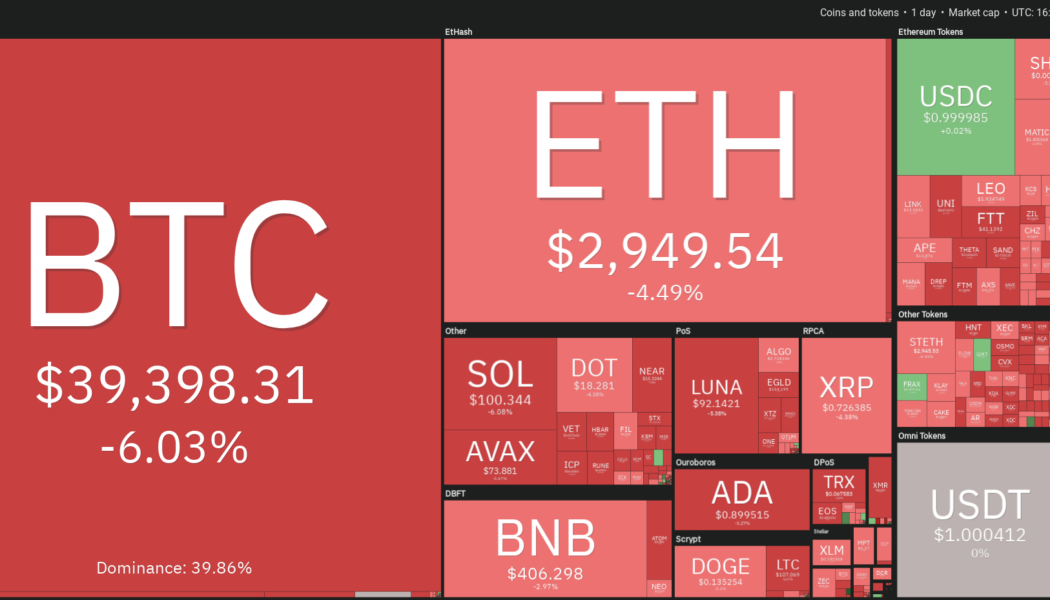

Price analysis 4/22: BTC, ETH, BNB, XRP, SOL, ADA, LUNA, AVAX, DOGE, DOT
Bitcoin (BTC) turned down sharply on April 21, maintaining its tight correlation with the U.S. equity markets, which reversed direction after U.S. Federal Reserve Chair Jerome Powell hinted that a 50 basis point rate hike was “on the table” in May. The selling has continued on April 22 as investors trim risky assets in expectation of an aggressive stance from central banks to curb surging inflation. Veteran trader Peter Brandt said in a tweet recently that the Nasdaq 100 (NDX) was showing a formation similar to the one it had made before plunging in the year 2000. If history repeats itself then the NDX could witness a sharp correction. That may be negative for the crypto markets in the short term because of the close correlation between Bitcoin and the NDX. Daily cryptocurrency market...


ETF Securities ties up with 21 Shares to launch BTC and ETH EFTs in Australia
EBTC and EETH would be the first spot ETFs tracking Ether and Bitcoin via the Australia Dollar Both ETFs are expected to go live on April 27 on the CBOE Australia exchange Exchange-traded products (ETPs) specialist firm 21Shares has joined hands with ETF Securities to launch two exchange-traded funds (EFTs) tracking the two largest digital tokens. The two would be named the ETFS 21Shares Bitcoin ETF – EBTC and the ETFS 21Shares Ethereum ETT – EETH. They would be novel EFTs to track Bitcoin and Ethereum-native Ether using the Australian Dollar directly. The exposure to cryptocurrencies that the two products will offer customers will be entirely backed by Bitcoin and Ether held in cold storage at the Coinbase crypto. The tickers will go live on April 27, listing on the CBO...

Russian tax authority proposes to use bitcoin for international payments
The Russian Federal Tax Office (RFB) has come forward with a surprising idea in the crypto law debate in Russia. According to the RFB, it is a good idea to allow companies to make international payments with crypto. Izvestia, a local newspaper, reports that the RFB submitted this as official feedback on the crypto legislation on Wednesday. “[…] to allow companies to pay foreign parties for goods and services and receive payments in digital currencies,” the RFB said in response to the first draft of the cryptocurrency bill in Russia. It could be a way to neutralize sanctions from the West. Should the proposal make it to the finish line, it would mean a significant change in Russia’s price on crypto. Cryptocurrency as an escape route As mentioned, the RFB’s proposal has the potential to comp...

Best tokens to buy under $1 on April 22, 2022
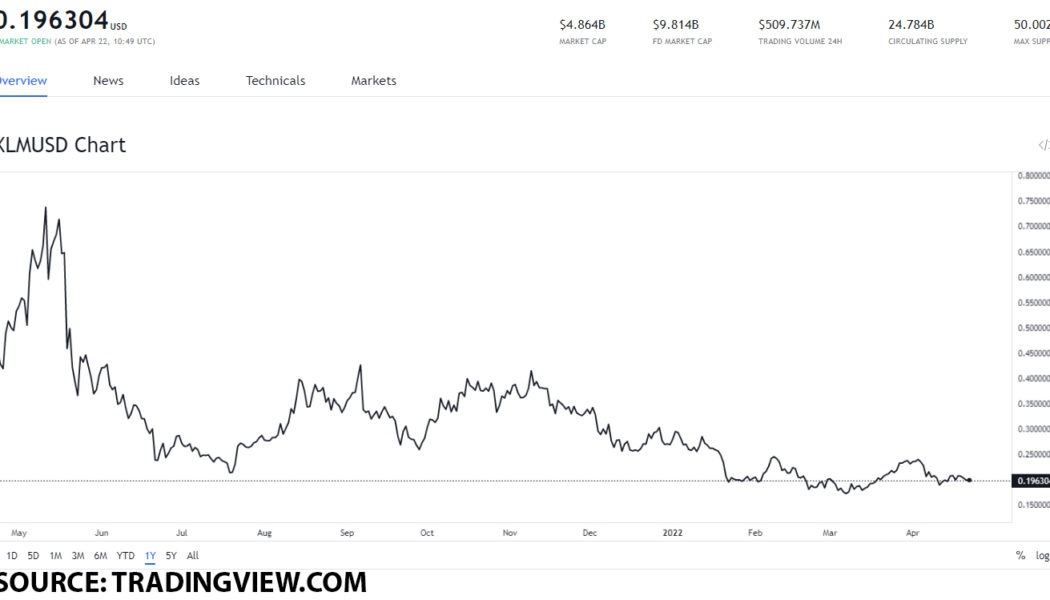
Stellar (XLM), Hedera (HBAR), Zilliqa (ZIL) and Chain (XCN) are all tokens you can get for under $1 All of these tokens have seen increases in value throughout the past month. Each token has huge potential for growth. Stellar (XLM), Hedera (HBAR), Zilliqa (ZIL) and Chain (XCN) are all tokens that are under $1, and we are going to go over each token individually so you can know what to expect when buying any one of them. Should you buy Stellar (XLM)? On April 22, 2022, Stellar (XLM) had a value of $0.196304. The all-time high value of Stellar (XLM) was on January 3, 2018, when it reached a value of $0.875563. Here, we can see that at its ATH, the token was $0.679259 higher in value or by 346%. When we go over the performance of the token throughout the previous month, Stellar (XLM) had its ...


Climate, blockchain and CBDCs: an interview with HyperLedger’s Karen Ottoni
“Cryptocurrency is just one use case for blockchain,” Karen Ottoni, director of ecosystem at Hyperledger, tells Cointelegraph in an interview during Paris Blockchain Week. From “supply chain and trade, finance and capital markets, tokenizing green bonds, tokenizing real estate,” the list of blockchain applicable ideas is numerous and growing. HyperLedger’s bread and butter is to sort through then support enterprise-grade blockchain software projects. From “managing food, fish, diamonds, minerals–the supply chain,” Ottoni told Cointelegraph. The interview took place during Paris Blockchain Week Summit. Source: Cointelegraph While HyperLedger works in every industry, for Ottoni personally, it’s the impact on climate and climate action that most inspires her. “To know whether or not the miner...


Why decentralized telecommunications is necessary to make Web3 a reality
The world knows the public internet as the best transport network and the backbone of their daily routines. However, if one looks closely, the internet is far from perfect, with many considering the network untrusted and its usage synonymous with poor reliability and performance issues. Although these faults were once overlooked, the impending Web3 revolution has led many to recognize just how far the current internet foundation is from supporting the increased usage and performance requirements that come with the metaverse, decentralized finance (DeFi) and other blockchain-technology use cases. Soon, every major company, industry and consumer experience will be shaped by the metaverse and accompanying technologies. One of the biggest gaps still yet to be filled is a network that can...


Polygon launches ‘Supernet’ chains, pledges $100M to Web3 developers
Ethereum scaling solution Polygon has launched a new network for Web3 development, pledging $100 million to early users who can help fast-track adoption. The Polygon Supernet chain gives developers the ability to build their projects in a customizable environment without hosting or operational costs, the company announced Friday. Developers will be able to deploy their projects on either a Supernet Sovereign Chain or Supernet Shared Security Chain — the former is managed by a single validator, which reduces maintenance costs, whereas the latter offers an easier path to decentralization with professional validators staking MATIC tokens to validate the network. Although supernets rely on Polygon Edge, a development framework for projects that want to create and deploy their own blockch...


Quantum computing to run economic models on crypto adoption
By many accounts, quantum computing (QC), which uses atomic “spin” instead of an electrical charge to represent its binary 1’s and 0’s, is evolving at an exponential rate. If QC is ever realized at scale, it could be a boon for human society, helping to improve crop yields, design better medicines and engineer safer airplanes, among other benefits. The crypto sector could profit too. Just last week, for instance, a Bank of Canada-commissioned project simulated cryptocurrency adoption among Canadian financial organizations using quantum computing. “We wanted to test the power of quantum computing on a research case that is hard to solve using classical computing techniques,” said Maryam Haghighi, director of data science at the Bank of Canada, in a press release. But, othe...


EU officials considered Bitcoin trading ban to enforce proposed mining ban
European Union (EU) officials discussed banning Bitcoin trading during a debate on a proposal to ban Proof of Work mining according to documents obtained through a freedom of information request. According to a report, published by German digital culture organization Netzpolitik, officials from the EU went as far as suggesting that an all out ban on trading Bitcoin (BTC) should be enforced in order to curb its overall energy consumption. The most worrying comments from the crypto community’s perspective came from a document that detailed the minutes from an EU meeting with Sweden’s financial supervisor and an environmental protection agency in which officials suggested that regulators pressure the Bitcoin community to switch to a Proof of Stake (PoS) mechanism, instead of its current...
