

Crypto news


Crypto strategist says XRP could blow after its SEC brawl – Here’s his argument
A top analyst has predicted that XRP will ‘rocket’ after the pending legal issues with the SEC are resolved Credible Crypto, as he is known on his socials, predicted XRP to peak the $20 to $30 range in this cycle A largely-followed crypto analyst and trader has predicted that XRP will explode after the legal matters between Ripple Labs and the US Securities and Exchange Commission (SEC) are settled. The pseudonymous crypto analyst, Credible Crypto, recently linked up with Thinking Crypto’s Tony Edwards and analysed a few coins based on their performance in the market, including the Ripple-affiliated XRP. Analyst advises getting in before its too late The crypto strategist observed that at the moment, XRP is looking bearish in the charts, and he expects its price...


Protesters migrate to crypto fundraising platform following GoFundMe ban
Truckers protesting the COVID-19 vaccine mandate in Canada have turned to Bitcoin-based crowdfunding platform Tallycoin, following a barrage of mounting political pressure from all sides that culminated in GoFundMe axing their “Freedom Convoy Campaign.” GoFundMe pulled the campaign and $9 million in donations on Friday in response to reports of violence, which it claimed broke its terms of service. Initially, donors needed to apply to have their funds refunded. However, following a flurry of criticism, the platform backtracked on Saturday, deciding it would automatically refund donors instead. Shortly after GoFundMe axed the campaign, a group of the organizers moved their efforts to Tallycoin, a crowdfunding platform built on the Bitcoin (BTC) blockchain. “Legacy financial infrastructure c...
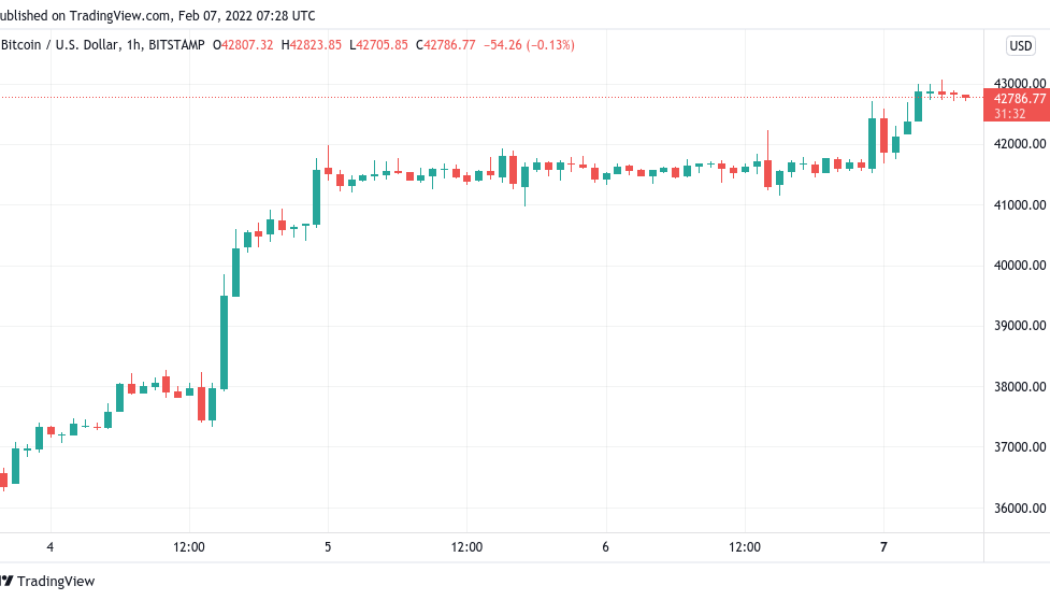

BTC price returns to $43K — 5 things to watch in Bitcoin this week
Bitcoin (BTC) is in a fighting mood this week as the weekly close buoys bulls’ cause and wipes out several weeks of downside — can it continue higher? After challenging $42,000 over the weekend, there was a cautious sense of optimism as higher levels remained in play. Sunday saw a fresh push, with overnight progress attacking $43,000 before fresh consolidation. With Monday’s Wall Street open primed to deliver more of the turbulence in big tech stocks seen late last week, the environment for crypto traders is an interesting one in February. With its notable positive correlation, Bitcoin is thus sensitive to moves up and down — but equities refuse to move unanimously in the same direction. Looking for guidance, hodlers will still remember January’s lows, and these are also fresh in the mind ...


RSS3 aims to be the decentralized information processor of Web3
Really Simple Syndication (RSS), the first information distribution protocol that saw massive adoption across the internet, is all set to take on Web3 with a decentralized information processing protocol called RSS3. In a technical white paper released on Monday, RSS3 laid out plans for taking its popular internet feed update to Web3. RSS3 would offer every entity an RSS3 file that will act as source data and be updated continuously. The source data file then can be used as an aggregation of all the cyber activities, which can then be used to build out social media, content networks, games and other data-driven applications. The source data will have control over what information to broadcast and what to keep private. RSS is a feed file containing a summary of a website’s updates, usu...


Venezuelans reportedly hit by new Bitcoin tax of up to 20%
The Venezuelan government has approved a new tax bill aiming to collect up to 20% in taxes from cryptocurrency transactions, according to local reports. Venezuela’s National Assembly held a second discussion session on Thursday for a new draft bill targeting taxes on “large financial transactions” in cryptocurrencies like Bitcoin (BTC). The Venezuelan government reportedly approved the draft bill last Thursday, requiring local firms and individuals to pay up to 20% for operations carried out in cryptocurrencies as well as foreign currencies such as the United States dollar. Filed on Jan. 20, the draft law aims to collect 2%–20% from transactions in any currencies other than those issued by the Bolivarian Republic of Venezuela, or the Venezuelan bolivar and the country’s oil-backe...


Lost Bitcoin may be a ‘donation,’ but is it hindering adoption?
Cryptocurrency custody solutions have become a big business over the last few years. Independent storage and security systems meant to hold large quantities of crypto on behalf of clients can bring in institutional capital and retail investors waiting on the sidelines simply because they remove a major fear: losing access to funds that become unrecoverable. Because of the decentralized nature of major blockchains like that of Bitcoin or Ethereum, whenever a user loses access to their wallet and doesn’t have a backup of their private keys, the funds within it cannot be recovered. There’s no central entity to turn to, and no one can control the blockchain to give anyone access back to their funds. Storing a private key can be challenging, as it needs to be kept away from bad actors, yet clos...


What is Harmony (ONE) blockchain and why it is getting so much traction?
Harmony is getting a lot of traction because it addresses core blockchain concerns, is energy-efficient, has cross-chain capabilities, offers lower gas fees and has a huge potential for nonfungible tokens (NFTs). Maintain decentralization and security Harmony thinks its network can scale while maintaining decentralization and security because it uses sharding, which divides validators into multiple groups and allows them to approve transactions and new blocks simultaneously. Harmony can now process 2,000 transactions per second (TPS), which is comparable to Visa, ONE of the world’s largest payment networks. Harmony believes it will process 10 million TPS in the long run. On the other hand, Harmony does not compromise security or decentralization even as it scales. For example, the ne...


Meta-Marriage: Decentraland hosts first Metaverse wedding
A Phoenix couple tied the knot with their digital identities this weekend in the first marriage to take place in the Metaverse. The wedding ceremony took place in Decentraland, complete with witnesses, Supreme Court Justice officiant Clint Bolick, and a virtual crowd of 2,000 guests on Feb. 5. The bride and groom, Ryan and Candice Hurley hired Rose Law Group to legally formalize the marriage. The group’s Founder and President Jordan Rose claims it was the first-ever wedding hosted on any blockchain-based Metaverse. That much anticipated wedding @decentraland @decentraspots @DCL_Events @peopleofdcl @Decentralovers @DCLDating @WearablesDCL @roselawgroup Congrats Ryan and Candice!!! pic.twitter.com/RA7oG9Qmcq — Kanard Azul (@KanardAzul) February 5, 2022 “Because the metaverse is still in its ...


BuzzFeed backlash after ‘doxxing’ of Bored Ape Yacht Club founders
American Internet media and entertainment company Buzzfeed has revealed the identities of two of the four original Bored Ape Yacht Club (BAYC) NFT collection founders “Gordon Goner” and “Gargamel” as being Greg Solano and Wylie Aronow in real life. Journalist Kate Notopoulos authored the Feb. 4 article, which was entitled “We Found The Real Names Of Bored Ape Yacht Club’s Pseudonymous Founders.” Notopoulos was able to uncover the pair’s identities by search the publicly available records of Yuga Labs, the company behind the collection. Yuga was incorporated in Delaware with an address associated with Greg Solano, and other records pointing to Wylie Aronow. Got doxxed against my will. Oh well. Web2 me vs. Web3 me pic.twitter.com/uLkpsJ5LvN — GordonGoner.eth (@GordonGoner) February 5, 2022 T...


Crypto rug pulls: What is a rug pull in crypto and 6 ways to spot it
There are several clear signs that investors can watch out for to protect themselves from rug pulls such as the liquidity not being locked and no external audit having been conducted. The following are six signs users should watch out for to protect their assets from crypto rug pulls. Unknown or anonymous developers Investors should consider the credibility of the people behind new crypto projects. Are the developers and promoters known in the crypto community? What is their track record? If the development team has been doxxed but isn’t well known, do they still appear legitimate and able to deliver on their promises? Investors should be skeptical of new and easily faked social media accounts and profiles. The quality of the project’s white paper, w...


Chainalysis report finds most NFT wash traders unprofitable
Nonfungible tokens (NFT) have taken the world by storm, resulting in mainstream interest and greater adoption of cryptocurrency. According to blockchain analysis firm Chainalysis, NFT popularity skyrocketed in 2021. Chainalysis’ “NFT Market Report” shows a minimum of $44.2 billion worth of cryptocurrency sent to Ethereum smart contracts associated with NFT marketplaces and collections last year. The report notes that this number was $106 million in 2020. While impressive, increasing scams and fraudulent activities have infiltrated the NFT space. For instance, major NFT marketplace OpenSea recently announced that its free minting tool was prone to misuse. As a result, OpenSea shared that 80% of NFTs created using this tool were either plagiarized, fake or spam. If that wasn’t bad enough, Ch...


DAOs: Where humans may fail, AI could succeed
Decentralized autonomous organizations (DAOs) offer a new way of organizing businesses in a non-hierarchical structure that encourages participation from every member of a community. With no central leadership and decisions made collectively, DAOs could revolutionize the way we think about work, but their implementation is not without challenges. The term DAO is sometimes used to refer to a system of software processes that coordinates and operates itself in a fully automated way, relying on humans only indirectly via outsourcing specific pieces of work to them as needed. The classic example would be a blockchain-based network that sells file storage space or machine learning model training services, advertising its wares, renting hardware, accepting payment and so forth via automate...
