

Crypto news


BlackRock CEO: FTX Token caused downfall, but tech still revolutionary
The CEO of the worlds largest asset management firm, BlackRock, believes that the reason why FTX failed is because it created its own FTX Token (FTT), which was centralized and therefore at odds with the “whole foundation of what crypto is.” Larry Fink, who serves as chairman and CEO of the $8 billion investment company — made the remarks during New York Times’ 2022 Dealbook Summit held on Nov. 30, and added that despite his belief that FTX’s own-created token caused its downfall, he believes that crypto and the blockchain technology which underpins it will be revolutionary. BlackRock CEO Larry Fink speaking at the 2022 DealBook Summit. Source: New York Times. Centralized exchange tokens, such as Binance Coin (BNB) and fellow exchange Crypto.com’s Cronos (CRO), account for over $57 b...


Bankman-Fried claims: ‘I unknowingly commingled funds’ at DealBook Summit
Former FTX CEO Sam Bankman-Fried has claimed to have “unknowingly commingled funds” between Alameda and customer funds at FTX. Bankman-Fried was speaking at the New York Times’ DealBook Summit via video conference on Nov. 30, in which journalist Andrew Sorkin noted “there appears to be a genuine commingling of the funds that are FTX customers that were not supposed to be commingled with your separate firm.” Sam Bankman-Fried speaking at the New York Times’ DealBook Summit. Source: New York Times Bankman-Fried denied knowing about the commingled funds and blamed it on poor oversight. “I unknowingly commingled funds […] I was frankly surprised by how big Alameda’s position was which points to another failure of oversight on my part and failure to appoint someone to be chiefly in ...


Huobi, Poloniex announced strategic partnership despite initial denials of a merger
Huobi and Poloniex announced a strategic partnership on Nov. 30. Reports of a planned merger of the two cryptocurrency exchanges emerged and were denied last week. The two exchanges will “progressively cooperate” on Huobi’s HT coin ecosystem development, connectivity, liquidity sharing and global compliance. Beginning in December, the Huobi Advisory Board will make a monthly evaluation of all Poloniex projects, with top performers potentially directly listed on Huobi, the exchange stated. Talk of a merger began with a tweet from Wu Blockchain. Poloniex is by far the larger of the two exchanges. It is not available to U.S. users. The Poloniex exchange, which Justin Sun acquired from Circle in 2019, will merge with his recently acquired Huobi exchange, according to sources familiar wit...
Huobi, Poloniex announced strategic partnership despite initial denials of a merger
Huobi and Poloniex announced a strategic partnership on Nov. 30. Reports of a planned merger of the two cryptocurrency exchanges emerged and were denied last week. The two exchanges will “progressively cooperate” on Huobi’s HT coin ecosystem development, connectivity, liquidity sharing and global compliance. Beginning in December, the Huobi Advisory Board will make a monthly evaluation of all Poloniex projects, with top performers potentially directly listed on Huobi, the exchange stated. Talk of a merger began with a tweet from Wu Blockchain. Poloniex is by far the larger of the two exchanges. It is not available to U.S. users. The Poloniex exchange, which Justin Sun acquired from Circle in 2019, will merge with his recently acquired Huobi exchange, according to sources familiar wit...


The metaverse is happening without Meta’s permission
In changing the name of its parent company to Meta, Facebook put a stake in the ground: It would be the symbol of the evolution of the internet, the metaverse. Whether we liked it or not. According to Meta, the metaverse is “a set of digital spaces to socialize, learn, play and more.” Its first true attempt came in the form of Horizon Worlds, a virtual reality universe so lifeless and devoid of content that it has people asking if the metaverse is a step forward or backward. Thankfully, it won’t matter. The metaverse, a term from long before Facebook existed, is happening. Its potential and draw are found in existing places — games like Fortnite, platforms like Roblox and online hubs like Discord. There will be no launch of the metaverse, no switch that turns it on. You’ve been experiencin...
The metaverse is happening without Meta’s permission
In changing the name of its parent company to Meta, Facebook put a stake in the ground: It would be the symbol of the evolution of the internet, the metaverse. Whether we liked it or not. According to Meta, the metaverse is “a set of digital spaces to socialize, learn, play and more.” Its first true attempt came in the form of Horizon Worlds, a virtual reality universe so lifeless and devoid of content that it has people asking if the metaverse is a step forward or backward. Thankfully, it won’t matter. The metaverse, a term from long before Facebook existed, is happening. Its potential and draw are found in existing places — games like Fortnite, platforms like Roblox and online hubs like Discord. There will be no launch of the metaverse, no switch that turns it on. You’ve been experiencin...


Axie Infinity is toxic for crypto gaming
Blockchain gaming is only four years old — a toddler compared to the rest of the industry. It has a lot of growing up to do, particularly when it comes to play-to-earn games. I’m a 28-year game industry veteran. I’ve produced 32 titles in that period of time on everything from Sega Genesis to Oculus Rift. Some of them were great. Many were forgettable. I didn’t hear much chatter about blockchain gaming from traditional developers and players until Axie Infinity began to take off. Cut to the peak of 2021, and the game had nearly 2 million players logging on daily. Most people outside the crypto community at the time were (and still are) extremely skeptical about blockchain’s ability to add anything meaningful to games. They see Axie as an example of the low production values and...
Axie Infinity is toxic for crypto gaming
Blockchain gaming is only four years old — a toddler compared to the rest of the industry. It has a lot of growing up to do, particularly when it comes to play-to-earn games. I’m a 28-year game industry veteran. I’ve produced 32 titles in that period of time on everything from Sega Genesis to Oculus Rift. Some of them were great. Many were forgettable. I didn’t hear much chatter about blockchain gaming from traditional developers and players until Axie Infinity began to take off. Cut to the peak of 2021, and the game had nearly 2 million players logging on daily. Most people outside the crypto community at the time were (and still are) extremely skeptical about blockchain’s ability to add anything meaningful to games. They see Axie as an example of the low production values and...


LBRY says it ‘will likely be dead’ following SEC loss
The firm behind the decentralized content platform LBRY said its days are likely numbered following its recent loss against the United States Securities and Exchange Commission (SEC) in court. It is specifically LBRY Inc that must die, the LBRY protocol and blockchain will continue. pic.twitter.com/SWwbqTq9In — LBRY (@LBRYcom) November 29, 2022 The SEC initially took LBRY Inc to court in Mar. 2021 over its LBRY Credit (LBC) tokens, alleging that the firm had been conducting unregistered securities offerings since 2016. The SEC ultimately won that battle last month on Nov. 7, after a judge deemed the tokens to be securities in a major blow to the industry. Providing an update on the state of the business via Twitter on Nov. 30, LBRY Inc explained that the company “will likely be ...
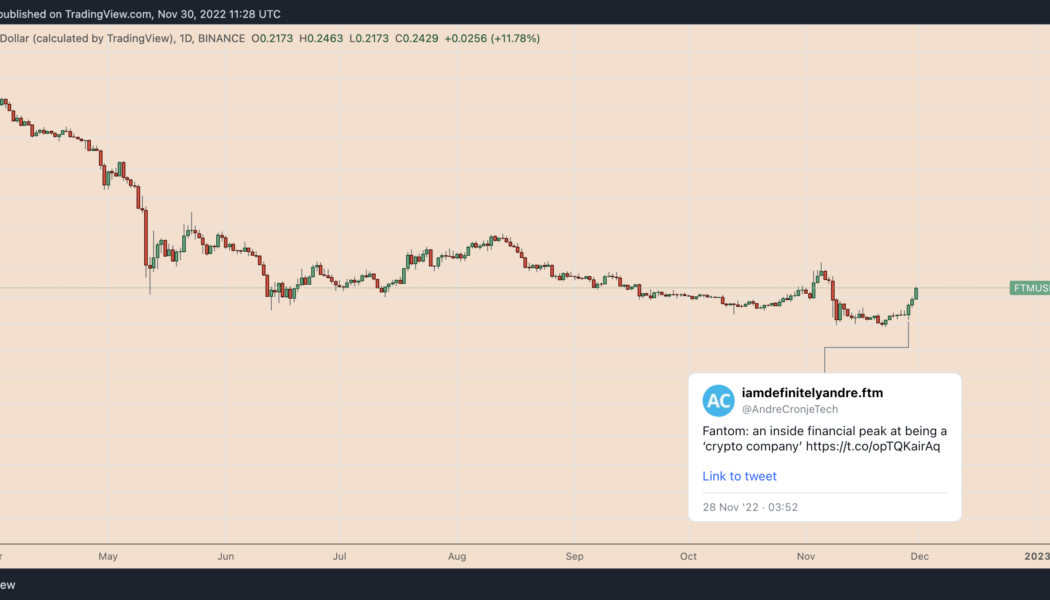

FTM price rebounds 50% as Fantom reveals 30 years runway (without having to sell its token)
Fantom (FTM) continued its upward momentum on Nov. 30 amid reports that the Fantom Foundation generates consistent profits and has 30 years of runway without having to sell any FTM tokens. Fantom’s FTM holdings up from 3% to 14% FTM price gained nearly 13.5% to reach $0.24, its highest level in three weeks. The rally came as a part of a broader rebound trend that started when it bottomed out at around $0.17 on Nov. 22. This amounts to a 50% price rebound in the last eight days. Interestingly, the rally picked up momentum after the Fantom Foundation’s “Architect,” Andre Cronje, released the firm’s financial records on Nov. 28, revealing that it had $340 million worth of digital assets and had been earning over $10 million annually. Notably: ...

Uniswap launches NFT marketplace aggregator
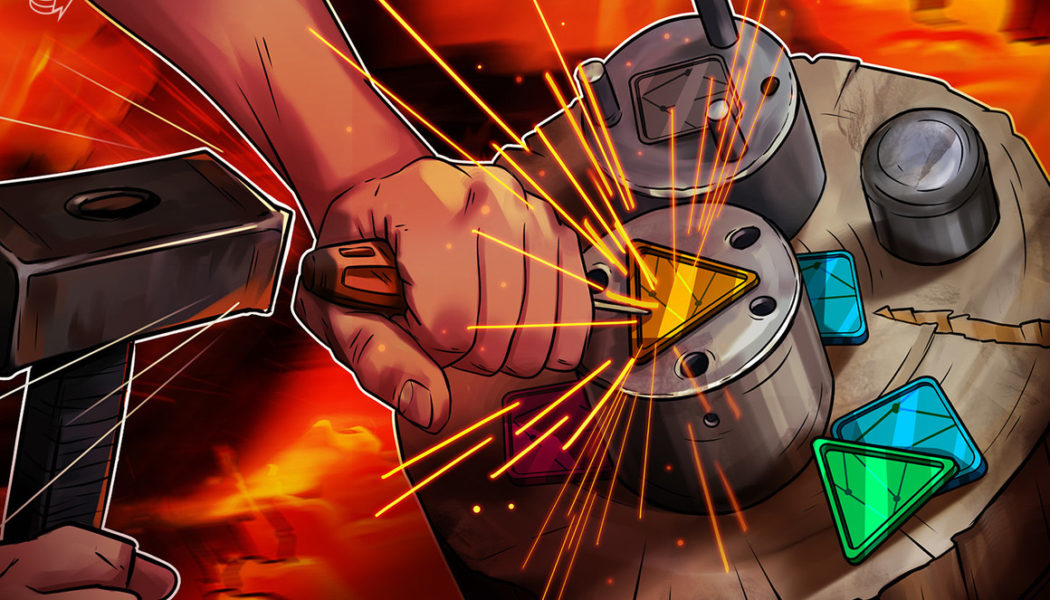
According to a new post on November 30, decentralized exchange (DEX) Uniswap announced that users can now trade nonfungible tokens, or NFTs, on its native protocol. As told by Uniswap, the function will initially feature NFT collections for sale on platforms including OpenSea, X2Y2, LooksRare, Sudoswap, Larva Labs, X2Y2, Foundation, NFT20, and NFTX. “To bring users the first-rate experience they’ve come to expect with Uniswap, we built the aggregator to deliver better prices, faster indexing, more unassailable smart contracts, and efficient execution.” Uniswap developers claim that users can save up to 15% on gas costs compared to other NFT aggregators when using Uniswap NFT. unifies ERC20 and NFT swapping into a single swap router. Integrated with Permit2, users can swap...


Secret Network resolves network vulnerability following white hat disclosure
On Nov. 30, Guy Zyskind, CEO of privacy smart contract blockchain Secret Network, said that developers had patched a privacy-related vulnerability and users’ funds remain secure. In a document dated Nov. 29, Secret Network wrote that users or developers required no action and that all active nodes were upgraded to correct the exploit on Nov. 2. 2/ You can read the post for the main details, but the important part is that the vulnerability was mitigated and unlikely to have been exploited. Most importantly, funds were never at risk, because Secret intentionally does not rely on SGX for correctness – only privacy. — Guy Zyskind (@GuyZys) November 29, 2022 The sequence of events, unveiled late yesterday by the Secret Network developers, began when a group of white-hat computer sci...
