

Spotify

Apple Music pays one penny per stream
Engadget Apple Music’s payment rate for artists and labels is fundamentally a penny per stream, according to a letter from the company posted on its artist dashboard and first reported by the Wall Street Journal. That payment rate is higher than Spotify, which has a confusing variable rate scheme that basically tops out at a half-penny per stream. Announcing a penny-per-stream rate is a nice PR win for Apple Music, since it is 1. very simple and 2. Spotify hates talking about its per-stream payments, which the company insists are a misleading figure. Seriously, it just launched an entire website called Loud&Clear last month designed to help artists and fans understand how payments work, and a good chunk of it is devoted to explaining why per-stream rates are not the right thing to focu...


Kitchen Rave: Spotify Data Proves That Despite Uncertain Times, Dance Music Thrived During the Pandemic
This year in numbers has shown that dance music has the ability to meet any moment. A new data-driven blog post by Spotify takes us behind the scenes to showcase the dance music boom happening online, despite uncertainties posed by the global COVID-19 pandemic. There seems to be a new sense of optimism in the air, especially with vaccines in distribution, that life will once again return to normal. January seemed to mark the start of a meteoric trend, as 80,000 Spotify playlists have since been created worldwide with “dance” included in the title. In some areas like the UK, the trend towards dance streaming is accelerating, with a 26% increase in playlists containing “kitchen rave” in the title having been created in the last 90 days alone. Familiar faces are l...

Spotify Is Rolling Out Voice Control Functionality: Just Say “Hey Spotify”
The Spotify experience is now hands-free. In a move to step up their “voice” game, the music streaming giant has implemented the use of a wake word that will allow users to navigate within the app upon command. Simply saying “Hey Spotify” now yields an on-screen prompt to try saying the name of a playlist, artist, or song. The wake word function will only activate if the app is open and presently onscreen. Even as music is playing, using the function will allow users to redirect with ease. Big tech sleuth Jane Manchum Wong first discovered that Spotify was working on such a feature back in early 2020. From the looks of her screenshots, the final product presently rolling out to users seems to be vastly similar to what she had uncovered at the time. Digit...

What Spotify Ratifying Ringer & Gimlet Unions Means for Music’s Labor Movement
“This is not just a significant victory, it’s also an innovative victory,” Bronfenbrenner says. “There’s language that prioritizes those that needed it the most. They’re fighting for the lowest-paid workers, workers of color and LGBTQ workers.” In recent years, unions have struggled to gain traction at Big Tech companies: Amazon warehouse workers lost an election Friday (April 9) to join the Retail, Wholesale and Department Store Union; Google workers formed the Alphabet Union in January, but it has only 700 members in a company of 130,000 employees. And although music workers aren’t specifically impacted by the Spotify ratifications, the streaming service’s action is the latest in recent small but positive signs for labor movements after indie rec...

Following Union Protests, Spotify Denies Demand for Penny-Per-Stream Payment
After months of campaigning for major changes to Spotify’s streaming model, the Union of Musicians and Allied Workers (UMAW) recently announced the streaming platform’s denial of their cornerstone demand: a penny per stream royalty agreement for all artists. According to Digital Music News, the update follows a series of worldwide protests on March 15th, hosted outside the Spotify offices in 15 cities. In addition to increased royalty payments, UMAW is also fighting for transparency in the company’s practices, especially for algorithms for playlist placement. “Spotify is the most dominant platform on the music streaming market,” UMAW’s website reads. The company’s premium subscription numbers topped 150 million in Fe...
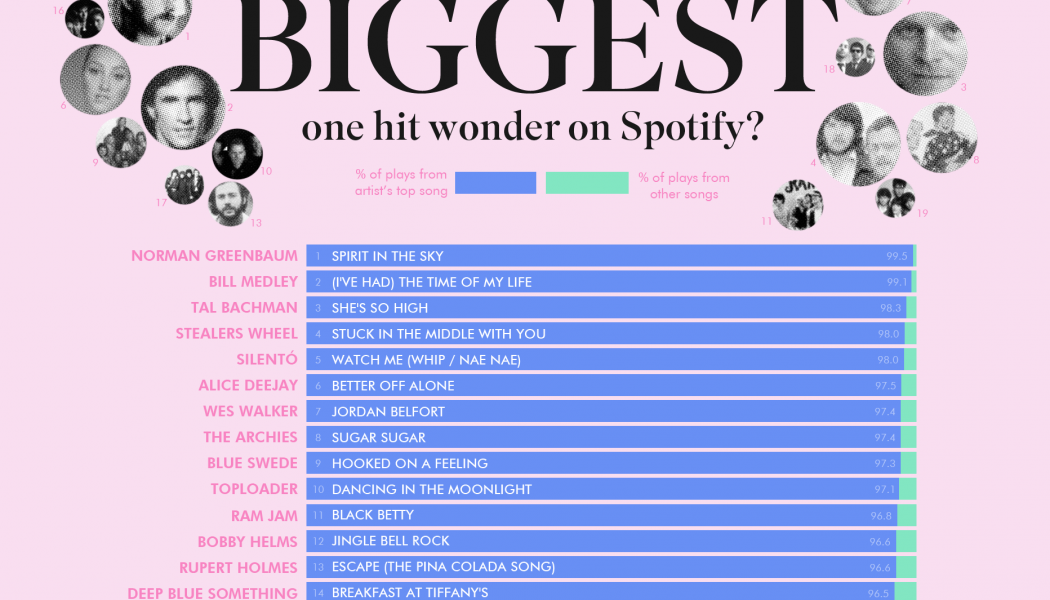

Here are the 50 Biggest One-Hit Wonders on Spotify
A new study has unearthed 50 songs that have the dubious honor of being the biggest one-hit wonders on Spotify. The study, conducted by broadbandchoices, found a number of electronic music classics to be considered among the streaming platform’s highest-earning one-hit wonders. Cookin’ On 3 Burners took the top spot among dance tracks for their global hit “This Girl,” slotting in at #2 overall. Others include Eiffel 65‘s inescapable “Blue (Da Ba Dee),” Alice Deejay‘s iconic trance banger “Better Off Alone,” and O-Zone‘s maddeningly catchy “Dragostea Din Tei.” We apologize if that last one is now stuck in your head. Taking the #1 overall spot is Gotye‘s 2011 breakup anthem “Somebody That I Us...

Spotify Launches “Loud & Clear” Initiative Aimed At Increasing Transparency
A new data-driven initiative from Spotify called Loud & Clear aims to provide increased transparency around the economics of streaming. “Questions and concerns about artist income from streaming have been around for over a decade, and in many ways, we feel we’ve been too quiet on the topic,” the streaming site reads. “Our aim with this site is to provide a valuable foundation for a constructive conversation.” The new initiative tackles both the macro- and micro-economic picture, starting first by broadly informing readers on the impact of streaming to the music industry as a whole, and then breaking down the mechanics and stakeholders within Spotify’s business model. In many ways, Loud & Clear reads like a direct rebuttal to music rights holder organiz...

The Stone Roses’ Ian Brown Claims Spotify Took Down His Anti-Lockdown Song
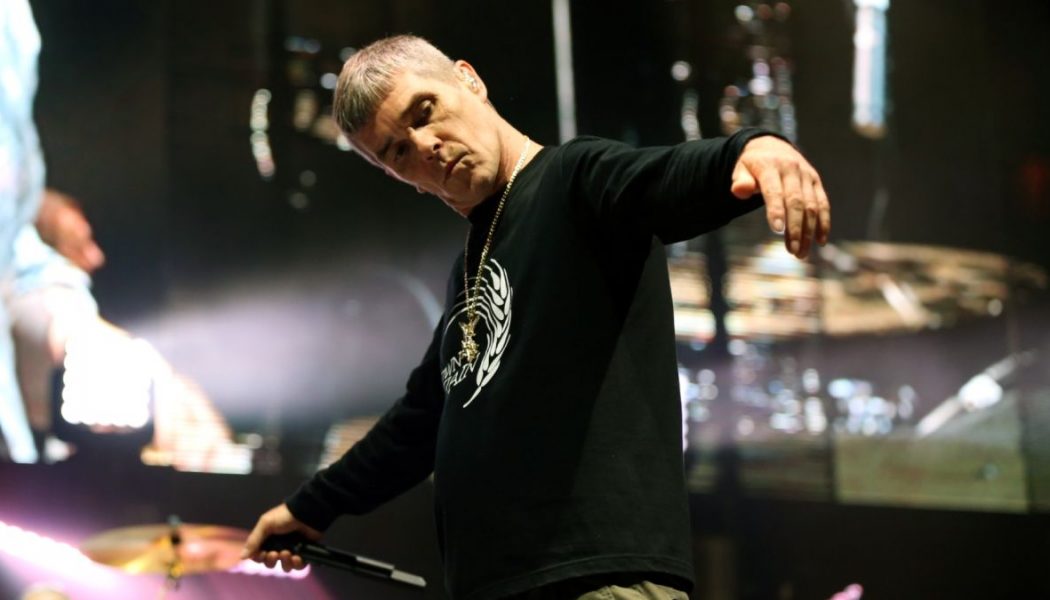
Former Stone Roses singer Ian Brown has been outspoken about COVID-19 “plandemic” conspiracy theories, which he says had made him a target of Spotify. On Friday, the British musician accused the streaming service of taking down his anti-lockdown anthem, “Little Seed Big Tree”, as an act of censorship. “SPOTiFY stream the streams and censor artists like they have with my last song TOOK IT DOWN just put it down the memory hole!” he wrote on Twitter. “FREE EXPRESSiON AS REVOLUTiON” Consequence of Sound verified “Little Seed Big Tree” is no longer playable on Spotify, but the conspiracy-spewing track remains up on Apple Music, TIDAL, and YouTube. Stream it below to open your third eye. For the uninitiated, the song features lyrics about forced vaccines and microchips. “A forced vaccine, l...
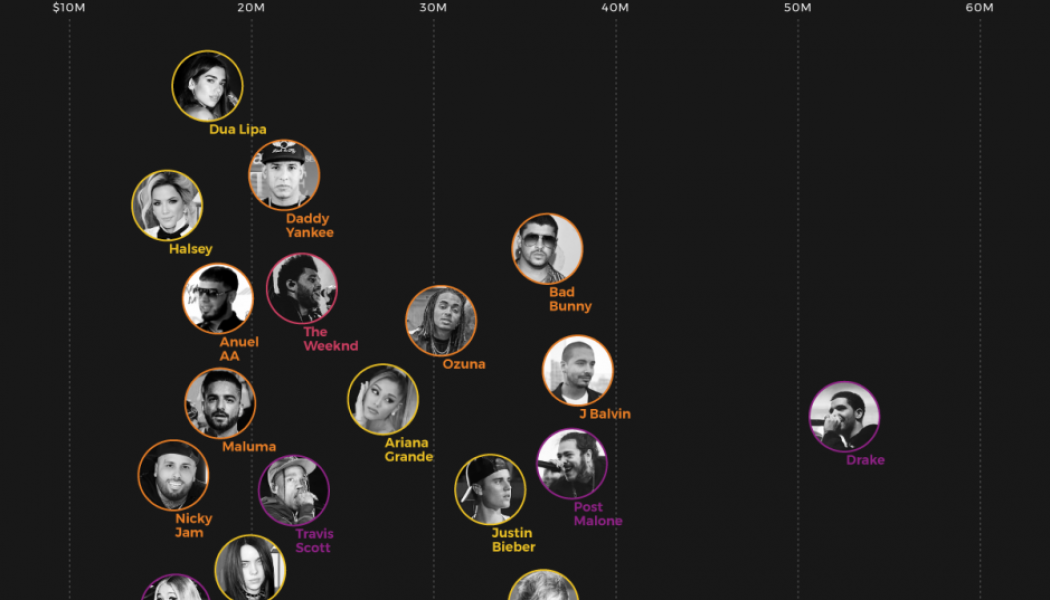

Spotify’s 10 Highest-Earning Artists Have Raked in a Combined $337 Million
An analysis published by financial publication Top Dollar has revealed Spotify‘s top earners and assets—and the numbers are eye-popping. Perhaps not surprising, Drake is the current king of Spotify with a take of $52.5 million in earnings generated from his 21.5 billion streams. His haul is unmatched, even by J Balvin, who took the #2 spot on the outlet’s “Spotify Rich List” by netting $37.9M. The first sighting of dance music producers comes at #16 with The Chainsmokers, who’ve generated an impressive 7.2 billion streams and $17.7 million. Calvin Harris has taken home a cool $14 million so far, landing him at #25. Drake, Post Malone, Ariana Grande, Bad Bunny, and more landed on Top Dollar’s “Spotify Rich List.” c/o Top Dollar ...
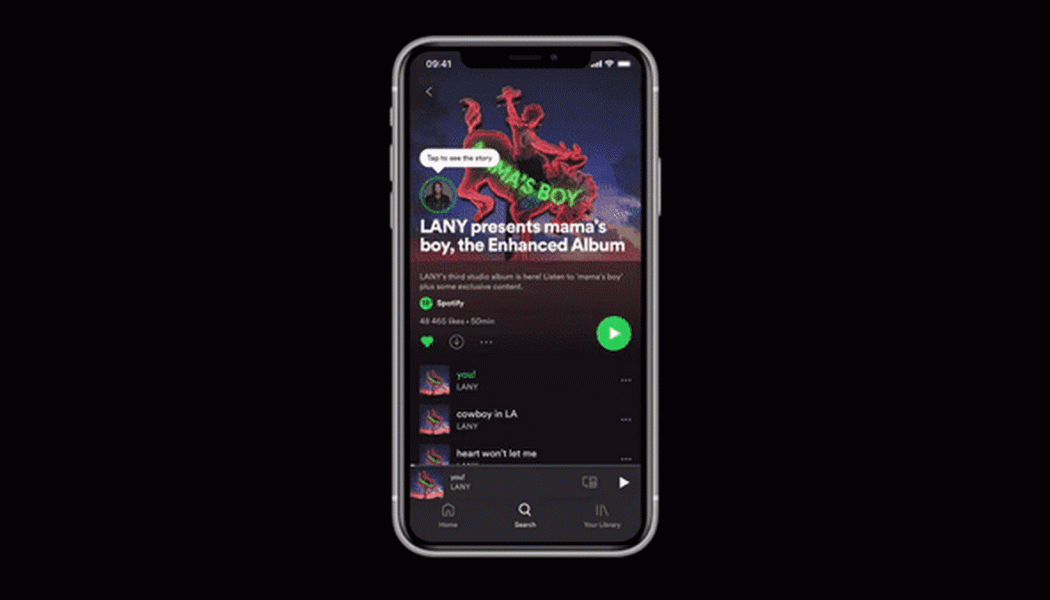

Spotify Launches New Snapchat-Like Clips Feature
Spotify hosted their version of an Apple-style product launch this week during their Steam On event. During the virtual program, which livestreamed on Monday, they broke down the power that audio has, the journey of music creation, and all the opportunities they have planned for both creators and the billions of fans who use their platform. One of those new features is the introduction of Spotify Clips. The format will look familiar because, just like Instagram, Spotify is drawing influence from Snapchat with the implementation of an ephemeral video format. The feature has been in the works since last year, when it was tentatively titled “Storyline,” but its beta testing phase was designated only for a few big names, like Kelly Clarkson and Jennifer Lopez....

Spotify Takes on $1.3B in Debt
Exactly how Spotify intends to use the money is unclear. The press release broadly states the company intends to use the proceeds for “general corporate purposes” — a term loose enough to cover capital expenditures, marketing or strategic acquisitions. Such a large amount suggests Spotify doesn’t intend to use the money for everyday costs of running the company. Instead, $1.3 billion is enough to make numerous acquisitions to build out its podcasting business, for example, and have a cushion for any uncertainty its leadership foresees in 2021 and beyond. Spotify will reserve the right to redeem the notes in a variety of scenarios. Until March 20, 2024, Spotify has the option to redeem the notes with cash, shares or a combination of the two if the company’s share price “exceeds 130% o...

President Barack Obama Says He Broke Kid’s Nose Who Called Him A Coon
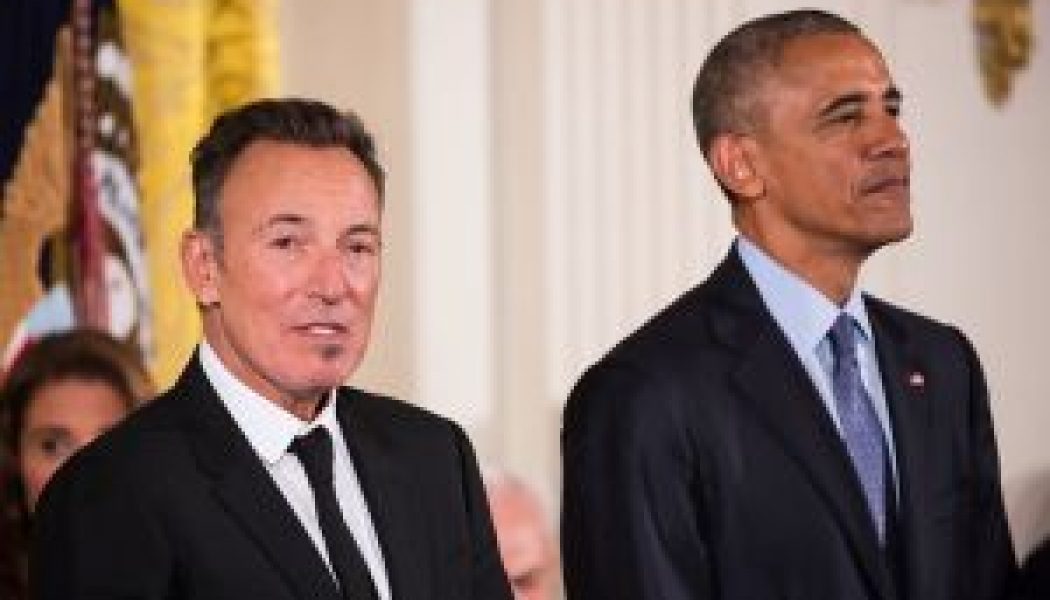
Source: NurPhoto / Getty Barack Obama has been busy since leaving the White House but the 44th President of the United States still has an impact on the culture at large. By way of a new podcast with Rock legend Bruce Springsteen, Obama shared a story of how he broke a friend’s nose who called a coon on the basketball court. Obama and Springsteen have paired up for the Spotify podcast series Renegades: Born In The USA, where the two men seemingly with little in common on paper are actually aligned more than any of their supporters or fans would know. With frank tales about their different upbringings and challenging discussions on race while living in America, Obama landed on a story about living in Hawaii as a teenager and the interaction where he was met with the derogatory term. This ca...
