

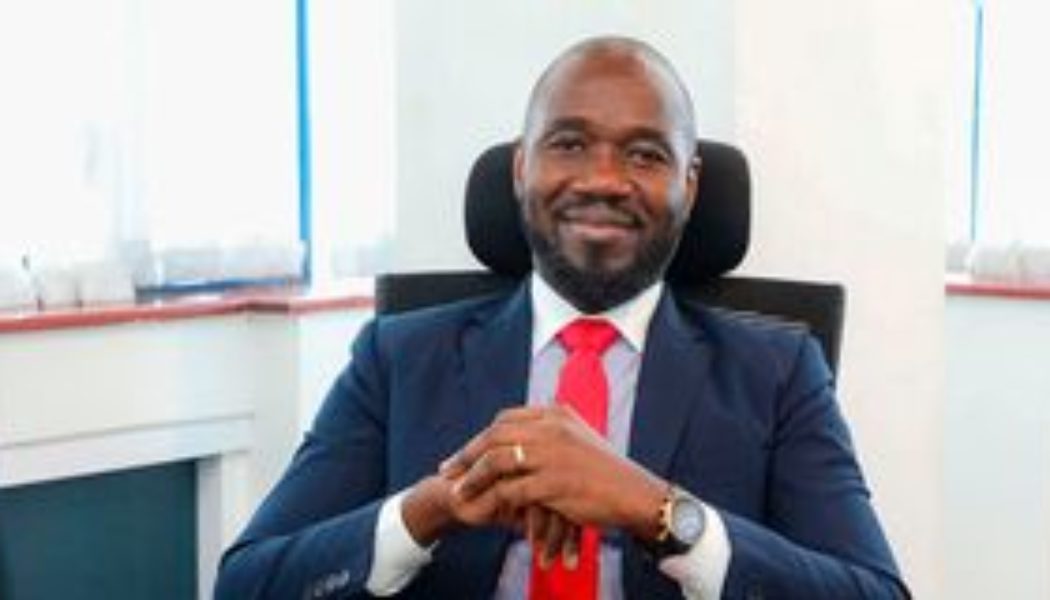
The nametag may read Vincent Odhiambo, Regional Director of Ashoka, but that would be false advertising. What he really is, is a contemporary yogi. His mind is whizzing: here, he is thinking about his family and friends and “people who come into your life for a reason”.
There, his thoughts drift to systems and consciousness. He ruminates a lot on whether he could have been taller, but by the time he got to that water, his brothers had drunk most of it.
In many ways, he is a construction of his thoughts, spending vast amounts of time chained behind his brain cells. Or hanging out with much older people, getting good advice, a nutrient-rich broth made from boiling down the bones of life.
“Don’t forget that life is all about relationships,” he says.
That has always been his north star. His intentionality in relationships. Understanding how to take advantage of your advantage.
“I am a fireball,” he says, “but also a wallflower.”
Not so much an overthinker, then, as he is a deep thinker. The wisdom plucked from the tendrils along the journey. Maybe that’s the real gift of success, not the money or the fame, but the wisdom and the life lessons.
What do you know about yourself that not many people do?
I am fascinated by why systemic change is so hard to achieve.
We often blame funding, policy or a lack of coordination, but I still struggle to understand why, despite the efforts of many well-intentioned people and organisations, we often fall short. I’m constantly thinking about the gap between our ambitions and the results we actually deliver.
Are you living the life you thought you would be at this age?
My journey sort of prepared me for this moment. I grew up with a very high consciousness of social and political issues, and was primarily thinking about inadequacies, imbalances and injustices around me. That set me on a path that I think is basically what I am living now.
I said to myself, “Why is it that there are people who thrive within these systems and there are people who are not able to?” And that led me on a journey from social work to community organising to leadership entrepreneurship, and now systems thinking, where I can be part of the solution in terms of removing barriers for people.
What is the least fun thing about you?
[Chuckles] I tend to oscillate more towards complex, insightful conversations. Things that are philosophical and require thinking outside the box. I like exploring that which is not being explored.
That is annoying sometimes, especially for people who don’t get it. It kind of comes out as, “Why are you always being the devil’s advocate?” Or as being obstinate and argumentative.
I see a ring on your finger. Of the two roles, which one has demanded more from you – this job or that ring?
There is a way they fit into each other. Leadership is all about relationships. It is about systems, processes, culture, and balancing those two is not easy because on both sides there are demands and things that need to be delivered.
The difference is that I have someone who has known me, who has seen me through all the different faces, and experienced the different versions of me: waking up full of energy, and another quieter version of me coming back at the end of the day, a wallflower.
That is grounding because that is the one person who provides all the inspiration and motivation. Don’t forget that life is all about relationships.
How has your spouse influenced the way you lead?
Good question. You see this pattern [on the wall]. Accountability, transparency, trust, innovation, respect and excellence [ATTIRE]. These are our values at Ashoka. But interestingly, accountability, trust and transparency are things we speak a lot about at home. These were basically my wife’s pillars, and finding grounding in these values, both at home and at work, has really shaped how I show up.
Are you a better husband or a better father?
Haha! If you ask her, she’ll say I’m a better father. If you ask the boys, they’ll say I’m a better husband. If you ask me, I’d say I try to strike a balance. But I always find that these are two different variables.
You can’t really measure what it is about being a husband that you can bring to being a father, and I deploy myself to each as appropriately as possible. Most people would point strongly in the direction of me being a better father due to my resolve to remove barriers for other people and help young people find a superpower they can contribute to changing the world.
What’s an underrated joy of fatherhood?
Fatherhood itself. Knowing there are people in this world who owe their being in this world to you. That in itself is joy. And you have a clean slate to mould them, train them and teach them.
What kind of father are you being to your children that you missed out on in your childhood?
A present father. Present meaning engaged and involved. My dad was present but not engaged. I think people know me with my sons more than they know me alone. A guard recently stopped me in a mall and asked how they were. I never experienced that level of involvement. I always want to know what they are thinking or planning, and whether they want us to go for a walk or cycling.
Which part of fatherhood has forced you to grow?
Making sure I don’t compare my sons, and avoiding those one-off statements like, “Oh, you should have…” Initially, it was not easy, but over time, I’ve mastered it. And learning how to balance work, the time I spend with them, and the time I want to spend with my wife too. I know how they feel when I am not around.
Do you have a family tradition that glues you together?
Yes. We do dinner together every evening. We have moments where we read together and moments where we play together, sing and dance. But dinner is our tradition, and afterwards, prayers.
We also have movie nights, and every birthday has to be celebrated and planned for. We also enjoy cooking together. I enjoy cooking with them more because if I blunder, they won’t know [chuckles].
I am a hands-on person, which helps with my mental space as I am always reflecting or processing something, and you never get to rest your brain by just resting it. I need some activities to reset.
What’s your signature meal?
I don’t think there is one, haha! Every dish requires some level of creativity. If they come home and see the meal is set, they will know it is me who has done it because they have never tried that combination before [chuckles]. Almost like sandwiching everything, haha!
Which decade of your life demanded the most from you?
If I look at my life journey, I see the curious mind; the wanting to think through individual challenges and societal challenges, and trying to marry those. How is it that some people thrive and some people don’t?
As a child, I often asked myself, why is this teacher caning me for nothing? And that sparked questions about the imbalance of power. That consciousness was already a burden; understanding that human potential is not necessarily matched with opportunity.
Vincent Odhiambo, Regional Director at Ashoka, says intentionality in relationships must be seen, felt and witnessed.
Photo credit: Lucy Wanjiru | Nation Media Group
What do you wish you’d learnt sooner in life?
That change does not come easy. And also the different levels of impact, from direct impact to indirect impact. Initially, I lent a lot of my energy to things that had direct impact, only to realise later that it was not sustainable or bringing about the kind of change that we want to see.
And as Vincent?
The complexities around what I call the interconnectivity of issues. When I approach something, it is from an understanding of how different aspects of it are interconnected, and understanding that relationships are not always just what you think.
People don’t turn out this way or that way by choice; there are so many things around that. If I had learnt that earlier, I would not have judged people so much.
Speaking of, what piece of advice do you wish you had not listened to?
[Chuckles] Actually, the one thing that I say contributed much to my worldview, and the person that I became, was that I hung out a lot with people who were older than me. I loved conversations that questioned things and required big, bold thinking, and I would only get this from people who were older than me.
I remember they told me, in Dholuo, that a ship capsizes when it is about to dock. You can interpret that in so many different scenarios, and it teaches you how to stay grounded.
But if I must know?
If you must know, someone once told me that hanging out with my sons was too much. That was pretty terrible advice.
Did hanging out with older people make you cautious?
Wiser, at a very early age. Being able to think through things a lot, and that meant oscillating more towards caution [chuckles].
Have you kept the promises you made to yourself as a young man?
I’d say the promises are evolving. Finding ways to address imbalances and inequalities is a constant theme for me. And I’d say with the roles that I have played, and the positions that I have been in, being part of teams that are keen on moving the needle is bringing me some level of satisfaction; and in that way, I am keeping the promise.
What bad habit have you failed to kick?
Haha! My waking-up time. It’s an unhealthy habit, but I am used to waking up early since back in the day, when my dad was going to work or coming home at dawn, I’d be up waiting for him.
That doesn’t sound like a bad habit.
It doesn’t? [chuckles]
Tell me then, what’s a small change you made in your life that has made a big difference?
Let me think [long pause]. Moving out to set up my own home. It remains the most transformative step I’ve ever taken.
When was that?
Just after high school, before joining campus. My parents were opposed to it, but I had made my decision. I never turned back, and that’s where I practised all my lessons as a scout [chuckles].
Is there anything you believed about success that has since changed?
Success was getting it right. Getting everything right. But there was also a lot of monetary value attached to that. Over time, you get to realise you cannot get everything right. It’s not a destination, it’s a journey.
But when you’re looking at success from a mission and passion perspective, then everything changes. For me, success will be achieved when everyone has their space, a support system, and a network to live up to their potential.
Do you have a mantra that governs how you live your life?
People come into your life for a reason or a season. The more I reflect on my journey, the more I realise how true that is.
Many of the most important moments in my life happened because someone showed up, offered guidance, made an introduction or created an opportunity. It reminds me that life is ultimately about people and the relationships we build along the way.
What does the perfect weekend look like for you?
I have people who are special in my life, people that I’ve journeyed with. Family, friends, and even colleagues, you know, people in this space. My perfect weekend involves having one of those around.
And, of course, the meaningful conversations with family, friends I’ve made over time, and very specific colleagues as well. I also like to read because I reflect a lot on what has happened. And moving about outdoors with my sons.
It’s a weekend where I get to experience all that. A bit of the wallflower part of me gets to be watered, and then the fireball part of me as well.
Do you have an insecurity that you can share with us?
[Chuckles] I don’t know how to convince myself of this, but I tend to believe that I could have been taller. Most of the time, when I’m meeting people for the first time, they expect somebody way taller than me.
Are you the shortest in your family?
My elder brother is taller than me. The one who follows me is also taller than me. Our youngest was really tall.
What advice do you feel compelled to share?
You don’tget to choose your family. Your friends could end up being circumstantial. But the one person that you deliberately choose – between a stimulus and a reaction, there’s a space to think through, and you’ve exhausted that space, and you’ve decided, this is the person – when you’ve made that choice, this person is part and parcel of your life.
What do you mean?
Meaning is in the intentionality of relationships. I don’t want to narrow it down just to marriage, but intentionality. You have identified someone, and you’re building, you’re together. That intentionality stems from the fact that you have made a choice.
So, every single day, that intentionality must always be there. It must be seen. It must be felt. It must be witnessed.
Did you choose well, based on your advice?
[Chuckles] So, it is because of the beauty that I see with that daily. The two-way intentionality in all this. And that leads me to the conclusion that we got each other. We got the right person for the right person.