

Summary
- Replicates the massive sound of the 1982 six-voice polyphonic synthesizer known for its triple-oscillator architecture
- Includes modern enhancements such as MIDI Polyphonic Expression, a drag-and-drop modulation system and an advanced arpeggiator
- Provides a stable software alternative for producers contrasting with temperamental vintage hardware units that retail for upwards of $15,000 USD
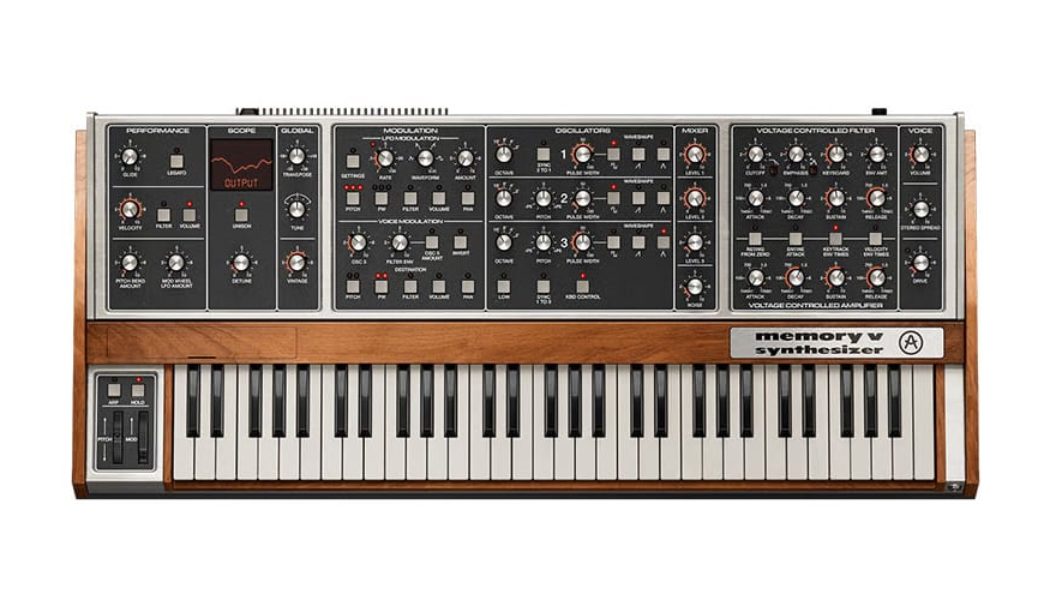
Arturia released Memory V to resurrect one of the most ambitious and notoriously unstable analog synthesizers in electronic music history. The virtual instrument meticulously emulates the 1982 Moog Memorymoog to deliver its colossal warmth without the hardware’s legendary reliability issues. Built between 1982 and 1985 as Moog Music’s final polyphonic flagship before bankruptcy, the original unit was celebrated for its thick three-oscillator-per-voice sound. It defined the character of early 1980s synthpop and progressive rock but was famously difficult to maintain due to complex circuitry and failing power supplies.
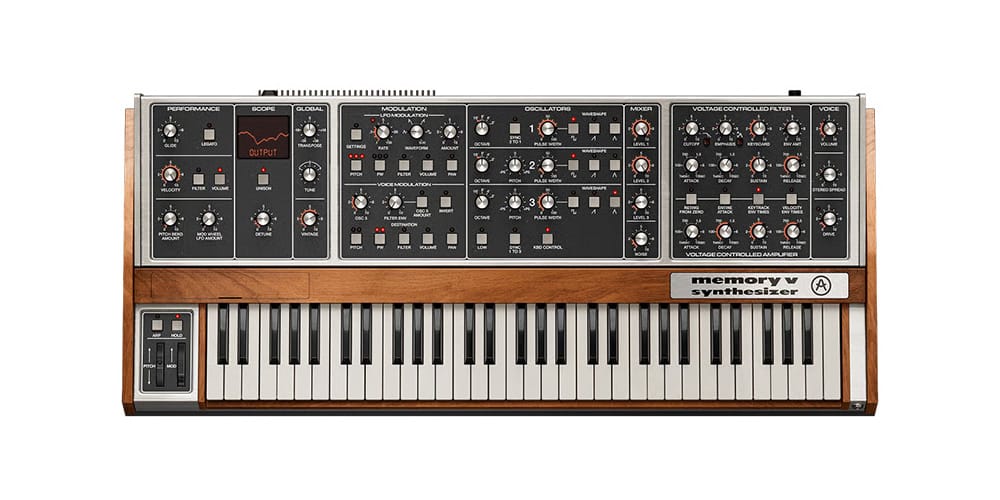
The new plugin mirrors the architecture of the vintage titan with three free-running oscillators and a lowpass ladder filter per voice. Arturia utilizes its proprietary True Analog Emulation DSP technology to model these components at the granular level. This captures the distinct analog non-linearities and drive that gave the original instrument its mythical status among musicians. Users can customize the level of analog drift through dedicated vintage and dispersion controls to introduce continuous component variation across pitch and pulse width.
Modern performance features elevate the software beyond a simple historical recreation. Producers can utilize 18 total oscillators in unison for powerful leads or push the polyphony from six voices up to 12. The software also introduces a powerful multi-arpeggiator and a flexible modulation matrix with multiple LFOs and envelopes. A four-slot effects rack brings contemporary sound design into the vintage-inspired framework with processing engines like tape delay and multi-band compression.
Preserving this specific sonic footprint matters deeply for modern electronic production. The original hardware shaped landmark tracks like Rush’s “Subdivisions” and Genesis’s “Mama” while finding a home in the studios of Stevie Wonder and Tangerine Dream. Because restored analog units now trade for extraordinary sums and require constant maintenance, a faithful digital recreation democratizes access to a defining sound of an entire era.
Available now for $149, Memory V arrives packed with over 300 factory presets spanning vintage brass to cinematic pads. It functions seamlessly across major digital audio workstations and supports modern protocols like MIDI Polyphonic Expression for nuanced performance control. The instrument is part of the expanding Arturia library of classic synth emulations. Existing customers are eligible for discount offers through their official accounts.