“These coolers carry more than food or flowers. They carry stories. They carry legacy. They carry dreams.”
Whether it’s a mural or a massive installation, your work is inherently accessible. Why is it vital for you that your art is in the streets rather than private galleries?
First, it’s extremely difficult for Black and Brown artists to transition from the streets to renowned galleries and museums; historically, this has always been the case. I believe many artists who paint massive murals and have a significant street presence also maintain a serious studio practice. It’s unfortunate we are often put in a box and labeled “Street Artist,” including graffiti artists and muralists. For me it’s extremely important to have my work in the streets because it often reflects the indigenous communities that make this country beautiful. I want future generations to feel seen, represented, and uplifted, the same way I felt the first time I seen Mexican muralism and artwork from legends like CHAZ BOJORQUEZ,John Biggers, Rivera, Orozco, and Siqueiros, to name a few.
I recently won the FRIEZE L.A impact award and the opportunity to have a solo exhibition at FRIEZE L.A. I also showed a major installation “Elevar La Cultura,” at The Shed NYC has traveled to major cities and was the main featured installation for SCOPE art fair in Miami during Art Basel. My transition from the streets to galleries and museums is thriving but I’m staying connected to my roots.
In “Elevar La Cultura,” you transformed everyday coolers into a monumental Mayan-inspired pyramid. What is the significance of elevating such a humble, utilitarian object into a spiritual structure?
There’s a unique kind of genius born from struggle; a creativity sharpened by necessity and resilience shaped by survival. For immigrants, especially those who arrive with little more than hope and hustle, creativity isn’t just self-expression, it’s a strategy. It’s how we feed our families, how we build community, how we leave our mark.
This spirit — the ability to turn anything into opportunity, to transform the ordinary into the extraordinary — is what inspired “Elevar La Cultura.” At its center stands a monumental Mayan pyramid, not made of stone, but of ice coolers, the same coolers used by street vendors across the country. This large-scale, 22-foot-tall immersive installation infuses cultural textiles, spiritual objects, and mural work. Blending ancestral symbolism with contemporary survival tools, the installation reclaims space and uplifts the beauty, resilience, and cultural power of marginalized communities. These coolers carry more than food or flowers. They carry stories. They carry legacy. They carry dreams.
Your exhibition at the University of North Texas was abruptly closed due to works critical of ICE. Can you walk us through that experience and how it felt to see your work censored?
I can honestly say it came as a big surprise because previously before my solo exhibition “Ni de Aquí Ni de Allá” was abruptly taken down the university asked me to judge their annual competition that gives students an opportunity to showcase their work and win financial awards. I was also given a tour of the university and introduced to several staff members. My artwork was displayed on everyone’s desktop with a banner on the UNT website and several social media posts and stories. My exhibition was fully installed and opened on January 3rd with the reception scheduled for January 19th. As the reception date approached, I started reaching out to the gallery director to ask when I could send out an RSVP link. I also asked numerous times for an update on the exhibition and for the gallery to send images of the installed work. When I didn’t get a response for several days I looked into their social media. By January 11th, every single social media post from UNT had been taken down and all information and images about my exhibition had disappeared from the official UNT website.
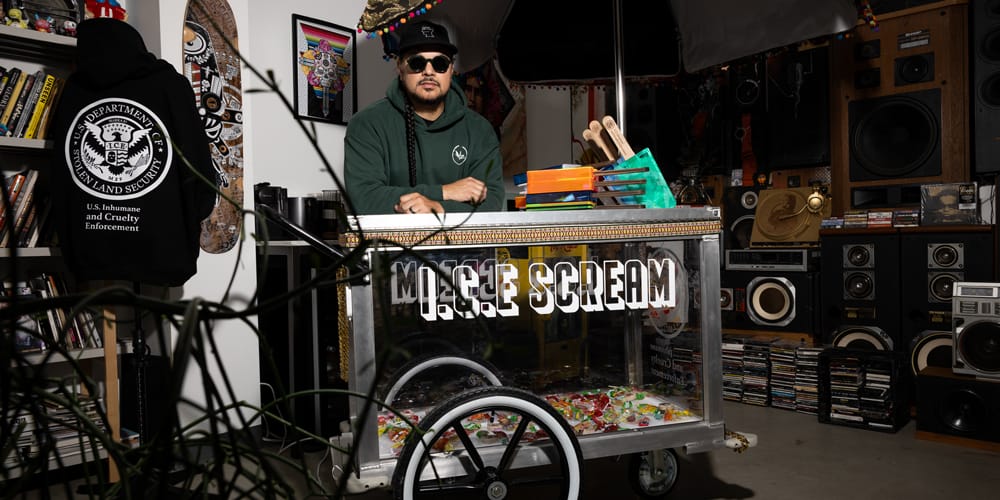
I was officially ghosted by an entire university and the feeling was incredibly frustrating. It was a miracle that UNT students began sending me DM’s through I.G an warned me that my exhibition had been covered up and removed. I asked them to send me photos and video for confirmation, and they did. Jenny Yanez, a student journalist at UNT, broke the story that went viral. I wanna be clear that no one UNT staff or employee reached out to let me know what’s happening. I’m proud of the UNT students for standing up to the faculty, protesting the censorship of my exhibition, and fighting for their freedom of speech. Finally the gallery director sent me and the Boston University Gallery Director a vague email stating that UNT has decided to terminate our loan agreement and will be returning the artwork to B.U. There was zero explanation why they censored the exhibition but it became clear that the work I created, titled “I.C.E “Scream” series, was the reason for the censorship.