

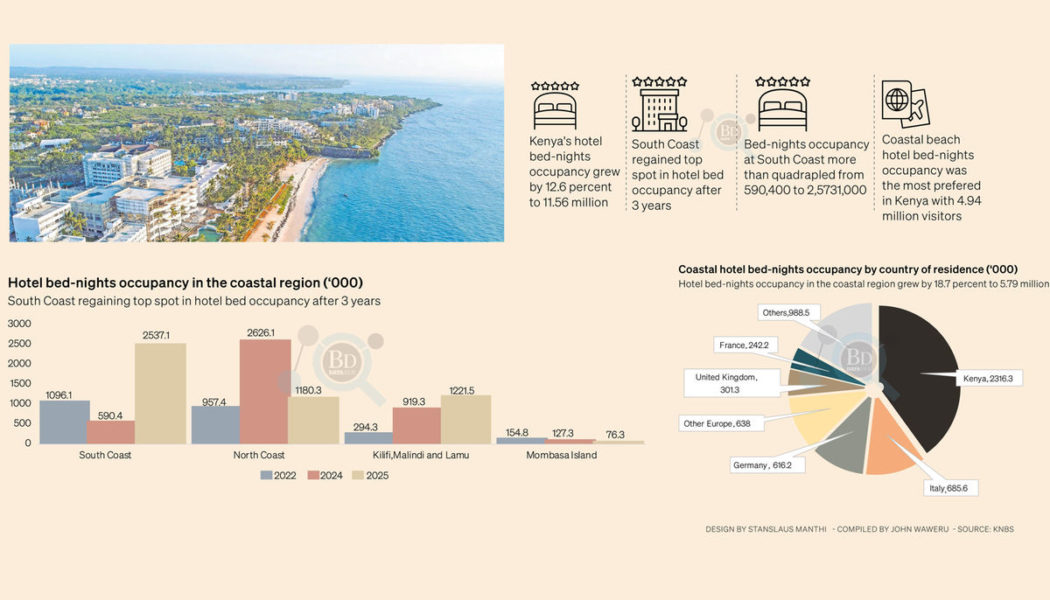
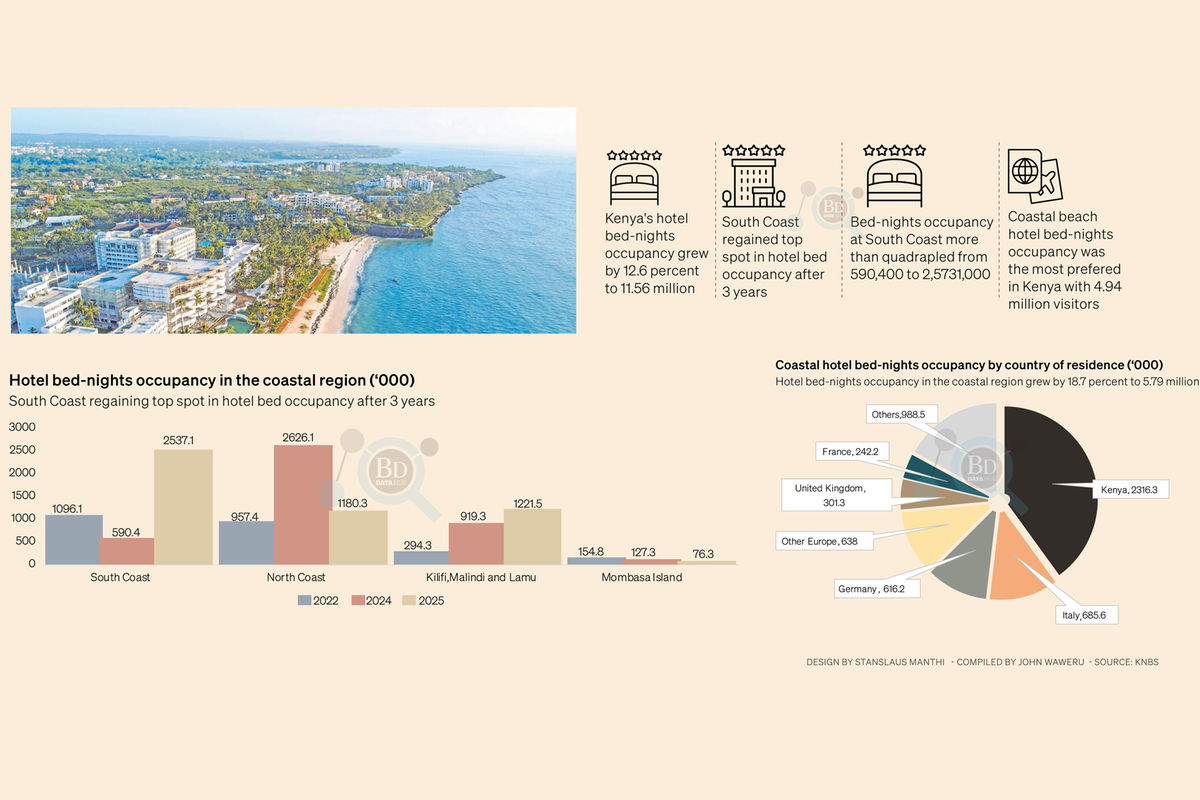
Kenya’s South Coast regained its dominance in hotel bed-night occupancy along the coastal beaches after three years of trailing its rivals on the back of increased tourism activity.
South Coast had 2.57 million bed nights or nights spent by total guests in a hotel last year, from 590,400 bed nights in 2024, says the Kenya National Bureau of Statistics (KNBS).
This saw it overtake North Coast, comprising Nyali and Bamburi under the KNBS classification, which had 1.1 million bed nights last year from 2.63 million in 2024.
Hotel bed-night occupancy is one of the key indicators used in the tourism industry to measure demand for accommodation and the overall performance of hospitality facilities.
Unlike simple visitor arrival numbers, bed night occupancy reflects length of stay, seasonality, and capacity use – all critical for hotel revenue forecasting.
South Coast regions of Wasini Island and Diani, which has idyllic palm-fringed beach resorts where the sands are pearl white, the waters clear turquoise.
Offering everything from big game safaris to sandy white beaches, Kenya attracts more than two million international visitors annually from countries such as China, Germany, France and Britain.
Tourism is a vital economic pillar, providing millions with employment and accounting for about 2.8 percent of the country’s gross domestic product.
The recovery at the South Coast also helped drive growth in overall coastal occupancy, with the Kilifi, Malindi and Lamu tourism circuit with beaches like Watamu recording an increase from 919,300 bed nights in 2024 to 1.22 million in 2025.
Mombasa Island recorded a drop to 76, 300 bed nights last year from 127 300 in 2024.
Domestic tourists trailed foreigners on hotel occupancy at the Coast, accounting for 5.2 million bed nights out of 11.56 million, underlining the growing role of local tourism in sustaining hotel business.
Among international markets, Italy emerged as the leading foreign source of hotel occupancy with 685,600 bed nights, followed by Germany at 616,200, other European countries at 638,000 and the United Kingdom at 301,300.
Tourism industry players say the rebound in hotel occupancy reflects aggressive destination marketing, improved infrastructure, direct international flights and renewed investments in hospitality facilities along the South Coast.
The sharp increase in bed-night occupancy is expected to support revenues for hotels, restaurants, tour operators and transport businesses that depend heavily on tourism activity.