
Abraham Ongenge’s father had a habit of saying, when something needed to get done and done properly: let Abraham do it. He said it about chores. He said it about responsibility. He said it, eventually, about everything that mattered, until it became a prophecy about a man. If it’s got to get done, Abraham will do it. So, let Abraham do it.
One imagines those words echoing, years later, in the deep-carpeted rooms where difficult decisions are made, before the call came appointing him acting chief executive of Stanbic Bank Kenya.
It seems fitting. Ongenge has spent the better part of two decades inside the Standard Bank Group machinery, rising through its ranks as a financial accountant, chief finance and value officer across Kenya, Uganda and South Sudan, taking a brief detour as finance director at KCB before returning to Stanbic as head of personal and private banking—the role from which he was elevated.
But the more interesting story isn’t on his CV.
The middle child of three boys, raised by a teacher and an accountant in Nakuru, working on a school farm and in church, left-handed, mathematically gifted and musically inclined. A boy whose father answered every difficult question with the same instruction: You’ll find the answer in the Bible.
And those experiences have built his leadership philosophy: trust, authenticity, impact. “I’m always aware that I don’t know everything,” he says of the decisions that land on his desk once there’s no one left above him to ask.
Congratulations, by the way. Where were you when you heard the news, what were you doing?
The nature of banking – and my role in particular – requires a lot of collaboration across the continent. The call came while I was at the airport in Johannesburg, travelling for a strategy meeting. One thing bankers are taught is never to discuss confidential matters in public places, so it was a slightly awkward conversation.
I had to keep my responses to a minimum – mostly “yes,” “no,” and “I understand” [chuckles] while trying to look completely calm. By the time the call ended, I had all the information I needed. I had arrived at the airport as one person and was flying home with a completely different responsibility.
I suppose OR Tambo will always hold a special place in your heart.
[Laughs] Yeah. Every time I land there, I’ll always be looking at my phone and saying, what’s the next good news before I fly back? [Laughs].
How excited were you with the news?
My first thought was about the trust this organisation places in its people. What hit me immediately, though, was the weight of the responsibility. You’re not just leading a business – you are responsible for steering an institution that has to make a meaningful difference in the country, while meeting the highest standards of governance and regulation, and doing right by its employees.
That was the overwhelming feeling: this is a huge responsibility. But it was balanced by confidence. I’d grown up in this organisation and had seen it invest in its people. I knew I wasn’t stepping into the role alone. There was a strong support system behind me.
You grew up in a very religious home. Your parents led the church, and your father kept its books. How has that upbringing shaped the way you see people?
It has shaped me profoundly. Even today, many of the choices I make are rooted in the foundation I received growing up, especially when it comes to matters of faith. I remember asking my father a question that has stayed with me. I said, “I’ve always come to you for answers. If one day you’re no longer here, where will I find them?” He was very calm. He said, “There will come a time when we won’t be together, and when that happens, you’ll find your answers in the Bible.” He believed there wasn’t a question life could ask that the Bible couldn’t help answer. I took that to heart. I invested a lot of time in reading and understanding it, and that has done more than shape my faith – it has shaped my character.
You were a bit of a bookworm as a young person, a geeky fellow walking about with text books under your arm scoring As all the time…
[Laughs] Let me give you some context. I grew up with two brothers – I’m the middle child. My older brother is a year older than me, and my younger brother is two years younger. In a house full of boys, there’s a lot of energy, but there’s also a lot of competition. So, quite early on, I realised I had to find my own competitive advantage. I found it in three things.
First, my identity. I’m left-handed, and as a child I thought that made me special. I even worked hard on my handwriting because I wanted to be known for it. Second, mathematics. It was considered the hardest subject, so I decided I wanted to be the best at it. I invested a lot of time in it. It also brought me closer to my father, who was an accountant, and I liked the idea that I was good at something he loved.
Third, the creative arts. I took part in music festivals and made sure I excelled there as well. So I wouldn’t describe myself as a complete bookworm. But I did become very good at mathematics because, to me, maths has always been fun.
Did you always want to be an accountant?
There’s a photograph my family still keeps of me at about one year old. I’m sitting holding a magazine on management accounting. Of course, I couldn’t read at the time, so perhaps it was just coincidence – but it’s a funny story given how life turned out. Growing up, I really looked up to my father, who was an accountant.
Naturally, I found his work fascinating and wanted to follow in his footsteps. That said, I also had another dream. I absolutely loved Michael Jackson. I knew all his dance moves. So if I hadn’t ended up in banking, there’s a good chance I’d have found my way into something creative instead.
What would people who’ve known you for 30 years tell your colleagues about you that would surprise them?
They’d probably tell them that I can organise a really good party. They’d also tell them it would probably be alcohol-free. (Laughs.) But if I’m planning something, I give it everything. I want it to be first-class.
More than that, I think people who’ve known me for a long time would say I’m someone they can rely on. My father used to say, “Let Abraham do it.” He had complete confidence that if he asked me to do something, it would be done – and done well. I hope that’s still true today.
Have you ever drunk alcohol?
No, I never have. Part of that comes from how I was raised. Growing up in a Christian family, it was simply understood that you didn’t drink. As I got older, though, I realised it had to become my own decision, not just something I’d inherited.
So I chose not to drink. One of the reasons is that I’ve always wanted to take full responsibility for the choices I make – even the wrong ones. I’ve often thought that when people aren’t sober, it’s easy to blame the bottle. I didn’t want that. I wanted every decision I made to be mine.
You went to South Africa unmarried and came back married. Did you meet in South Africa or you engaged in a little import business?
[Laughs] I was introduced to her in December 2006, and by June 2007 I was leaving for South Africa. We’d only known each other for about six months, and although the relationship wasn’t very serious at the time, we were growing fond of each other. We’re very different people.
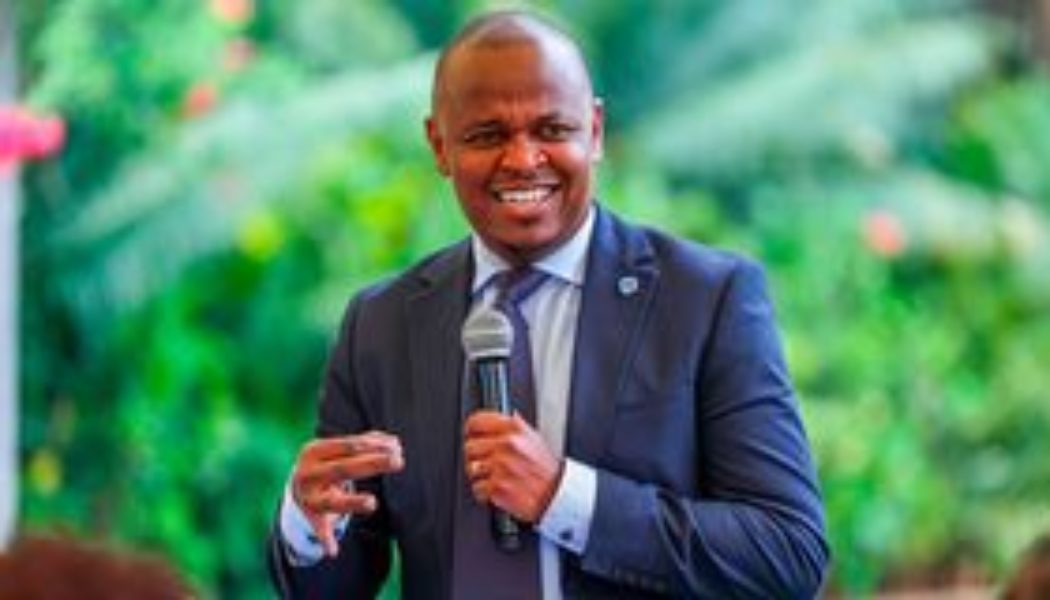
Stanbic Bank Kenya Limited Acting Chief Executive Abraham Ongenge.
Photo credit: Pool
I’m an extreme introvert, while she’s an extreme extrovert. She’s naturally warm and outgoing, and somehow that balance worked for us. The relationship continued long-distance, which gave me every reason to keep coming back to Kenya whenever I could. Over time, what had started rather quietly grew into something much bigger, and we got married in September 2009.
It was around then that I realised just how important she would become in my life. After our wedding, I had to return to South Africa to continue working. The 2010 FIFA World Cup was only months away, so I had a choice to make: stay and experience what was probably a once-in-a-lifetime event, or come back to Kenya and build a life with my family.
I chose to return to Kenya in April 2010. I missed the World Cup, and I’ve never regretted that decision.
Sixteen years on, any personal insights on marriage you want to share?
They say that in marriage the wife is always right – and when she’s wrong, you simply refer back to the first rule. (Laughs.) But, seriously, I think the biggest lesson is that you have to be all in.
When you bring your authentic self into a marriage, you allow your partner to truly understand who you are. That makes it much easier to navigate not just the good times, but also the difficult seasons.
For me, being all in means not hiding parts of yourself. If you’re someone who expresses emotion by crying, then don’t suppress that. Bring your whole self into the relationship. When both people do that, there’s less second-guessing because you’re dealing with each other honestly. That’s what has helped us through some of our toughest moments.
Children?
I have two children – a 15-year-old son and a daughter who will soon turn five. My son is autistic and is yet to develop speech. Being his father has taught him to appreciate small steps. Progress doesn’t always come in giant leaps, and when it does come, you celebrate it. That lesson has shaped me not just as a father, but also as a leader. It has made me more patient and more intentional.
In any organisation, people grow at different speeds. Some reach their full potential quickly; others take longer. As a leader, you need the patience to walk that journey with them, and the wisdom to celebrate every milestone along the way. Our daughter came after a very different journey. Looking at the age gap, people often ask what happened.
The truth is that, as a family, we went through several miscarriages. Those were difficult seasons, but our faith sustained us. Today, every time we look at our daughter, we’re reminded of that journey.
She is, in many ways, a testament to the hope and patience that carried us through. Sometimes I even joke that perhaps there’s a reason I was named Abraham. [Chuckles] Patience, after all, is one of the things he’s remembered for.
You’re 45 now. How would you describe this season of your life? In many ways, you’ve crossed into the second half.
I think of it as a legacy-setting season. It’s a time of consolidating the things that matter most. First, my faith – being intentional about grounding it because it’s the foundation of everything else. Second, my health. I actually started focusing on that just before I turned 40, recognising that if I want to make a meaningful contribution in the years ahead, I need to take care of myself.
Third, my career. Reaching a point where I’m clear about the kind of leader I want to be and the impact I want to have. And finally, my family. I’m thinking much more deliberately about the legacy I leave behind for them. For me, this season is really about answering those four questions with clarity.
Any fears?
What worries me most is the example I’m setting and the character I’m shaping in the people around me. I’m conscious of the energy I bring into every space – whether it’s with my children, my wife, the teams I lead or society more broadly.
I often ask myself: Am I contributing to a better society, or am I taking something away from it? That’s a question that keeps me very self-aware.
When do you experience self-doubt?
Whenever I’m faced with decisions where there’s no obvious answer. One thing I’m always conscious of is that I don’t know everything.
As a leader, difficult issues eventually find their way to your desk, and sometimes, once they get there, there’s no one else to pass them on to. In those moments, you inevitably ask yourself: Am I making the right decision? Is my intuition right?
In closing, do you want to say anything as close, something you want to add?
The only thing I would have changed is the tie. (Laughs.) I wish I’d done this interview without one.
But I’ve genuinely enjoyed the conversation.
In many ways, it has been therapeutic.
What has helped me is drawing on the diversity of knowledge around me. I seek different perspectives from my team and from the people around me. It doesn’t eliminate self-doubt, but it helps me make better decisions. Those moments still come because I’m deeply aware of my own limitations.