
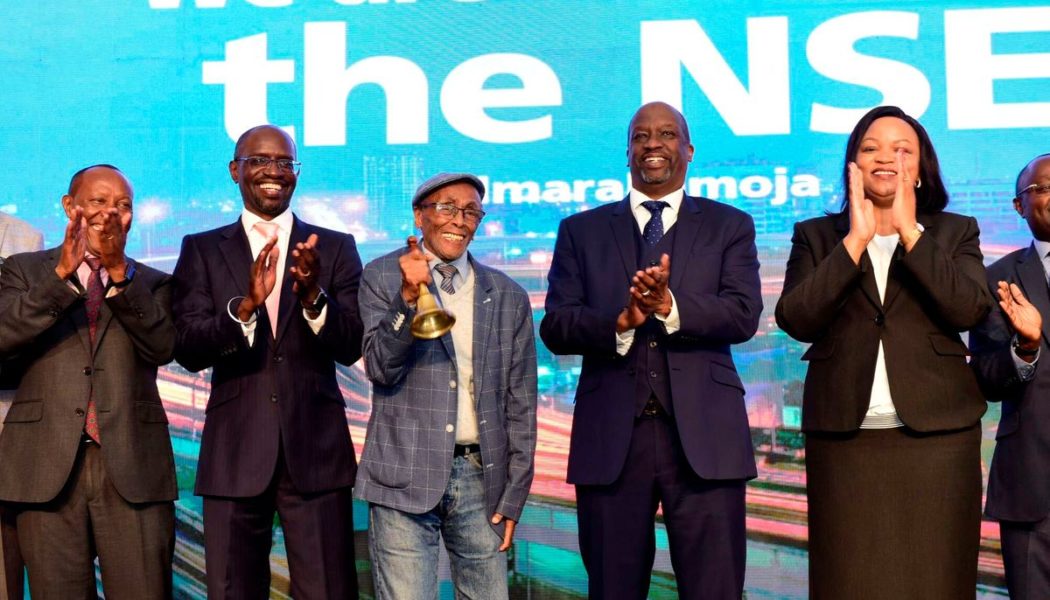
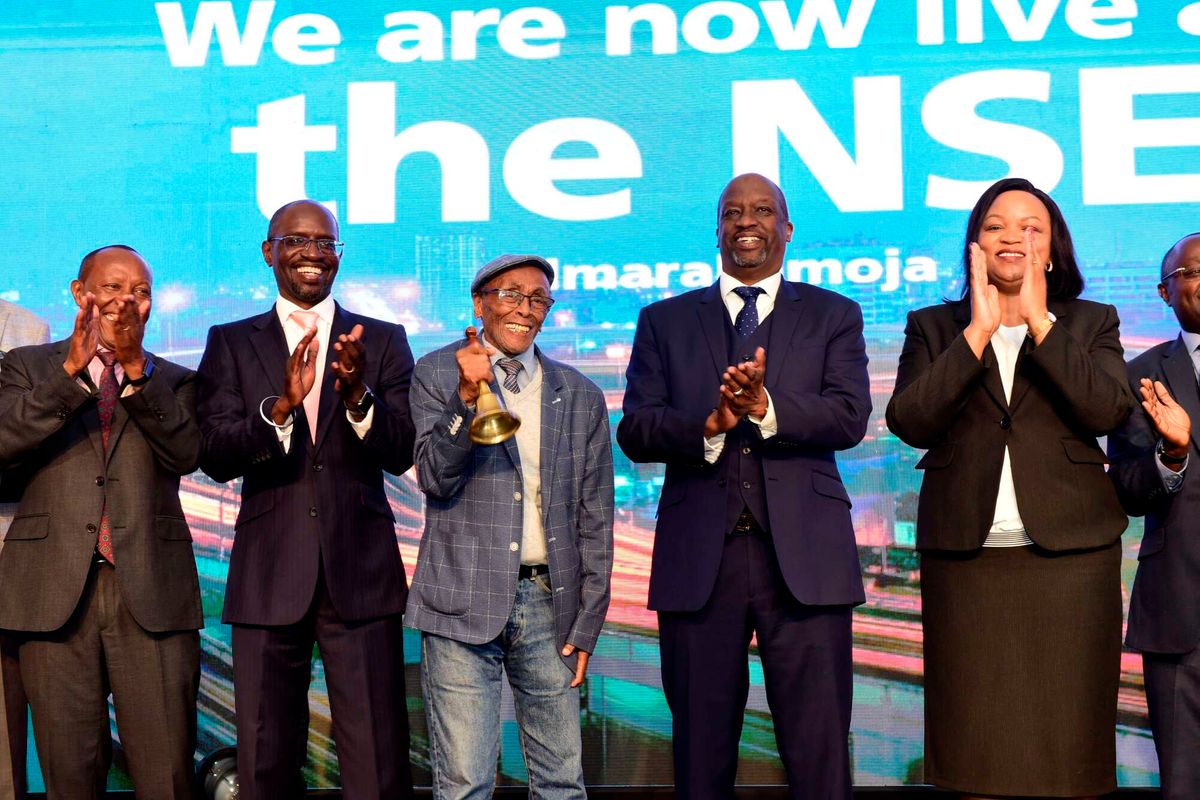
The share of investor wealth at the Nairobi Securities Exchange (NSE) concentrated on the banking segment has climbed to a record 42.5 percent after a price rally in the past year and the addition of Family Bank through a new listing.
Banking stocks are now collectively valued at Sh1.56 trillion, having seen their value rise by 70.4 percent from Sh913.4 billion a year ago.
They have raced past Safaricom, which is now valued at Sh1.32 trillion.
Twelve months ago, Safaricom had a market value of Sh967.6 billion, meaning it was valued more than all the banks combined.
Although the telco’s share price (and valuation) has gone up by 36 percent, banks have grown twice as fast on a mix of acquisition announcements, higher profits and dividends. Between them, Safaricom and the banks account for 78 percent of the NSE’s total market capitalisation or investor wealth of Sh3.679 trillion.
The energy segment is the third largest with a valuation of Sh283.6 billion, accounting for 7.7 percent of the NSE’s total, followed by manufacturing at Sh280.4 billion or 7.6 percent of the market. All the other segments including commercial, insurance, agriculture, construction and investment each account for between 0.2 and 2.7 percent of the market.
This rising prominence of banks at the NSE has now increased the concentration risk at the market, which has been dominated in recent years by a few large blue chips including Safaricom and large banks.
Family Bank’s listing by introduction on Tuesday has added Sh37.2 billion to the banking segment market cap. The tier two lender listed 1.66 billion shares at an entry price of Sh18 each, but the stock had climbed to Sh22.40 by close of trading on Thursday.
Other listed banks have in the meantime all recorded double-digit percentage gains on their share prices in the last year, led by Co-operative Bank of Kenya whose stock is up 104.7 percent to Sh34.80 in the period. The lender’s valuation has thus doubled to Sh204.2 billion from 99.7 billion a year ago.
Equity Group, which is the largest listed bank by market capitalisation, has seen its valuation rise by Ksh120.4 billion to Sh298.12 billion in the past 12 months after recording a 67.7 percent jump in share price to Sh79.
KCB Group’s valuation has gone up by Sh96.6 billion to Sh239.4 billion, thanks to a 67.6 percent rise in share price to Sh74.50 in the period.
Absa Group’s market cap is up Sh74.1 billion to Sh175.4 billion on a 73.2 percent jump in share price to Sh32.30.
Among the other listed banks, DTB’s valuation has risen by 87.5 percent to Sh38.9 billion, I&M Group by 79.7 percent to Sh105.3 billion, NCBA Group by 58.2 percent to Sh151.16 billion, and Stanbic Holdings by 79.8 percent to Sh114.6 billion.
Others are Standard Chartered Bank Kenya with a gain of 14.3 percent to Sh126.5 billion, BK Group at 64.6 percent to Sh48.2 billion and HFCB Group at 35.4 percent to Sh17.86 billion.
The sharp gains in the share prices has been attributed largely to the banking sector’s rising profitability and dividends.
In the year to December 2025, the sector recorded a 20 percent or Sh51.8 billion growth in pre-tax profits to Sh311.8 billion, rising on reduced cost of funding as interest rates came down in the economy. This was the first time the banking sector’s annual profits crossed the Sh300 billion mark.
With record profits in the bag, listed banks announced larger dividend payouts for the year, making their socks attractive to investors, including offshore buyers who tend to concentrate on big blue chips when trading in the Kenyan market.
The nine tier one banks distributed a combined Sh111.2 billion in the 2025 financial year, marking an increase of Sh26.7 billion from the Sh84.5 billion paid for the prior year.
The sector has also seen heightened interest from foreign multinationals that are seeking a larger slice of the East African market, which has added to the positive investor sentiment that has driven share prices higher.
Most notable is the bid by South Africa’s Nedbank for a 66 percent stake in NCBA for a total consideration of Sh110 billion.
The cash and stock deal that was announced in January 2026 has contributed significantly to NCBA’s 12-month share price gain of 60 percent. For the sellers qualifying for the cash option for their shares, Nedbank will pay a premium price of Sh105 per NCBA share.
Absa Group of South Africa announced last week that it is bidding to raise its stake in its Kenyan unit (Absa Bank Kenya) from 68.5 percent to 85 percent in a deal valued at Sh30.9 billion.
The lender plans to purchase an additional 895.99 million shares in Absa Bank Kenya at a price of Sh34.50 each, taking its ultimate holding to 4.62 billion shares.
Standard Bank of South Africa —which trades locally as Stanbic Bank— is also said to be in the market for an East African acquisition, having explored a bid for NCBA before Nedbank swooped in with its offer.