

Business
Wazupnaija – Naija Entertainment blogs & Forums – Business


Axie Infinity is toxic for crypto gaming
Blockchain gaming is only four years old — a toddler compared to the rest of the industry. It has a lot of growing up to do, particularly when it comes to play-to-earn games. I’m a 28-year game industry veteran. I’ve produced 32 titles in that period of time on everything from Sega Genesis to Oculus Rift. Some of them were great. Many were forgettable. I didn’t hear much chatter about blockchain gaming from traditional developers and players until Axie Infinity began to take off. Cut to the peak of 2021, and the game had nearly 2 million players logging on daily. Most people outside the crypto community at the time were (and still are) extremely skeptical about blockchain’s ability to add anything meaningful to games. They see Axie as an example of the low production values and...
Axie Infinity is toxic for crypto gaming
Blockchain gaming is only four years old — a toddler compared to the rest of the industry. It has a lot of growing up to do, particularly when it comes to play-to-earn games. I’m a 28-year game industry veteran. I’ve produced 32 titles in that period of time on everything from Sega Genesis to Oculus Rift. Some of them were great. Many were forgettable. I didn’t hear much chatter about blockchain gaming from traditional developers and players until Axie Infinity began to take off. Cut to the peak of 2021, and the game had nearly 2 million players logging on daily. Most people outside the crypto community at the time were (and still are) extremely skeptical about blockchain’s ability to add anything meaningful to games. They see Axie as an example of the low production values and...

LBRY says it ‘will likely be dead’ following SEC loss
The firm behind the decentralized content platform LBRY said its days are likely numbered following its recent loss against the United States Securities and Exchange Commission (SEC) in court. It is specifically LBRY Inc that must die, the LBRY protocol and blockchain will continue. pic.twitter.com/SWwbqTq9In — LBRY (@LBRYcom) November 29, 2022 The SEC initially took LBRY Inc to court in Mar. 2021 over its LBRY Credit (LBC) tokens, alleging that the firm had been conducting unregistered securities offerings since 2016. The SEC ultimately won that battle last month on Nov. 7, after a judge deemed the tokens to be securities in a major blow to the industry. Providing an update on the state of the business via Twitter on Nov. 30, LBRY Inc explained that the company “will likely be ...

Concord Taps Bond Market With $1.65 Billion Asset-Backed Security
Independent music company Concord is the latest to tap into a growing market for music royalty-backed securities with Concord Music Royalties, LLC, Series 2022-1, a $1.65 billion asset-backed security. The bond will be supported by mechanical, performance and synchronization royalties from more than 1 million assets. The proceeds will be used to fund reserve accounts, pay transaction expenses, repay debt and for other general corporate purposes, according to a report by ratings agency KBRA. KBRA gave Series 2022-1 a preliminary rating of A+ (on a scale ranging from AAA to D), citing the “large, diversified catalog with globally recognized songs and artists” such as R.E.M., Plain White T’s, Creed, Evanescence, Genesis, Phill Collins and Mike + The Mechanics — the latter t...

FTM price rebounds 50% as Fantom reveals 30 years runway (without having to sell its token)
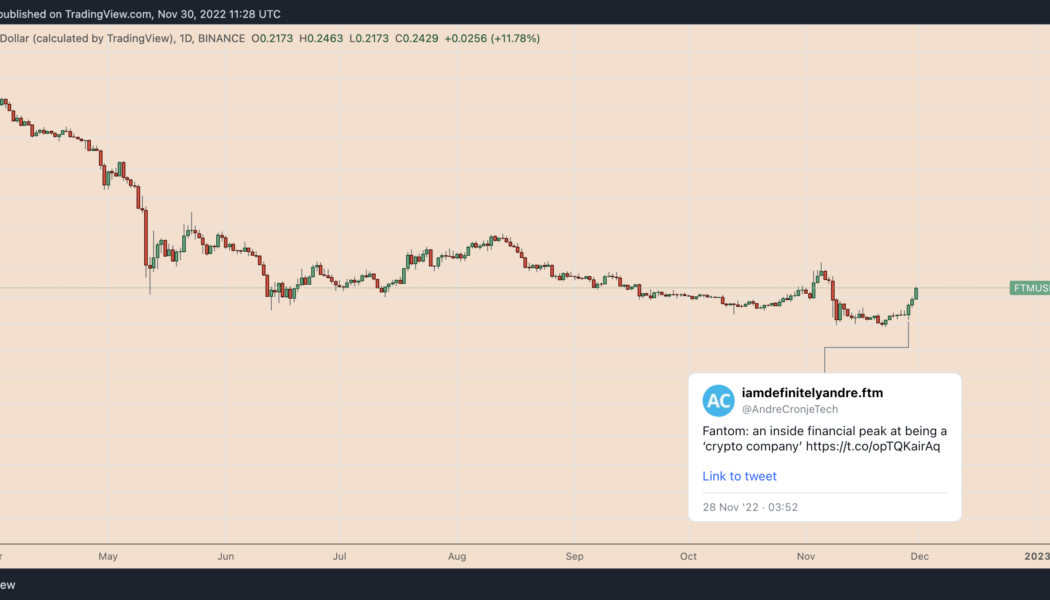
Fantom (FTM) continued its upward momentum on Nov. 30 amid reports that the Fantom Foundation generates consistent profits and has 30 years of runway without having to sell any FTM tokens. Fantom’s FTM holdings up from 3% to 14% FTM price gained nearly 13.5% to reach $0.24, its highest level in three weeks. The rally came as a part of a broader rebound trend that started when it bottomed out at around $0.17 on Nov. 22. This amounts to a 50% price rebound in the last eight days. Interestingly, the rally picked up momentum after the Fantom Foundation’s “Architect,” Andre Cronje, released the firm’s financial records on Nov. 28, revealing that it had $340 million worth of digital assets and had been earning over $10 million annually. Notably: ...

Uniswap launches NFT marketplace aggregator
According to a new post on November 30, decentralized exchange (DEX) Uniswap announced that users can now trade nonfungible tokens, or NFTs, on its native protocol. As told by Uniswap, the function will initially feature NFT collections for sale on platforms including OpenSea, X2Y2, LooksRare, Sudoswap, Larva Labs, X2Y2, Foundation, NFT20, and NFTX. “To bring users the first-rate experience they’ve come to expect with Uniswap, we built the aggregator to deliver better prices, faster indexing, more unassailable smart contracts, and efficient execution.” Uniswap developers claim that users can save up to 15% on gas costs compared to other NFT aggregators when using Uniswap NFT. unifies ERC20 and NFT swapping into a single swap router. Integrated with Permit2, users can swap...


Secret Network resolves network vulnerability following white hat disclosure
On Nov. 30, Guy Zyskind, CEO of privacy smart contract blockchain Secret Network, said that developers had patched a privacy-related vulnerability and users’ funds remain secure. In a document dated Nov. 29, Secret Network wrote that users or developers required no action and that all active nodes were upgraded to correct the exploit on Nov. 2. 2/ You can read the post for the main details, but the important part is that the vulnerability was mitigated and unlikely to have been exploited. Most importantly, funds were never at risk, because Secret intentionally does not rely on SGX for correctness – only privacy. — Guy Zyskind (@GuyZys) November 29, 2022 The sequence of events, unveiled late yesterday by the Secret Network developers, began when a group of white-hat computer sci...
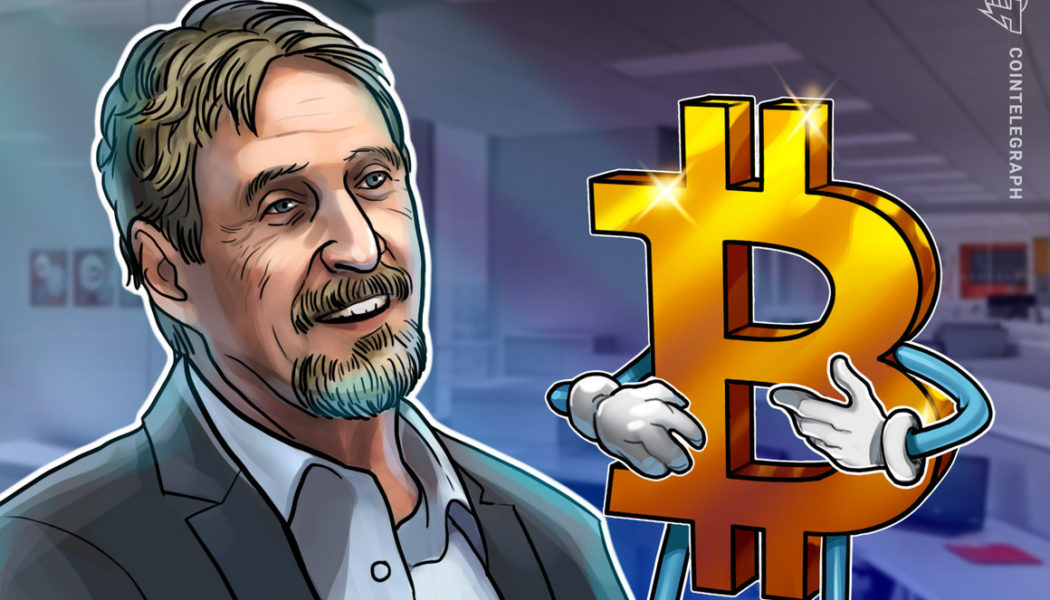

Crypto Stories: The late John McAfee tells the story of how he first found out about Bitcoin
From the Cointelegraph archives, John McAfee tells his crypto story and takes a look back at his very fascinating life. Early in his life, the computer programmer landed a job at the United States National Aeronautics and Space Administration, also known as NASA, and worked on the world’s first weather satellite. There, he learned about computer security and people’s concerns over unauthorized actors gaining access to private data. McAfee also shared that he made all his money not from the popular “McAfee” antivirus software but from other projects. He explained: “People know me from McAfee, but no, that was not my greatest success. That was some trivial thing. It was my future things, which I did not attach my name to, that taught me and made me all of my money.” In 2011, McAfee’s friends...

Warner Records’ Web3 Label Sold 5,555 NFTs in 7 Minutes. Now It Wants to Share IP Rights With Fans
What happens when you let 5,555 music fans make decisions at a major label? Warner Records is about to find out through its new Web3 imprint Probably a Label. After selling out a collection of NFT access-passes, the holders will now gather in a Discord server to help develop artists together, share the credits of any future awards such as a Grammy, and ultimately offer intellectual property rights in some of the projects to NFT holders. The experiment is a collaboration between Warner Records UK and Web3 brand Probably Nothing, whose debut NFT collection fetched $500k in seven minutes in October. Each NFT comes with different rarity and label roles (4,000 scouts, 1,500 managers and 55 label heads), allowing holders to vote on certain decisions. The rarest — and most expensive, currently at...

Blockchain-based supply chain platform canned by IBM and Maersk
United States technology company IBM and Danish logistics firm Maersk have decided to discontinue their co-developed blockchain-backed supply chain platform, TradeLens, citing a lack of “global industry collaboration” as a key reason behind the decision. Maersk stated on Nov. 29 that it has begun taking immediate action to cease operations on the platform, which should take full effect by Q1 2023: “The TradeLens team is taking action to withdraw the offerings and discontinue the platform […] During this process all parties involved will ensure that customers are attended to without disruptions to their businesses.” While the blockchain-based shipping solution was introduced by the two firms in August 2018 to help industry participants adopt more efficient international supply chain p...

Brazil passes law to legalize crypto as a payment method
While Brazil has not made Bitcoin (BTC) legal tender as El Salvador did last year, the South-American nation has passed a law that legalizes crypto payments throughout the country. The Chamber of Deputies of Brazil, a federal legislative body, has passed a regulatory framework that legalizes the use of cryptocurrencies as a payment method within the country. While this makes significant progress for crypto within Brazil, the law still requires the signature of the president of Brazil for it to be enacted. The passing of the bill does not make any cryptocurrencies legal tender within the country. However, the bill will include digital currencies and air mileage programs in the definition of payment methods that are under the supervision of the country’s central bank. After being passe...


South Korea issues arrest warrant for Do Kwon’s former colleagues
Amid the ongoing manhunt for Terraform Labs co-founder and CEO Do Kwon, South Korean authorities have spread out their investigations to target other Terra executives. Prosecutors issued an arrest warrant for co-founder Daniel Shin and seven other engineers and investors of the firm following suspicion of gaining illegal profits before the massive collapse of the Terra ecosystem. The Seoul Southern District Prosecutors Office in South Korea suspected that Shin possessed Terra (LUNA) tokens, which were pre-issued without the public knowledge of investors. In doing so, Shin allegedly bagged profits worth 140 billion won (roughly $105 million) by selling the pre-issued tokens during the bull market. Arrest warrants were also sought for three Terraform Labs investors and four engineers re...
