
“In some ways, softness is perceived as a weakness. But for me, I want to present softness as a strength.”
“When you take the Black body out of the context of how it’s stereotypically known, and put it up against historical ideologies, the narrative shifts.” Out with the Old Guard and in with the new. Fantasy, here, is reengineered into tools for unapologetic self-image. “It’s not just seen as some element of erotism, but as them owning their own prowess.”
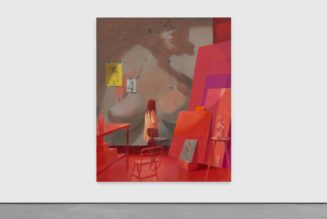
The process behind each work is cinematic. In the best films, she explains, the storytelling is all in the editing, taking contradicting frames and making them into one. Richly patterned compositions pull from her library of references, as various eras, images, and styles happily collapse into sites of belonging, memory, and leisure. Even visual juxtapositions can be orchestrated into a symphony when done carefully.
Thomas stops in front of another piece, “In Blue: The Thinker,” on the opposite wall. The figure, channelling Rodin’s iconic sculpture, appears otherworldly, the back of his body cloaked in deep lapis paint. “He’s blossoming and contemplating the next move,” she muses. The work emerged from reflections on the bodies among the transatlantic. “What was that like for them to harbor this strength, harbor this tradition of protection of their people, and to be stripped of that?”
The story of transformation, told throughout the show, is also one of transcendence. Working with non-binary and trans models, too, gives acceptance that much more texture and depth, all of which radiate from the seven-foot-long canvas, “I’m Here,” the largest work in the show. Inspired by the luminous stained glass windows at the Shepherd, a Romanesque-style ex-church, three picks from the new “Au Revoir” series are featured alongside the portraits, echoing ongoing themes of rebirth and sacredness.