
Frank Mwiti likes to say that he could have been an astronomer. He certainly shoots for the stars, because when he was a boy, he sent NASA a letter. The space agency replied with space magazines, and Frank became an instant celebrity in his local Meru School, a superstar. He was a new generation of nerd back then, its promised messiah.
Not that the CEO of the Nairobi Securities Exchange (NSE) has lost that sense of wonder. If the world is still an oyster, he has eaten most of it—devouring horses in Russia, whale meat in Japan and wrestling with the notoriously pungent fermented fish in Finland. He is down for whatever. “Paying for a trip has a better return on investment than going to a movie theatre or a lecture hall,” he says.
Travel has whetted his appetite for life. To cover the world before it covers him. It’s what an astronomer would do. “By the way,” he says, “I am an astronomer, not an astrologer. There is a difference.” The difference is he can’t read stars, but he knows, in his favour, they are aligned.
What is the best compliment you’ve received that has stayed true over the years? That I’m not a pushover. It came through earlier in my career, but it has become more pronounced as I grew older. If I think there is something that needs to be done and I am the person to get it done, then I walk the journey, and I won’t get pushed over. But there is probably an element of stubbornness too [chuckles].
What do you believe today that the 25-year-old you would not? Haha! I’m surprised that I am still in employment. Because as much as I’m in a leadership position, I had exited employment and started running my business, transitioned back to Kenya, and joined Ernst and Young as a partner. And a partner is an owner of a business. I’m happy where I am, but maybe in my twilight, I will go back to entrepreneurship.
Do you remember your first ever salary? PwC in the year 2000. When they offered me a role, I was on campus, and at that time, I had been offered Sh45,000 by KPMG. So I went and told PwC that if they wanted me, they needed to give me Sh50,000. They gave it to me, and I thought I had negotiated a lot of money [chuckles].
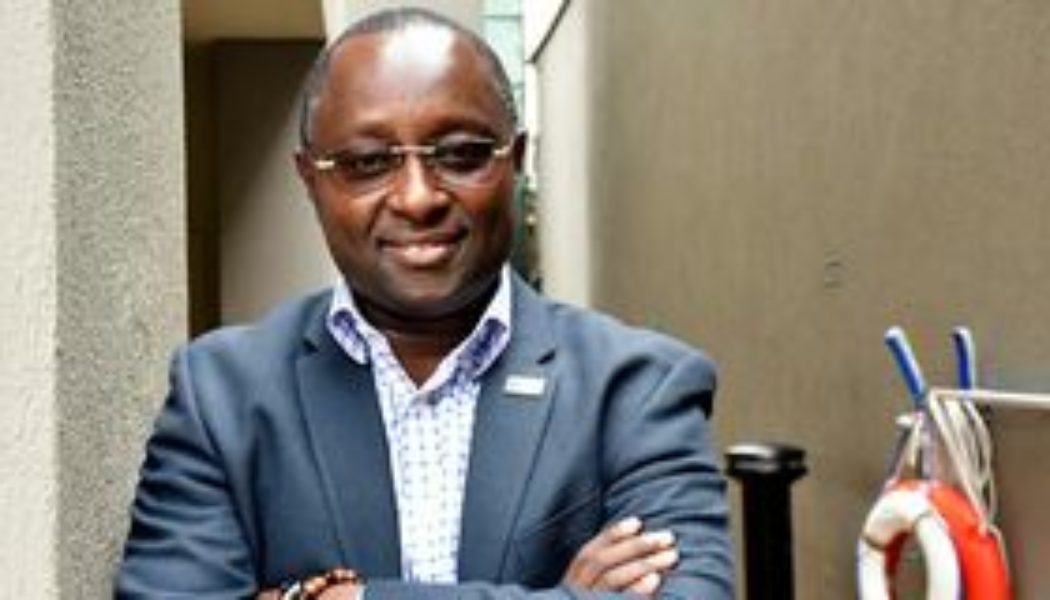
Nairobi Securities Exchange CEO Frank Mwiti poses for a photo at Radisson Blu Hotel, Nairobi on July 10, 2026.
Photo credit: Francis Nderitu | Nation Media Group
Was that good money? For a young single man? Okay, my context is different. When I joined university, I was already doing different biashara. I was selling stationery; I had some part-time accountancy job, I had done my CPAs. I was selling clothes from Gikomba…I had money. Sh50,000 in 2000 was good money haha! And it was constant too.
What did you understand about money then that has been helping you till now? Saving. Biashara money was volatile. Getting into employment and having a constant check that was also supporting savings into pension. I saved in Saccos, and used some money to buy I shares in the NSE. I have kept that discipline.
What do you admire most about that young man? He was very intellectually curious. He embraced change very early. And that has actually been a big contributor to my career growth. He enjoyed himself, and aspects of that have remained. I read a lot, especially documentaries and astronomy. I am an amateur astronomer.
What does that look like, astronomy? Looking at the sky, following developments around matter and space. Thinking about my early childhood, big ambition to be an astronaut and go to the moon. I would love to travel in space. That’s on my bucket list. I’m a member of the Kenya Space Society. I love going to Meru just to look at the stars; you can’t do that in Nairobi. Space grounds you—how significant and insignificant we are.
How does a boy from Meru start learning about space without people thinking he is going cuckoo? I have always been fascinated by space. I decided one day to write a letter, while in Standard Four, to NASA. True story. I bought a stamp, sent the letter, and a year later I got a package from NASA with magazines about rockets, space travel, the astronaut club, such things. I was a big celebrity in my school then [chuckles]. They told me that being an astronaut would be tough, so the next best thing was to be a pilot, which is how I ended up at Mang’u High School, which offered aviation classes.
How do you ensure the boy in you doesn’t lose that sense of wonder? By remaining curious and not defining myself by the work I do. To lead a full, purposeful, healthy life, you have to have different interests and accommodate them. I’ve never gotten to a point where I think it’s all work and nothing.
How has astronomy changed the way you live? One, it has enabled me to have other friends and relationships outside work. Two, it has informed my view of life, which is that we really are stewards of this planet. It’s incomprehensibly big, which means you cannot consider yourself overly important. Three, it’s an escape from all the pressures and stresses of working life. I couldn’t care less about football; I know I’m a nerd [chuckles].
Tell me about your shamballa. Do they have a meaning for you? All of them have serious meaning, and I have had them for long. I have one that speaks to my continent, Africa. I lived in the UK for 15 years, and part of the reason I came back is that I feel we need to pull our weight because no one is coming to save Africa. It’s for the same reason I have one Shamballa for Kenya. Then I have this one, that’s about my children, why I wake up every day. There’s Leo, my son; he’s seven, so that tells you I started late [chuckles]. And my daughter, Rose Watiri, but we call her Teshi. This other Shamballa was from my wife. And the final one reminds me of my extended family. I have been wearing my watch on the right since the year 2000.
Starting a family late, do you think your children got a better father now than they would have if you had started earlier? Yes. I look back now, and I feel I really was absolutely inexperienced. I got my children in my 40s. They now have a more patient father compared to who I was in my 20s and 30s. I don’t suffer fools. I was fairly impatient. Now I am more sober. They also have a more experienced father, who has figured out his life’s purpose.
How did you block out the pressure of your contemporaries having children earlier? So you’ve assumed it was a plan? Haha! I used to say I would marry when I was 35. It was just life happening the way it did. You go through ups and downs. You have relationships that don’t work and all that. With hindsight, this has been fantastic. It is working exactly how it should work. I am very happy.
When your children are adults, you will be at a different stage of life than many other fathers. How does that shape the way you think about the years ahead? My focus is to bring up children who are globally oriented. I also want to bring up children who have moral values, including respect and hard work, not just instructions. I also want them to be proud of being African.
How has travel changed you? I’ve been very fortunate to travel the world extensively. In Africa, you can count on my hands where I have not been. Perhaps that’s part of the reason I got married late. I was all over the place [chuckles]. In many ways, that has also contributed to who I am now. But it has also helped demystify some of these places and made me realise they have serious challenges, but also that some have absolutely done phenomenal transformation that we can learn from. Travel widens your perspective.
What’s your top travel tip? Be open-minded. I would even say don’t plan everything to the T. Go off the beaten path. When I travel to a popular tourist destination, say Rome, I try the local areas and food. The tourist places are very sanitised and scripted for you and boring, actually, in my view.
How has travel changed over the years? When I moved to the UK in 2004, and budgets were very constrained, I only went to the common places. Over time, I have been more adventurous, going to destinations others are not going. I value local guides. The difference is real. The local guide will accompany you and tell you stories about things that are very different from if you were just sauntering alone. They will even make you notice things you wouldn’t otherwise have noticed. Be open to cuisine too. I can eat anything.
What’s the strangest thing you’ve eaten? Frogs. Horses in Russia. Whale meat in Japan. I have tried shark meat too. I don’t hold back [chuckles]. There is a fish (surströmming) in Finland that smells so bad; in fact, it is rotten. I have eaten that one too haha!
What’s a misconception about travel you’d debunk? That it’s expensive. Travel is not expensive. Buying travel tickets early can be very affordable. Travelling is not just about plane tickets; a lot of Kenyans have not even been to Uganda or Turkana. What is travel for you? Start where you are.
What habit are you trying to break? I have many [chuckles]. One is being preoccupied with work. I want to strike a better balance between work and life. If I have more life than more work, then all the other things I can solve. But I also want to be a better person. Eddie, we need to be optimistic about our continent. We have everything we need to make Africa successful. More of us need to commit to unlocking Africa’s potential.
What part of success disappointed you? Maybe not disappointing but eye-opening. You climb a hill. You get to the peak. And then you find there’s another hill. It’s a sobering, Herculean task.
When is it enough? It’s enough when it’s served its purpose. If I set out to do a task or to accomplish a goal, and that goal is accomplished, in my view, it’s enough. They say money will never be enough. Money itself has no value. It’s what you use it for. And it’s enough when the purpose for which you set out to do is accomplished.
What do you do today exactly the way your mother taught you? I have to be tidy. When I wake up, I have to make the bed. I need to wear clean, polished shoes. My mum said, “Be tidy.” My dad said, “What you start, you finish.”
When you look in the mirror, what do you hope to see? The man staring back at me is a man who knows his weaknesses and his strengths, and has come to embrace them. But it is also a man who is very purposeful in playing a role in Africa’s transformation, which starts with me being a responsible father and husband. And then it goes to my country.
Tell me a life secret that life has taught you. Be you, the world will adjust. It also removes a lot of stress [chuckles]. In my 30s I realised I needn’t copy others, just be you.
What’s your superpower? I can focus, and I see my daughter has the same focus. I don’t get easily distracted.
How do you do that considering the world we are living in today, everything wants your attention? It’s down to things that align with my interests and my purpose. If it’s not aligned with my interests or my purpose, it doesn’t attract my attention. It can be in my view, but the filter is my interests.
When was the last time you did something for the first time? Two weekends ago, I switched off my phone on Friday and switched it back on on Monday. The stock market did not crash, which tells you I built a team and an institutional system that works haha! It was liberating! We all underestimate how much the phone has enslaved us.
What is your top tip for the second half of 2026? The stars are aligned with my purpose, which is to champion Africa’s transformation and the success we are having at the NSE. The peace and the joy of my family. When I look up at the sky, it confirms that I’m a child of the stars and the stars are with me.
What success metric no longer defines you? Being praised. See, you don’t require external validation. You know you’ve done it, whether you are praised or not. When I was younger, that mattered a lot.