
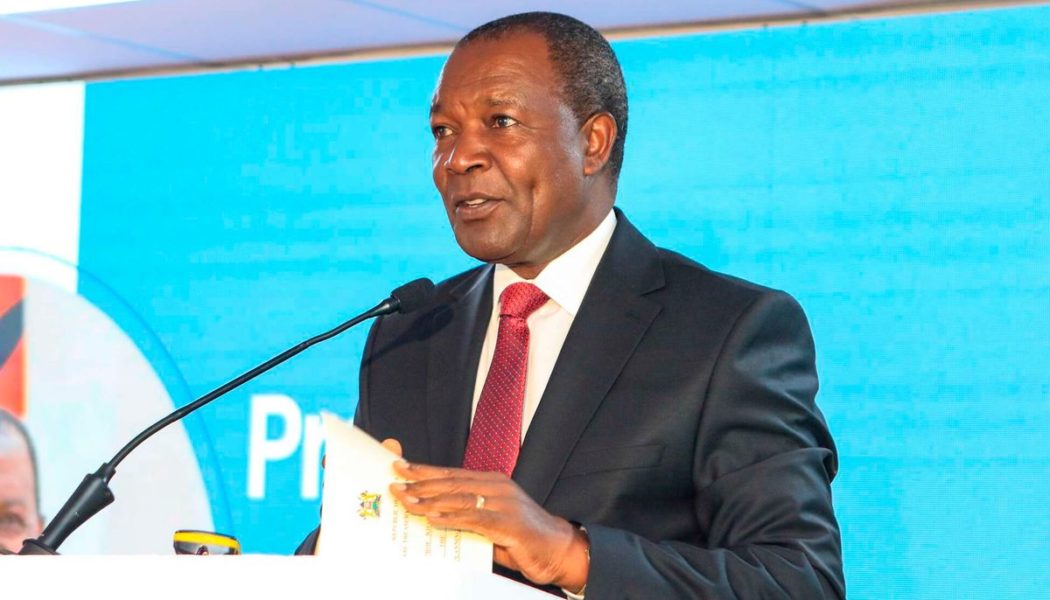
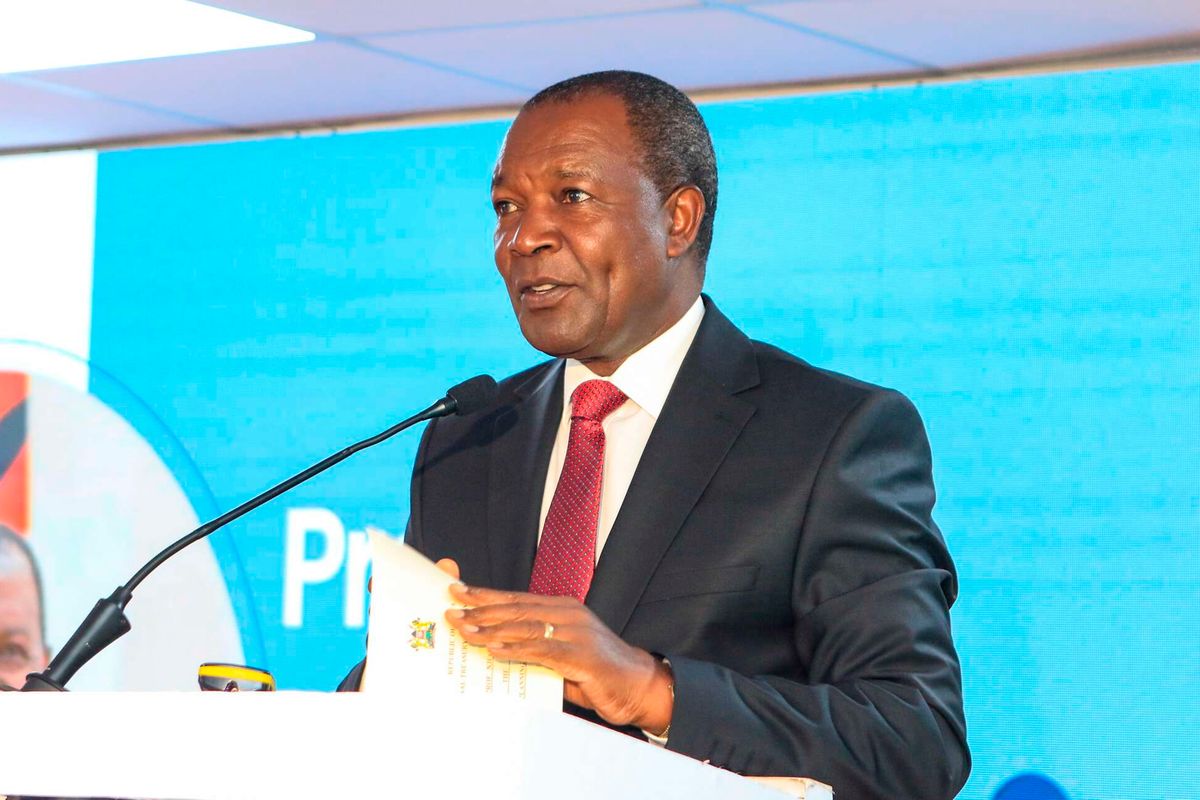
The former Cabinet Secretary for the National Treasury has described President William Ruto’s leadership style as a one-man show in which the Head of State overshadows independent institutions.
Speaking as a guest speaker in a conference on aid in Sweden, Professor Njuguna Ndung’u accused President Ruto of frequent interference in the affairs of independent institutions, which, he said, has hampered their ability to discharge their mandates.
He said that although institutions have the capacity to do the right thing, their ability to do so is constrained by what he described as “the institutional failure problem”, where “somebody wants to overrun the institutions.”
“Right now, the current president (Dr Ruto) overruns all the institutions,” said Prof Ndung’u, before asking the media to go ahead and quote him.
“And that is why everybody in those institutions has to conform for fear. But I refused to do deals in the Ministry of Finance,” said Prof Ndung’u.
State House officials did not respond to our questions on the remarks by the time of going to press.
This is the first time Prof Ndung’u, who was dropped from the Cabinet following the violent Gen Z-led anti-tax protests in 2024, has spoken publicly about his often-frustrating tenure at the National Treasury.
The remarks bring into sharp focus President Ruto’s leadership style, which critics have cast as that of a micro-manager, while his supporters portray him as a hands-on leader with a firm grip on every aspect of government.
It is not the first time reports have emerged of how President Ruto’s hands-on leadership has rattled some of his allies, who have spoken of low-ranking officials receiving high-voltage phone calls from the most powerful man in Kenya, while others have been caught off guard by off-the-cuff pronouncements with huge implications for their dockets.
Recently, President Ruto announced that university education would be free, catching most policymakers off guard, even though, not long ago, he had insisted that such a move was not possible.
Political associates and technocrats in the Kenya Kwanza administration have painted a picture of a President in full control of operations in his administration.
While some characterise this as being hands-on and decisive, others say it is peppered with meddling and threats that make it hard for officials to do their jobs independently.
During the signing of performance contracts for Cabinet Secretaries and Principal Secretaries (PS) at State House on August 1, 2023, President Ruto wondered why he knew more than his ministers. He also admitted that he made calls to his PSs.
“The moment I know more than you in your ministry, then you must begin to understand that something is very wrong. Because, by the Constitution, you are supposed to advise me. Explain to me how you are going to advise me if you have less information than I have,” said President Ruto.
“I call many PSs and ask them what is going on… they have no clue… and this is your department. You are not a messenger, you are not a security person, you are not a photographer, you are not a watchman. You are the PS or the minister,” he added.
The hands-on leadership style stands in stark contrast to the laid-back approach adopted by his predecessors, Presidents Uhuru Kenyatta and Mwai Kibaki, who preferred to let their ministers work independently.
However, the President and his supporters see this as a virtue rather than a vice. They say he wakes up early and retires late, with his diary perpetually full.
Before he was axed from the Cabinet following the anti-tax protests against the Finance Bill 2024, there were rumours that Prof Ndung’u wanted to resign.
The Finance Bill 2024 sought, among other things, to introduce a motor vehicle tax, impose value-added tax on bread, and increase excise duty on mobile money transactions and airtime.
In his handover speech, Prof Ndung’u coyly laid bare his frustrations, noting that the National Treasury had struggled to stabilise the economy because of persistent shocks.
He added: “There were also inconsistencies in terms of internal politics.”
At the beginning of its reign in late 2022, the Kenya Kwanza administration resembled a Tower of Babel.
When he came to power, President Ruto preferred a governance system in which he relied on a group of powerful advisers domiciled at State House.
This group of economic advisers—a kitchen cabinet of about seven individuals whose public face was the vocal economist Dr David Ndii—played an outsized role in shaping the country’s economic policies during Kenya Kwanza’s first two years.
One of the main points of friction between Prof Ndung’u and the Ruto administration was what he described as the “notion that high tax rates will raise high tax revenue.”
“The reality is the opposite. I don’t want to mention who drives us there,” said Prof Ndung’u.
The idea of increasing tax rates to collect more revenue had never sat well with the economics professor.
In the Finance Act, 2018, the former administration of President Uhuru Kenyatta increased the excise tax on money transfer services by banks from 10 percent to 20 percent, on telephone services (airtime) from 10 percent to 15 percent, and on mobile phone-based financial transactions from 10 percent to 12 percent.
The Act also introduced a 15 percent excise tax on internet data services and fixed-line telephone services.
Prof Ndung’u was not pleased. In August 2019, he authored a policy brief arguing that increasing tax rates beyond a certain point could reduce, rather than increase, tax revenues, warning against relying on ever-higher taxes to finance government spending.
The criticism comes as questions continue to be raised over the concentration of decision-making at the centre of government.
It is not the first time a former senior government official in the Kenya Kwanza administration has criticised President Ruto after leaving office.
Former Public Service Cabinet Secretary Justin Muturi, after exiting government, accused the President of presiding over a corrupt administration.
President Ruto rose to power promising to dismantle what he termed State capture, arguing that institutions such as the Kenya Revenue Authority, the Directorate of Criminal Investigations, the Assets Recovery Agency and even the courts had been weaponised by his predecessor to target his political allies.
However, critics argue that the President has increasingly centralised decision-making, often taking positions on matters that traditionally fall within the remit of Cabinet Secretaries and heads of independent institutions.
During the debate over the Finance Bill 2024, President Ruto became the face of the controversial tax proposals that culminated in violent nationwide protests, appearing to take the lead on issues ordinarily expected to be driven by the National Treasury.
In 2025, following the mosquito net procurement scandal at the Kenya Medical Supplies Authority (Kemsa), President Ruto sent the entire board home, including the CEO, reigniting debate over the extent of presidential involvement in the running of State corporations.
Following the Kemsa sackings, former Azimio la Umoja-One Kenya coalition leader Raila Odinga publicly faulted President Ruto’s leadership style, arguing that Cabinet Secretaries should be allowed to make policy decisions within their ministries.
“A government should be administered as such, with ministers entrusted with specific responsibilities. Why do we not see ministers addressing key policy matters? It is the President who is making important policy decisions. If there is a major policy statement in Education, it should come from the Minister of Education,” said Mr Odinga.