
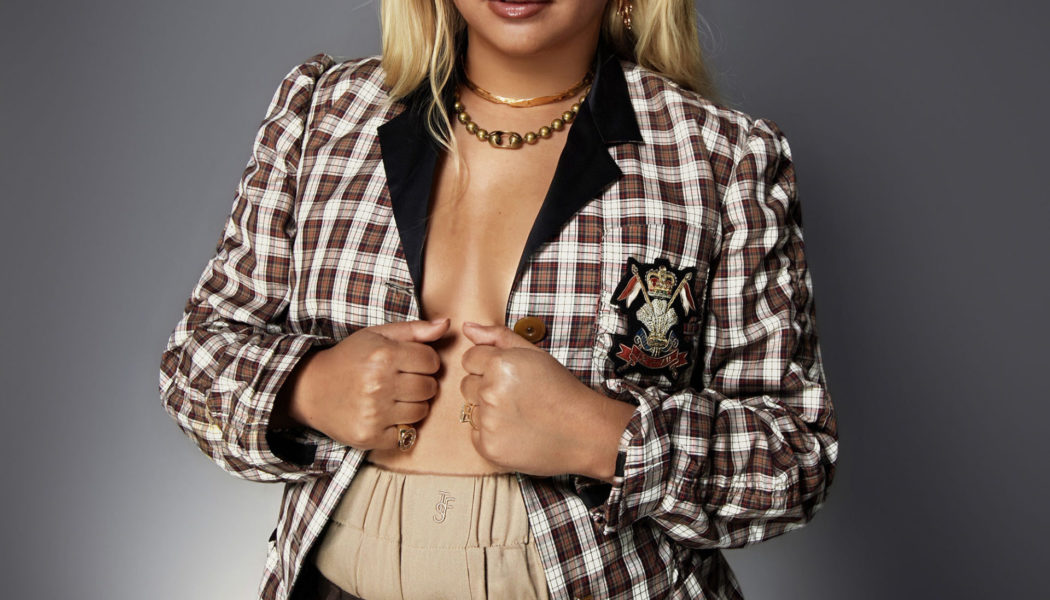
In 2015, Hayley Kiyoko released her single “Girls Like Girls” and subsequent viral music video starring Stefanie Scott as Coley, a 17-year-old girl navigating a crush on her female friend Sonya (Kelsey Chow). The empowering anthem for queer women was a breakout hit for the artist. Since its release on YouTube, the video has accumulated 163 million views and over 171 thousand comments, mostly calling for Kiyoko to expand on the teen dream world she created. In 2023, the artist released Girls Like Girls, the number one New York Times best-selling novel praised for its portrayal of sapphic youth, but the goal for Kiyoko was always to create a feature-length film. Eight years in the making, Girls Like Girls finally hits theaters this month.
While getting Girls Like Girls off the ground was not without its challenges, Kiyoko believes it to be the most authentic version of the story of Oregon teens Coley and Sonya. Similar to its music-video predecessor, the film sees Kiyoko at the helm and fresh-faced rising stars as its leads, with Maya da Costa and Myra Molloy delivering standout performances steeped in vulnerability. Everyone can relate to the emotional high stakes of pursuing a crush, and Girls Like Girls captures that experience beautifully through a nostalgic lens and summer-tinged soundtrack. In its final form, Kiyoko’s Girls Like Girls is at its best.

(Image credit: Grace Scuitto)
Take me back to writing your 2015 viral hit “Girls Like Girls.” What did it represent for you at the time?

It was a rainy day in Los Angeles in 2015, and I remember one of my cowriters, [Lily-May Young], was like, “What is the thing you’re most scared to share with the world?” I cried and was like, “I’m gay.” It was the first time I had really come out to any of my coworkers, and we wrote a song about how I wish I felt approaching women and feeling confident and “stealing kisses from your missus.” It was this manifestation of wanting to be confident in self-love and self-worth. It’s so wild to see where the seed was planted, to release the music video, to have the book, and now the most authentic version of this story, which is the feature film.
What was the catalyst for turning the music video into a novel? Why that medium?
There were so many comments like, “We need this as a feature film” and “I want to know more,” and I realized there was a big space and hole in media and representation for sapphic women that I wanted to contribute to. Expanding the story of Coley and Sonya and finding a way to tell my personal story when I fell in love with this girl in high school through the lens of Coley and Sonya was really exciting for me to do. I felt like it was just important to be able to have that representation, especially as a half-Japanese, half-white person growing up in Los Angeles. In the book, I made Coley half Japanese and half white and got to indulge in more of her internal struggles.
Growing up queer when you know you’re queer and you’re hiding it, it’s a very silent journey because you’re not sharing it with a lot of people, so the book really gave me that medium to share my experience as a queer teenager navigating young love and how life-and-death it feels. When you fall in love with someone, you’re like, “I’m going to marry this person.” That’s why when I finally was able to direct the movie, I approached it from a mature lens. …Even though our protagonists are young women, you feel like you’re 35 when you’re 16, 17 years old—like, “I have it all. I know it all.” That was really important to me with my approach.
I heard it took about eight or nine years to get the film greenlit. What were some of the hurdles you faced in that time?
I think a lot of people don’t understand the filmmaking process and how long it can really take and the challenges you have to go through to get there. It was, How do you write a great story? How do you pay for that story? Who’s paying for that story? How do you get people to believe in you as a first-time filmmaker and to invest and take a chance on the fact that maybe there is a community that wants to see the story? So for eight years, with so many nos and so many “we’re not sure”-s and so many “Oh my gosh, we almost shot it, but we’ve lost our funding” or “We can’t shoot there anymore,” it was full circle when I finally got the green light and we were finally going to shoot the film.

(Image credit: Grace Scuitto)
Your first director credit is the “Girls Like Girls” music video, and now, your first feature-length director credit is the Girls Like Girls film. How have you grown in that time as a director and artist?
I think I started directing out of necessity. I codirected “Girls Like Girls” with Austin Winchell back in 2015, and I was like, “Oh my gosh, I love directing.” This is what I’ve always been doing. I just didn’t realize it. From there, I directed 11 of my music videos after that, and I just caught the bug of “I love storytelling. I love world-building.” But then you’re a woman of color trying to be like, How do you actually direct a feature film? And how do you create this trust with people to be like, “Hey, let’s direct a 90-minute film”? It’s just been an ever-evolving journey.
As an artist, I’ve always had to create from a place of necessity of not being able to hire a director and having to step in, and with this feature film, it was really cool because it was like coming home. I love directing. I love storytelling. I love casting. I love writing music. I love creating worlds, and I did create this out of necessity because we need a movie like this more than every 10 years, every 20 years. But I also felt like this movie was just a love note to my younger self who felt so unseen and lost. Even every single person, no matter who you love, has had to approach their crush and be like, “Do you like me back or not? Are we moving forward or not?” It’s so nerve-racking, and it’s so vulnerable. These experiences bring us all together. I’ve evolved immensely as a director. I feel very confident in who I am and in my vision and that I want to continue to do this forever.
Talk to me about the casting process for the film. Stefanie Scott and Kelsey Chow, who played Coley and Sonya respectively in the music video, were fresh faces at the time, similar to the film’s leads, Maya da Costa and Myra Molloy. What was important to you in terms of finding these leads?
Maya da Costa was actually the very first audition tape I was sent. We had over 4000 submissions, and I watched her tape, and there was a moment at the end where she was just sitting on the bed in Sonya’s room and taking in the space. I remember that moment of being in my crush’s room, and you’re just like, “Oh my gosh, this is so vulnerable that it is their space.” And I was like, “She’s gonna be the one to beat.” She was 18 when we shot this movie. She’s just so authentic, so innocent, and just so Coley. I’m so proud of her performance.
Myra actually auditioned for Coley [first]. She turned around, was wearing this jean jacket, and I was like, “Uh, you’re Sonya,” so we brought her back for a chemistry read. It wasn’t planned, but I’m so proud that both leads are half Asian and reflect what I look like and represent my experience so authentically. But I love working with young talent. I think it’s really exciting to be immersed in a film and to not be like, “Oh, that’s so-and-so.” It really gives the audience a blank slate going into it. So I was so grateful that Focus Features and my producer team supported me in casting young, new talent for this film. Also, as an actress back in the day, I would have dreamed to be able to be a lead in a movie like this, so to be able to pass the baton and create that space for these young girls to shine bright as they are is super rewarding.
You cowrote the film with Stefanie Scott, who was in the original music video. Was that always the plan from the beginning?
I’m so grateful for Stefanie. She took a chance on me and starred in my music video when I was a nobody and then was very involved early on in the development process of the story. I felt it was important because she originated the character of Coley in the music video. From there, I took it on, and there’s been so many different iterations and life-forms of this story, but I’m so grateful for her. The music video was so special, and she was a big part of that.

(Image credit: Grace Scuitto)
The story and film are set in 2006, which was very nostalgic for me watching as someone who graduated high school in 2005. Why did you want to keep this particular time period for the film versus setting it today?
My experience was in 2006, falling for my crush at that time period. My experience was AIM. My experience was MySpace or waiting for people to text you back, and you only have so many characters to text someone back. I just wanted to tell my authentic experience and story, so it was really important for me to set it in 2006. To be honest, it’s so funny. It is nostalgic and timeless, but also it’s kind of current even now because I feel like their fashion is very Gen Z. So it’s totally a throwback, yet it’s very modern.
Can you tell me about working on the film’s soundtrack, which features collaborations with other queer artists?
When I finished the film, my dream was to have some kind of soundtrack inspired by an album. It was so awesome to jump back into the studio and write music through the lens of the characters’ eyes. Also, I approached this album of not overthinking it and going back to my roots. I used to write songs on the guitar in my bedroom, and going back to my younger self, a couple of the songs in the actual film were ideas that I had started when I was 16 and was able to write and complete it for the film.
But every artist on this soundtrack—with Young Miko and Tegan and Sara and Gigi Perez and Chelsea Cutler—they’ve all been somehow connected to Girls Like Girls. So when I was putting this together, I was like, “I want to bring my favorite artists together to celebrate this cultural moment,” and I’m so grateful for these artists to collaborate with me. I also got to genre-bend because there’s so many different genres. There’s literally a song for everyone. It’s one of my favorite albums. I’m so excited for people to hear it. Honestly, I just tried to write an album that I wanted to listen to. The brief was summer nostalgia, and if it feels like summer, if it feels nostalgic, then it’s going on the album.
If you could expand on another one of your singles via a novel or film, which would it be and why?
I don’t know if I’ll ever do a journey like this ever again because it was so long. But I love “Gravel to Tempo,” and I had done a music video to that song that I really loved and was more my experience in high school. “What I Need” featuring Kehlani is really great, too, and is a great music video. I’m so proud of all my music videos, actually, and music videos are so hard to make. I mean, just any kind of visual is so hard to make nowadays, but I’m looking forward to the future. I have my second book, Where There’s Room for Us, so maybe I’ll be able to make that into a movie or a TV show. Adapting a song into a movie, this might be a one-off.
Girls Like Girls is in theaters June 19.
Explore More: