
Physiotherapy is increasingly emerging as one of the most popular courses among Kenyan university students, reflecting a shift in career interests and a growing awareness of rehabilitation medicine.
The latest Economic Survey report published by the Kenya National Bureau of Statistics shows that the number of students enrolled in physiotherapy rose by 29 percent to 730 in the 2024/25 academic year, up from 566 in 2023/24 and 429 the previous year.
Although still relatively small compared with traditional medical programmes, physiotherapy is recording some of the fastest growth rates among health-related courses. The field had 420 students enrolled across public and private universities in 2021/22, highlighting the speed at which interest has accelerated.
As demand surges locally and abroad, these healthcare professionals are also finding career opportunities beyond Kenya’s borders.
Women continue to account for the majority of students entering the profession. In 2023/24, female students accounted for 307 enrollments compared with 259 men.
The surge in enrollment reflects a broader shift in healthcare, where rehabilitation is no longer seen as an add-on but as an essential part of patient care.
Physiotherapists are being hired in hospitals or specialised centres to help patients heal from injury, manage chronic conditions and deal with age-related conditions such as arthritis, stroke, and mobility problems.
At Kenya Medical Training College (KMTC), growth in physiotherapy training is evident at the diploma level. Enrolment in physiotherapy-related diploma courses more than doubled from 300 students in 2023 to 673 in 2025, signalling rising confidence in the profession’s career prospects.
Dr Kelly Oluoch, chief executive of KMTC, told BDLife that increasing interest in physiotherapy is being driven by both public awareness of the profession and growing demand for rehabilitation services worldwide.
“First, it is being driven by awareness about physiotherapy and what it is in terms of its scope (career),” he says. “Second, there’s demand for physiotherapy services in the community.”
Why Germany
Such demand, he elaborates, is no longer confined to hospitals. Physiotherapists today work in sports clubs, rehabilitation centres, special schools, and provide private home care. Others, he notes, build careers independently, offering home-based therapy to stroke patients, people recovering from fractures, and children with developmental challenges.
“Physiotherapy is one of the few health professions where you do not necessarily need formal employment,” says Dr Oluoch, making the course attractive to those looking to go into self employment.
The profession’s global mobility is also a major pull factor for students looking for a lucrative career path. Germany, in particular, has emerged as a significant destination for Kenyan physiotherapists.
“Just last year, we were able to process papers for 84 people to practise in Germany,” he says, adding that the main requirement is proficiency in the German language to enable ease of practice.
Dr Oluoch notes that increasingly, students with high academic grades, many of whom would traditionally pursue university degrees, are opting for diploma training in physiotherapy and related areas such as sports science.
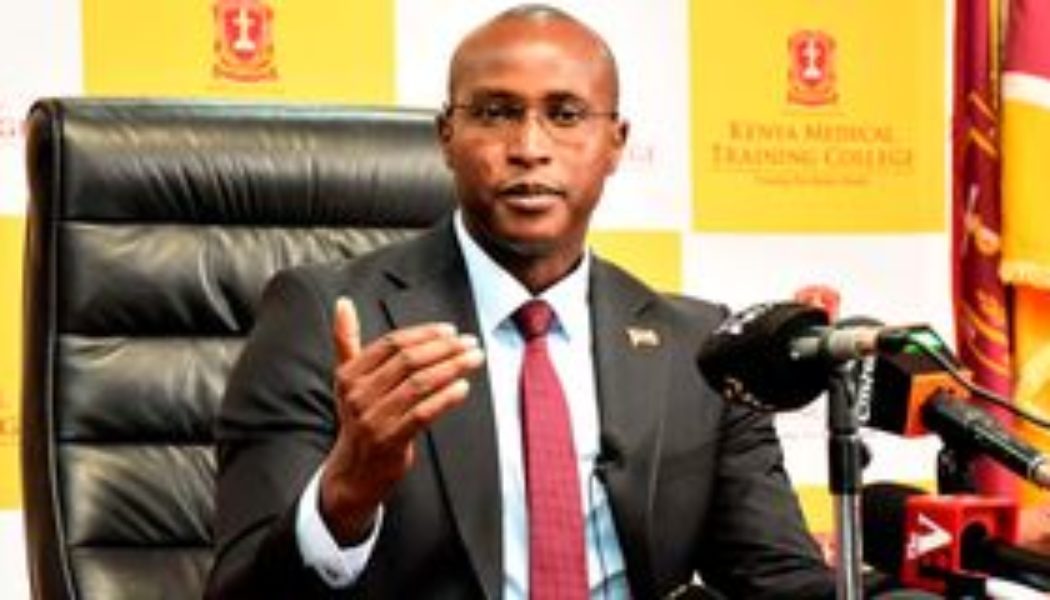
Dr Kelly Oluoch, Chief Executive Officer of the Kenya Medical Training College (KMTC), addresses journalists at the institution’s headquarters in Nairobi on April 30, 2026.
Photo credit: Shutterstock
The profession is also attracting career changers, suggesting its appeal extends beyond school leavers and reflects growing confidence in long-term employment prospects.
Most undergraduate and diploma students are aged between 19 and 23 years, but KMTC, which specialises in orthopaedic manual physiotherapy, neurorehabilitation, women’s health and pelvic rehabilitation, is also seeing applicants above 25 returning to study after completing university education or working in other fields.
“Students joining diploma programmes like physiotherapy at KMTC are no longer the traditional secondary school leavers.”
Misconceptions persist
Yet, despite the profession’s growth, misconceptions persist.
“One misconception is that the course is not very clinical. People think that any medical course should constitute some level of invasive care, such as operating on fractures or injecting patients,” says Dr Oluoch.
“Others think physiotherapy is synonymous with massage and exercises, and therefore it does not have the prestige of medicine.” Physiotherapy, he emphasises, is a tightly regulated profession overseen by the Physiotherapy Council of Kenya. Practitioners cannot simply open clinics without accreditation and proper training.
“We don’t exceed 50 students in a class. For higher diploma programmes, the numbers are even lower, at around 30, because we are dealing with human life. A health provider who is not well-trained or half-baked is more dangerous than having no health provider at all,” he adds.
Dr Oluoch points to rapid technological advancement and the growing emphasis on evidence-based practice in physiotherapy.
“Our training is competency-based. Seventy percent of the time, our students practise either in the lab or in a clinical setup. So we need a lot of clinical placement sites to enable our students to easily access and practise.”
Canada, Australia
At Jomo Kenyatta University of Science and Technology (JKUAT), physiotherapy programmes start from the undergraduate to the post-graduate level.

A physiotherapist guides a female patient through a resistance-band exercise during a rehabilitation session at a clinic.
Photo credit: Shutterstock
The number of physiotherapy graduates at the university rose from 52 in 2023 to 94 in 2024, and then dipped to 90 in 2025. Female students outnumber their male counterparts.
Dr Wallace Karuguti, who oversees the university’s rehabilitative sciences, says the demand has been on an upward trend, particularly at the Bachelor’s degree level, over the past three years.
The profession depends on close supervision, specialised equipment and extensive clinical exposure, making uncontrolled expansion difficult. Although it can accommodate as many as 70 students, the university generally limits Bachelor of Science in Physiotherapy classes to 50.
“Physiotherapy is not a cheap course. It is also a skill-based profession, so numbers can affect the quality of graduates you get. We try to limit the numbers because we do not want to overpopulate the training facilities,” says Dr Karuguti.
He notes that the global labour movement has significantly increased opportunities for Kenyan graduates, particularly in countries facing ageing populations and rising rehabilitation needs.
“Physiotherapy is universal. A physiotherapist trained in Kenya can work anywhere,” he says. “There has been a very high labour movement to Europe,Canada, the US, and Australia.
Minimum entry requirement
Dr Karuguti notes inter-university and intra-university transfers into physiotherapy are increasingly common, especially from science and clinical courses.
“Mostly, we get transfers from science courses or even from clinical medicine. Medicine students rarely shift.”
JKUAT is also currently the only university in Kenya enrolling postgraduate students in Master’s in Physiotherapy, reflecting the institution’s growing role in advanced rehabilitation training.
Although the minimum university entry requirement for the course is a C+, students with stronger grades often secure placement first.
“The numbers that can be accommodated will usually be taken by students with As and Bs grades early. If you have higher grades, you are more likely to get the course than someone with lower grades,” says Dr Karuguti.
Private institutions, like Amref and other colleges, have also entered the market, offering physiotherapy-related courses at the undergraduate level.