Kenyans living abroad are sending home about Sh280 billion annually in unrecorded remittances through informal channels and non-monetary items, indicating that they are playing a bigger role in funding households than was previously thought.
A new official survey of diaspora remittances shows that total inflows stood at Sh931.8 billion in the 12 months to May 2025, inclusive of in-kind items and cash that was brought into Kenya outside of formal channels like banks and remittance service providers.
This amount is Sh280.6 billion higher than the Sh651.2 billion inflows that were recorded by the CBK through formal channels like banks, mobile money and remittance service providers in the period.
The survey was carried out in August 2025 by the Kenya National Bureau of Statistics (KNBS), the Central Bank of Kenya (CBK) and Financial Sector Deepening Kenya (FSD Kenya), polling a total of 4,400 households. This is the first comprehensive nationwide assessment of household remittance flows in Kenya.
Remittance inflows in cash stood at Sh848.4 billion, while the in-kind flows totalled Sh83.5 billion.
“The report has revealed the invisible 40 percent of remittances that we did not see, that was in the informal channels. This is the money that is quietly pressed into the palm of a cousin you meet when you go back home, or the phone that somebody carries in their luggage for you,” said FSD Kenya chief executive officer Rashmi Pillai.
Some of the channels preferred by those sending money home informally include in-person delivery through self or relatives who are visiting home, Hawala systems or through cryptocurrencies. The main motivation for using these channels was to cut the cost of transmission, speed, and ease of access.
For the in-kind delivery of goods to relatives, 30 percent of Kenyans living abroad either deliver the items themselves when visiting, or hand them to other travellers to deliver to recipients. This way, senders avoid high courier charges, reduce the risk of loss or damage, ensure timely delivery to intended recipients, and bypass complex customs procedures.
For those living in neighbouring countries — particularly along the Uganda and Tanzania corridors— 26.8 percent reported using road transporters including buses, matatus, motorcycles, and bicycles to ferry goods to their relatives in Kenya.
Dense social networks, frequent cross-border mobility, and short travel distances make road transport convenient and affordable for small consignments from neighbouring countries, the survey found.
This higher-than-expected volume of cash and items being sent home from abroad has also highlighted the growing importance of the transfers to households, especially in a time when budgets have become constrained by rising cost of living and stagnant wages in the formal sector.
Critical buffer
In the survey, 73.1 percent of recipient households said that they use a significant part of their cash to purchase food and other basic consumer goods, making the continued support from relatives abroad a critical buffer against economic vulnerability.
Education and medical expenses also featured prominently among the key uses of remittances at 31.4 percent and 23.9 percent respectively, followed by purchase of clothes at 19.8 percent, payment of rent at 9.3 percent and ceremonies such as funerals and weddings at 8.8 percent.
“A substantial share of remittances was directed towards basic consumption, particularly food, household goods and services, underscoring their importance in sustaining livelihoods,” reads the report in part.
“Beyond consumption, the survey revealed that remittances also make a significant contribution to human capital development through spending on education and healthcare.”
Among households surveyed, 42.3 percent reported remittances as a supplementary source of income, 36.4 percent as additional income, and 22.3 percent as their main source of livelihood.
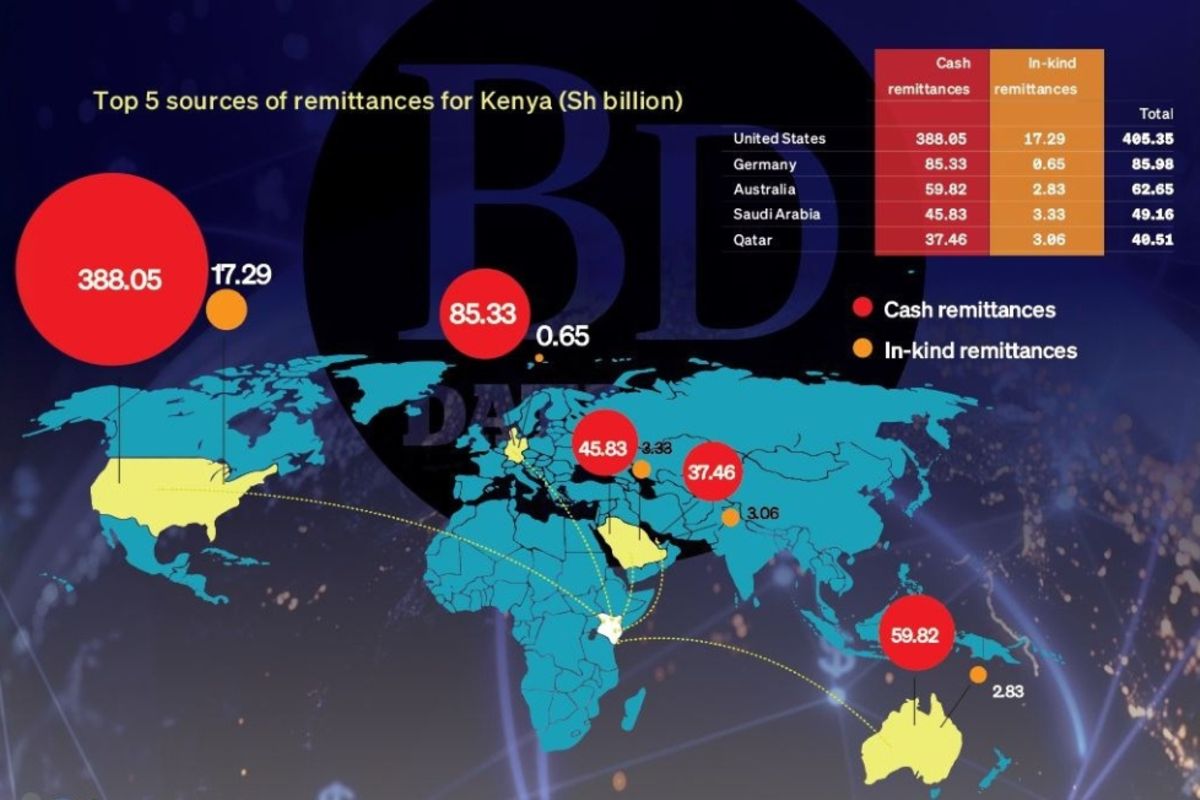
The findings also affirmed that the US remains the largest source of remittance into Kenya at Sh405.4 billion, equivalent to 43.5 percent of total flows. The world’s largest economy accounted for Sh388.1 billion in cash remittances, and Sh17.3 billion in in-kind items such as clothing, footwear and electronics.
Germany was second with inflows of Sh85.98 billion, followed by Australia at Sh62.6 billion and Saudi Arabia at Sh49.2 billion.
Under the usual monthly remittance reporting by the CBK, which excludes the informal flows, the US has been enjoying a share above 50 percent of total flows, while the United Kingdom and Saudi Arabia have been sitting in second and third spots.
This new data has now unearthed previously undetected flows from major economies such as Germany and Australia, which have recently taken in a growing number of Kenyan labour and education migrants.
These countries have also tended to attract a higher number of white-collar migrant workers compared to those in the Middle East, hence their higher flows.


![Weekly Report [June 07 – 14]: 3iQ Crypto Feeder ETFs, Lithuania booming crypto wallet ban, MasterCard NFT collaborations and more](https://www.wazupnaija.com/wp-content/uploads/2022/06/weekly-report-june-07-14-3iq-crypto-feeder-etfs-lithuania-booming-crypto-wallet-ban-mastercard-nft-collaborations-and-more-327x219.png)