
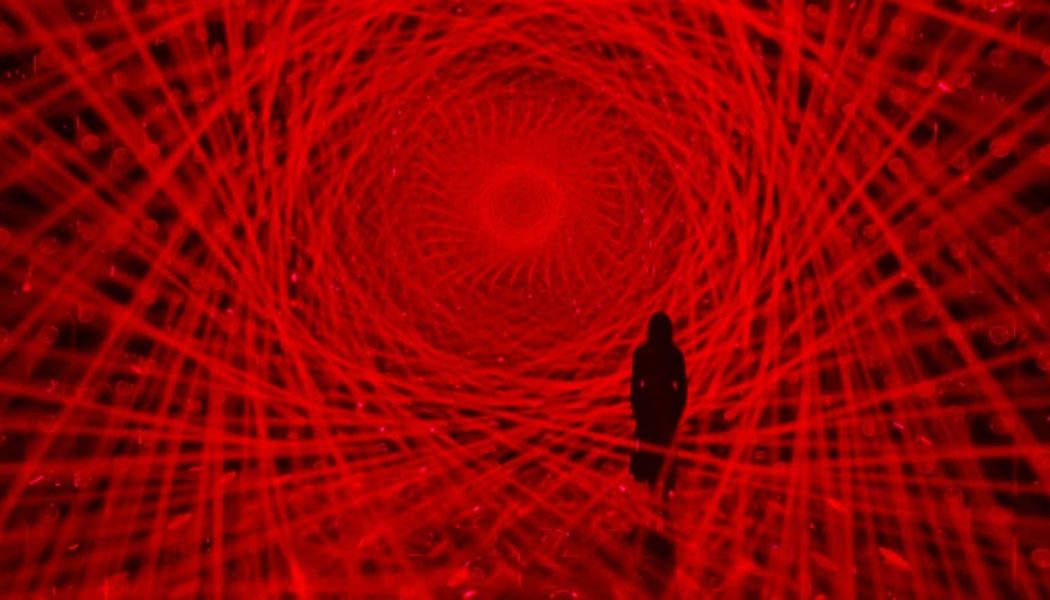
teamLab Borderless in Tokyo has opened “On the Asymmetry of the Universe,” a special exhibition commemorating the reopening of the museum’s Light Sculpture – Flow artwork space, running from July 8 through October 8
The exhibition introduces two new series: “Asymmetric Existence,” which constructs a single sculpture from two light forms that exist in separate spatial planes (one only in physical space, one only inside a mirror), and “Chromatic Existence,” where sculpture is generated entirely by the self-organizing order of color
Both series extend teamLab’s ongoing investigation into sculpture as spatial existence defined by perception and order rather than material surface boundaries
teamLab Borderless in Tokyo has opened “On the Asymmetry of the Universe,” a special exhibition marking the reopening of the museum’s Light Sculpture – Flow artwork space with two new series that interrogate the mechanics of how sculpture can exist across separate spatial planes. Running from July 8 through October 8, the exhibition introduces “Asymmetric Existence” and “Chromatic Existence,” both of which operate on the premise that sculptural form can emerge without material surface boundaries, generated instead by the behavior of light, the self-organizing properties of color, and the perceptual integration performed by the viewer.
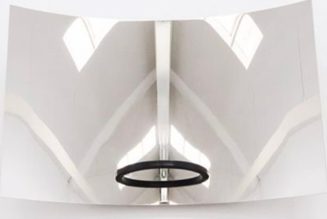
“Asymmetric Existence” is the exhibition’s most technically precise proposition. The work is structured as a single sculpture formed by the integration of two distinct light sculptures that each appear in only one spatial plane. The first light sculpture is visible exclusively in the physical room and produces no reflection in the mirror. The second exists only inside the mirror and has no corresponding presence in real space. The two forms are positioned so that the viewer perceives them as a unified sculptural object, despite the fact that no single vantage point contains both in the same spatial register.
The mechanism overrides a fundamental property of mirrors: their inherent symmetrical reflection of physical space. In “Asymmetric Existence,” the mirror’s surface ceases to function as a boundary that duplicates what stands in front of it and instead becomes what teamLab describes as a field connecting existences that appear in separate spatial domains. The real-space sculpture and the mirror-space sculpture are not mirrored versions of each other. They are asymmetric forms that become one only within the viewer’s perception, meaning the completed artwork does not reside in either space alone but in the cognitive act of integrating both. teamLab frames the work as an attempt to expand sculpture from a physical object enclosed within real space into an existence that traverses real and mirror-image space, unified by perception rather than material continuity.
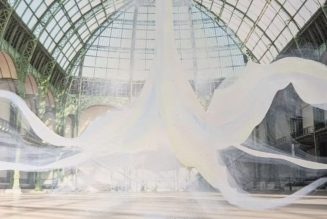
“Chromatic Existence” operates on a different axis. Where “Asymmetric Existence” splits a sculpture across two spatial planes, “Chromatic Existence” generates sculptural form through the self-organization of color flowing through space. When colors move through the environment and establish their own internal order, a sculpture of color emerges. The resulting form possesses no material surface boundary; it is a spatial existence produced entirely by the structural relationships between colors as they arrange themselves. The distinction teamLab draws is between sculpture as a physical object and sculpture as an emergent phenomenon, something that comes into being when order arises within a medium that has no fixed shape.
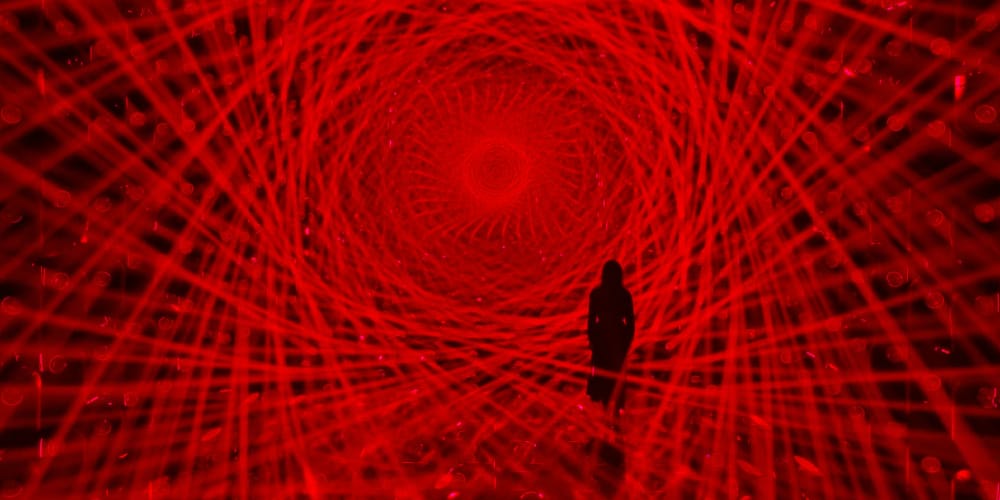
Both new series sit within the broader framework of Light Sculpture – Flow, the artwork space in which the exhibition is housed. The program’s foundational concept is drawn from the physics of ocean vortices: the inside and outside of a vortex are composed of the same water, with no material difference between them, yet the vortex is perceived as a singular entity. The difference, teamLab argues, lies not in material but in order. When order emerges within a flow, existence appears without requiring material boundaries to define it. Light Sculpture – Flow applies that principle to continuous streams of light rays that form spatial order, producing sculptures that change dynamically in response to the presence and movement of people in the room. The boundary between artwork and viewer is deliberately left ambiguous, making the body part of the sculptural system rather than an observer outside of it.
The reopened space and its two new series represent a continuation of teamLab’s long-running project to redefine sculpture as something that does not require fixed physical form, material surface, or spatial enclosure. “Asymmetric Existence” and “Chromatic Existence” each arrive at that redefinition through different means, one through the perceptual merger of spatially separated light forms, the other through color’s capacity to self-organize into structure, but both share the same underlying claim: that sculpture can exist as a function of order and perception, independent of the objects traditionally understood to contain it.
“On the Asymmetry of the Universe” is on view at teamLab Borderless in Tokyo from July 8 through October 8.