
“You’ve lost some weight. Last time, you looked much bulkier and more built…” a visibly concerned Patrick Kondo tells me when we meet for the second time at Nairobi’s Parklands Sports Club.
“I lost my father three weeks ago. I haven’t been quite myself,” I answer.
It has been exactly a month since our paths first crossed. We met during a gruelling outdoor workout session where a group of fitness enthusiasts had made it a tradition to invite strangers for a Saturday morning endurance challenge at the club.
On that day, 62-year-old Kondo was the oldest participant in the group. The youngest was 25.
At 62, the gas and oil consultant is in the shape of his life. With just eight percent body fat, visible abs form a neat cube pattern beneath his blue training bib.
Veins crisscross his lean arms and legs in tight, web-like patterns, the kind of definition that tells the story of a man whose fitness would put many people, even those half his age, to shame. Kondo looks every bit the seasoned athlete you know.
“That’s what you get when you stay disciplined and consistent,” he chuckles when I point out how rare it is these days for men to keep a flat stomach, let alone visible abs.
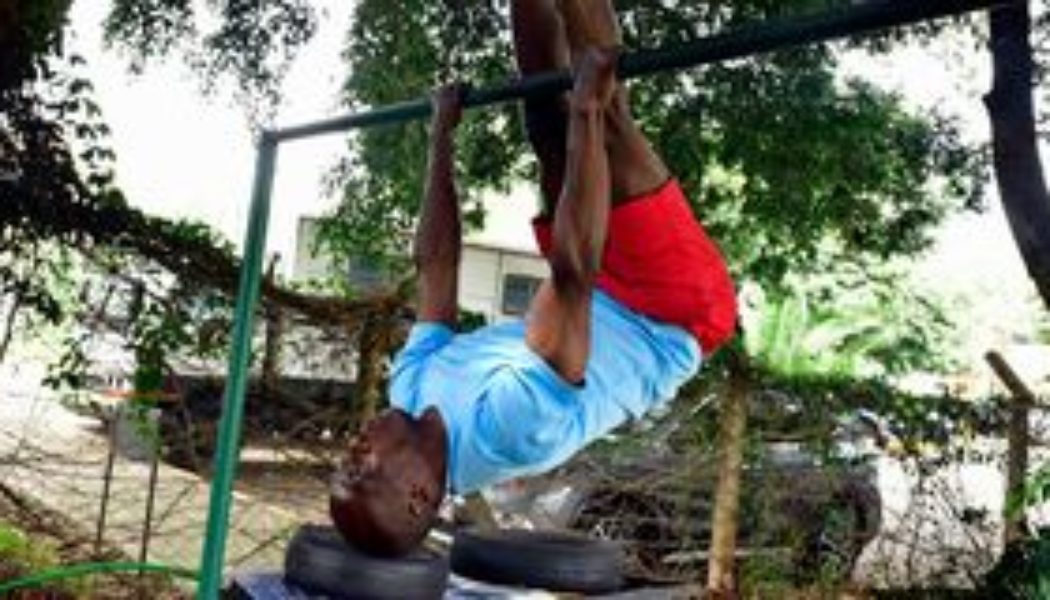
Patrick Kondo performs a toes-to-bar exercise.
Photo credit: Francis Nderitu | Nation Media Group
You would be forgiven for assuming Kondo has spent most of his life in the gym. The reality is quite the opposite. Unlike many people who embrace fitness after a health scare, he was not battling high blood pressure, diabetes or obesity. In fact, he had always been naturally slim.
What eventually pushed him into exercise was something far less dramatic: a bruised ego.
“I hadn’t retired yet, and there was this lady friend who was a fitness freak. Every minute she was doing something active,” Kondo recalls, smiling.
“She never liked my physique at all. She didn’t think I looked attractive in that physique. She’d tell me bluntly that she didn’t like how I looked, that I was too thin for a man, and that every suit I wore looked oversized, like I was a hanger walking around in it. She would bluntly tell me that. That got to me. As a man, you know how it stings when a woman says something that bruises your ego like that. That uncomfortable truth stayed with me.“ Kondo chuckles again.
For a while, Kondo brushed it off or tried to. But life kept reminding him.
“My boss was a few years older than me, and every time we travelled overseas for work, the first thing he’d do after checking into the hotel was go for a run. Didn’t matter how packed our schedule was, he always found time. And that got me thinking. First, someone tells me my physique isn’t attractive to look at, then my boss, someone older than me, is always out running while I do nothing. That was enough push to start.”
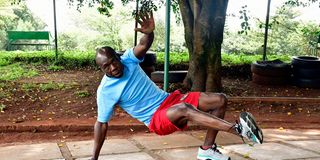
Patrick Kondo performs a breakdance move during a workout session.
Photo credit: Francis Nderitu | Nation Media Group
Twelve years later, that bruised ego and a decision made during a work trip to Burundi have evolved into a way of life, measured in weights lifted, kilometres logged and half-marathon personal bests.
Exercise in retirement
Kondo, who now spends his retirement years consulting for companies, sitting on corporate boards, and overseeing family business interests in hospitality and construction, still remembers those humbling moments that pushed him to take the first step.
“When I started, I could barely manage a kilometre on the treadmill. Now I run 21 kilometres in under two hours.”
Having taken part in nine half marathons, his personal best of one hour 44 minutes at the Nairobi City Marathon two years ago still makes him smile.
“I’d never imagined I could do that kind of time. I wasn’t even trying to break a record. I just joined the pacemakers, felt good, and kept going.”
When he first began, he weighed 69 kilos.
“My highest weight was about 69 kilogrammes. I wasn’t overweight. I was just unfit. I had no muscle. If I climbed a few office stairs, I would get exhausted and sometimes struggle for breath.”
He first started by taking the stairs to his office on the 11th floor every morning. Then one kilometre on the treadmill became two. Two became three. Three became four.
50km every week
By 2015, he was running about 50 kilometres a week. The mileage transformed his fitness but steadily stripped away his weight, reducing him from 69kg to 62 kilos.
There was one problem: he was getting thinner rather than stronger, and his knees were beginning to complain.
“When you run a lot, you become very lean, with little muscle. I started looking thin, almost frail. And as you age, you need muscle, not less of it.”
And just as he was trying to figure out what to do, another woman showed up again.
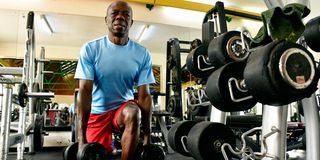
Patrick Kondo performs forward lunges with dumbbells during a workout session.
Photo credit: Francis Nderitu | Nation Media Group
“It was a young trainer named Andy, who had just joined our gym, who was the first to suggest that I should consider lifting. Then I met a friend who finally pulled him into a structured strength training routine, and with time, the nagging knee pain that had plagued me for months began to ease because I was now building muscles. I started running more comfortably than I had in years.”
His week now runs like clockwork. Monday is chest day, Tuesday legs, Wednesday rest, Thursday chest again, Friday full body, and Saturday the notorious outdoor endurance ‘Konki’ session, the same gruelling group workout where we first met.
“After Konki, which is always an hour and a half, I always head straight to the treadmill for an hour-long run, on an incline,” he laughs.
Sundays are sacred. He does nothing but recharge.
“I take a sedentary life that day, rest, drink lots of water, and eat protein. The body doesn’t need much food when it’s recovering.”
Not prove anything
Now he trains alongside men and women in their 20s and 30s, lifting the same weights they do.
At an age when many of his peers are complaining about aching joints and dwindling energy, Kondo is matching men and women enough to be his children.
“There are even a few exercises I can do better than some of them. Strength builds over time, and there are things I can do better than they can,” he says with a grin.
Kondo is also realistic about ageing.
“The body will slow down, I’ve made peace with that,” but insists that consistent effort is what keeps the slowdown gradual rather than sudden. Even when pain shows up, he doesn’t stop entirely. “That pain is trying to ground you. If you let it, you’ll be grounded forever. You still seek treatment, but you keep moving however little.”
It’s advice he extends well beyond the gym. To his peers, who wave off exercise.
“There are those of my peers who think I have lost it with my workout obsession at this age. Some think going to the gym at my age means I’m trying to prove something. But really, it’s like anything worthwhile in life. I always say to them, the easy path is walking into a bar, ordering a beer, then another, and drowning it with nyama choma. It is always a feel-good moment that you will end up paying for dearly. Many have.”
For Kondo, fitness has now become about much more than muscles, but rather life lessons. The greatest lesson has been discovering just how much the human mind and body are capable of.
“What fitness taught me is that we can achieve much more than we think. Most people give up before they even try. They say, ‘I can’t do that.’ But if you put in the effort, stay consistent, and believe in yourself, you will be surprised by what is possible. I was never a runner. I had never lifted weights. I started that at 50, and now look at what I can do at 62.”