
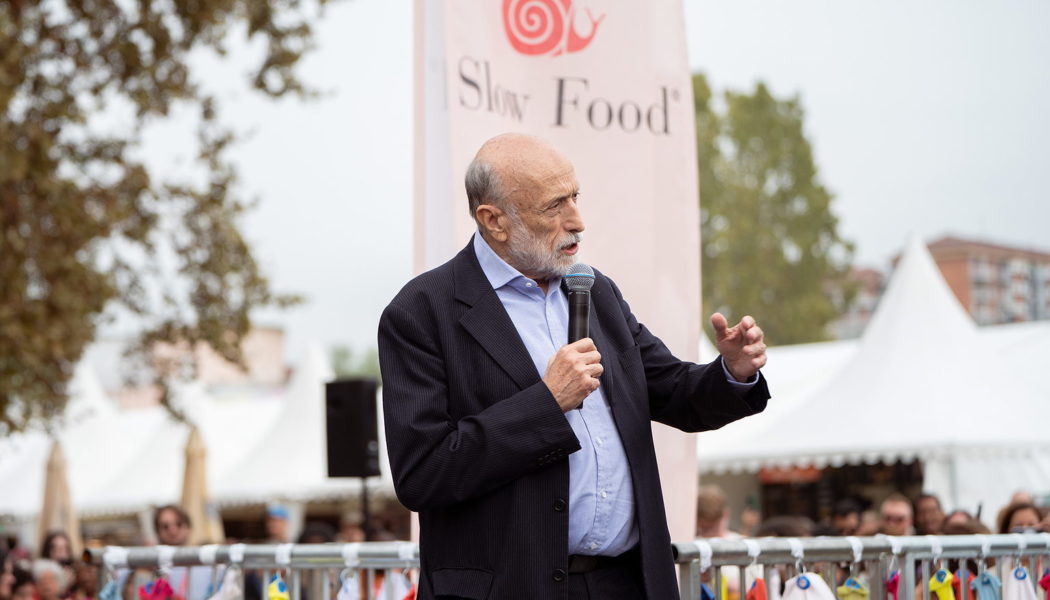
Slow Food founder Carlo Petrini didn’t just change the modern food world. He taught those around him how to dream impossibly big. Eugenio Signoroni shares an intimate look at his late mentor.
“A gastronome who is not an environmentalist is a fool, but an environmentalist who is not a gastronome is a sad one.” You’ll read many quotes from the great Carlo Petrini, father of the Slow Food movement, in the wake of his death yesterday at age 76. But I think this one captures, better than most, the spirit with which he loved to make revolution. There is no change without pleasure. No justice without joy. No reform without beauty. And it was never a celebration without music. The image above is Carlin, as we all called him, cantando le uova—singing the eggs—an ancient pre-Easter ritual that he decided to bring back to life and turn into a kind of initiation rite for his university students arriving from across the globe. He was my mentor and my instructor, at university and afterwards, and we spent long nights with the newcomers, belting out Cielito Lindo, Pena de l’Alma, and a handful of traditional Piedmontese folk songs. I am there in that photo too, as a younger man, perhaps trying to shield myself from the broad, theatrical, somewhat haphazard gestures with which Carlin always kept time.
It wasn’t just that his life was made of extraordinary, wildly ambitious ideas. It was his immense delight in putting them into practice. If a great new project needed to be born, the first order of business was to lock yourself away somewhere beautiful, somewhere far from the noise of everyday life, somewhere where the food and wine were very very good. He was convinced that truly great ideas could only take root in that kind of environment. To see everything Carlin accomplished over the last forty years, one would say he was probably right.

First came Arcigola, the forerunner of the Slow Food movement that would follow just a few years later. Born within the world of the Italian left, it represented something close to heresy in that milieu, which even in the eighties still regarded food and the act of caring about it as a trivial thing, fit only for idlers or the bourgeoisie. And yet Carlin understood early on that there was nothing more progressive than taking food seriously. In the words of Jean Anthelme Brillat-Savarin, whom Carlin admired so deeply, “gastronomy is concerned with everything that has to do with man, insofar as he feeds himself.” To talk about food was to talk about the environment, about social justice, about economics, history, art, religion, death and life.
With that powerful idea firmly in mind, Carlin founded the University of Gastronomic Sciences at Pollenzo in 2004. It was his most audacious project and, in the end, his most concrete one. In Pollenzo, his revolution found its fullest expression. It was, and still is, a place where food is not simply the object of a superficial inquiry into whether something tastes good or not, but instead is the lens through which we view, understand, and narrate the world. A place that Carlin had envisioned from the very beginning as a space for exchange, for sharing, for dialogue. It was a utopic, almost giddy vision—a place where young people from around the world could come together to talk about food, balancing science and tradition and pleasure equally. Pollenzo remains a place to study and dig deep, yes, but also a place to enjoy life, to revel in the joys of food and of youth.
That is where I met Carlin, and that is where my life, thanks to him, took shape. I was driving him from Pollenzo toward my home region of Franciacorta for some event, and after a few minutes—just before drifting off into his trademark car nap—he turned to me and said: “You’re not taking a vacation this year. I’ve already worked something out with the Slow Food publishing house — you’re going there to do an internship. I think you’re made for this kind of work.” It was a statement, not a question. And I quickly agreed. Carlin, like many charismatic figures, wasn’t fond of being turned down, and in this case, the offer was genuinely tempting. And so I began: first working on the guide to Italian beers, then on the Osterie d’Italia guide, with a stint on Slow Wine, before landing on perhaps our biggest project — Slow Food Planet. It was a grandiose thing, a worldwide map of places to eat, drink, and buy food according to the Slow Food philosophy. We worked closely, intensely, at times with great pressure and disappointment. It wasn’t that it was a bad project; it was that Carlin thought it should do nothing less than overtake TripAdvisor. And he convinced me to aspire for the same.

Carlin didn’t just know how to dream. He knew how to make others dream alongside him. He had an extraordinary gift for pushing those around him to attempt things that would have seemed, not unreasonably, impossible to pull off. Between him and his converts, he had achieved some impossible things. “Fly high, Eugenio,” he told me once, while we were working on a new project together. “You can always come back down.”
That is how Carlin became one of the most important figures, if not the most important figure, in the modern food world. If we look at a steak today and think about its environmental, political, social, and economic implications, we owe that in large part to him. If being a farmer, a cheesemaker, a fisherman, a butcher has become something not merely acceptable but a source of pride, we owe that to him. If we believe that revolution can exist in the simple choice of where to buy our eggs or our salad greens, we owe that to him. I will miss his voice, which was both ringing and calm at the same time. Those deep, piercing eyes. The way he would mutter his unmistakable low “ah, popopo…” when searching for a restaurant along the beach near Montpellier, or a farmstead in the Alta Langhe. I am, above all, grateful. Nothing of who I am today would have been possible without him, without his vision and his example. Carlin is gone, but his ideas remain to those who followed him. With his wildness and joy as our inheritance, we will still change the world. That’s a promise.